

Saplings sprout in the worst places: along fence rows, in gravel driveways, between patio pavers, and right where your lawn meets the woods. Pulling them by hand feels productive for a weekend and then they come roaring back from the root system. A targeted herbicide cuts that cycle short, sending the chemistry down into the vascular tissue so the whole plant dies instead of just the top growth.
This list pulls together eight concentrates built around triclopyr, glyphosate, and aquatic-safe blends. Some handle brush and vines, others handle woody saplings specifically, and one covers pond-side growth where runoff is a real concern. The picks below cover the most common scenarios a homeowner runs into across a single growing season.
An Overview Of The Picks
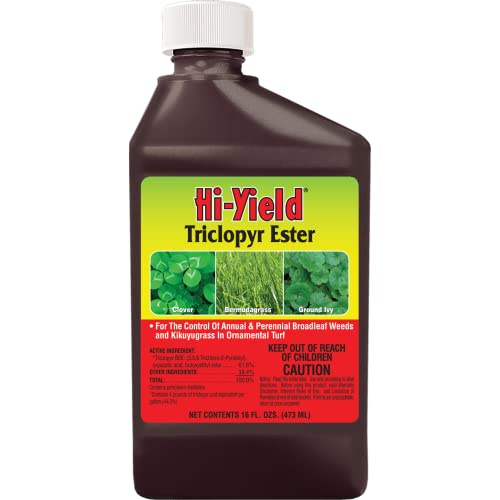
Hi-Yield (35262) Triclopyr Ester, 16 oz
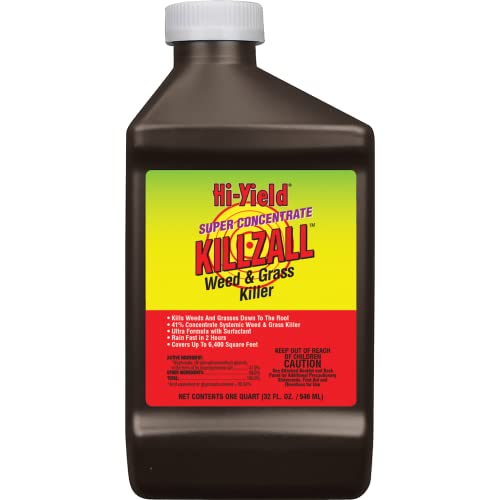
Hi-Yield (33692) Super Concentrate Killzall
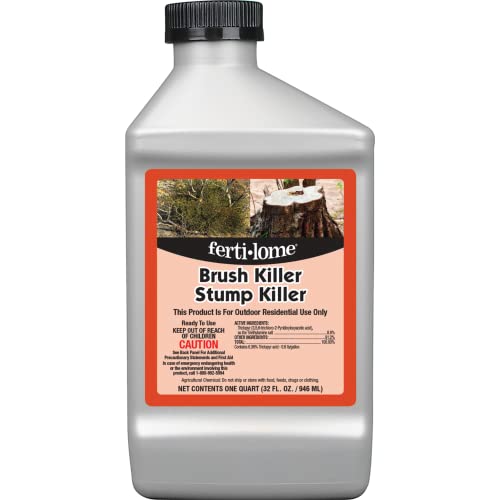
Fertilome (11485) Brush Killer & Stump Killer

Southern AG 01113 Brush Weed Killer

Roundup Poison Ivy Plus Tough Brush Killer2

Airmax Shoreline Defense Emergent Weed Control

Hi-Yield 11484 Brush Killer Stump Killer

Bonide Vine & Stump Killer with Applicator
The Picks, Examined More Closely
Triclopyr is the active ingredient most homeowners reach for when broadleaf weeds start taking over a cool-season lawn, and Hi-Yield bottles it in a compact 16-ounce concentrate that’s easy to mix in a pump sprayer. The ester formulation (a chemistry variant that penetrates waxy leaf coatings more aggressively than amine salts) works well on actively growing plants like oxalis and wild violet, the two stubborn weeds that laugh at hand-pulling.
It’s also labeled as a bluegrass suppressor, which is useful if you’re trying to thin out a patch without killing the surrounding rye or fescue. For most yards with mixed turf, that’s a meaningful distinction: many brush killers on this list would nuke the lawn along with the weed.
What It Does Well
- Targets actively growing broadleaf weeds including oxalis and wild violet.
- Compatible with perennial bluegrass, ryegrass, and tall fescue turf.
- Doubles as a bluegrass suppressor for selective thinning.
- Liquid concentrate mixes cleanly with standard pump sprayers.
- Smaller 16-ounce bottle suits homeowners with modest treatment areas.
Things To Consider
- Cannot be used on Bahiagrass, Bentgrass, Bermudagrass, Centipedegrass, St. Augustine, or Zoysiagrass.
- Works only on actively growing plants, so dormant-season applications won’t deliver results.
Best Suited To
Homeowners with cool-season lawns fighting persistent broadleaf invaders.
Skip It When
You’re clearing woody brush along a fence line, where the Hi-Yield Killzall covers more ground for the cost.
When the goal is total vegetation control, not selective weeding, the Killzall concentrate steps in with a broader-spectrum formula. The label covers grasses, broadleaf weeds, and woody brush species, which means young saplings in gravel or along a bare fence row are all fair game. A double-surfactant formulation (wetting agents that help the spray stick to waxy leaves) speeds up drying and absorption so rain or morning dew doesn’t wash the active ingredient off.
The 32-ounce bottle covers up to 6,400 square feet at typical dilution rates, which is the kind of coverage that justifies a refill rather than a small spot-treat bottle. For homeowners reclaiming a neglected corner of the yard or prepping a section for new landscaping, that’s the volume you want on the shelf.
Strengths Worth Knowing
- Covers grasses, broadleaf weeds, and woody brush in one product.
- Double-surfactant blend helps spray adhere to waxy leaf surfaces.
- Treats up to 6,400 square feet from a single 32-ounce bottle.
- Suitable for fence lines, driveways, and barn-approach cleanup.
Points To Note
- Not for use on lawns you want to keep; this is a non-selective formula.
- Spray drift can damage nearby ornamentals on windy days, so coverage matters.
Made For
Property owners clearing saplings and brush from non-lawn zones like gravel drives and fence rows.
Look Elsewhere When
You need stump-killing precision, which the Fertilome Brush Killer handles better with its paint-on option.
Fertilome’s woody plant control is a true two-in-one formula. Apply it undiluted with a brush onto a freshly cut stump, and it works its way down into the root system to prevent regrowth. Mix 8 ounces into a gallon of water and spray it onto brush foliage, and the same active ingredient kills vines and saplings through the leaves.
The stump-application window is tight: treatment needs to happen within about 45 minutes of cutting, while the vascular tissue is still exposed. That’s a small detail but a critical one, because once the cut surface dries and calluses over, herbicide uptake drops sharply. Plan the cut and the brush-on application as a single sequence rather than separate weekend chores.
Positive Takeaways
- Functions as both a brush killer and a stump killer in one bottle.
- Spray mix ratio is straightforward: 8 ounces per gallon of water.
- Brush-on application minimizes overspray on nearby desirable plants.
- Targets vines, saplings, and woody regrowth from cut stumps.
Room For Improvement
- Brush applicator is not included, so a separate paintbrush needs to be on hand.
- The 45-minute window after cutting requires planning the cut and treatment together.
The Right Fit For
Landowners removing established woody growth and wanting to stop sapling regrowth at the root.
Consider Something Else When
Your target is broadleaf weeds in a maintained lawn, where the Hi-Yield Triclopyr Ester is a safer turf match.
Southern AG puts the same active ingredient found in the well-known Garlon brand into a quart bottle aimed at non-crop land. The 8.8% triclopyr concentration handles vines, hard-to-control brush species, and saplings growing in places that aren’t mowed: road rights-of-way, rangeland, pasture edges, and fence rows.
For homeowners with acreage, that’s the sweet spot. A typical foliage spray mixes 4 to 8 ounces per gallon, and stump treatment stops new sprouts from forming along old fencelines where chain-saw cuts keep coming back. It’s not a suburban lawn product, and that’s actually the point.
Well-Handled Touches
- Contains 8.8% triclopyr, the same active ingredient as commercial brush products.
- Designed for non-crop settings: pastures, rights-of-way, fence rows.
- Controls vines and regrowth on freshly cut stumps.
- Foliage spray mix is simple to scale by area.
Trade Offs
- Not intended for use around ornamental landscape beds or home lawns.
- Coverage requires a dedicated pump sprayer kept separate from lawn-care use.
Whose Shelf It Belongs On
Rural homeowners and small-acreage owners clearing saplings and brush from pasture and fence-line zones.
Another Choice May Suit
Suburban yards are better served by the Hi-Yield Killzall, which carries less rigid non-crop labeling.
Roundup’s tough brush formula extends beyond saplings into the vines and woody perennials that ruin a backyard perimeter: poison ivy, poison oak, poison sumac, wild blackberry, and the famously aggressive kudzu. For homeowners whose sapling problem comes with a side of itchy rashes, that dual capability is worth more than any single-target herbicide.
The concentrate is rainproof in as little as 30 minutes, which means a pop-up shower doesn’t ruin the application. Depending on conditions, replanting in treated areas is possible within a window after treatment, though the label is the final word on timing for any specific situation.
Everyday Wins
- Tackles poison ivy, oak, and sumac alongside saplings and brush.
- Rainproof in roughly 30 minutes under typical conditions.
- Visible results show within hours of application.
- Concentrate format lets you dial the dilution for spot or broadcast work.
Soft Spots
- Non-selective, so overspray will damage lawn grass and ornamentals.
- The 32-ounce bottle ships in a two-pack, which is more product than small yards need.
Perfect Match For
Homeowners managing saplings along with vining weeds like poison ivy near fence lines and wood edges.
Not Your Match When
You’re working selectively in a maintained lawn, where a triclopyr-based product like the Hi-Yield Triclopyr Ester fits better.
Saplings and brush aren’t only a backyard problem. On lakefront and pond-side properties, cattails, phragmites, and other emergent plants grow right at the water’s edge, and ordinary herbicides can’t legally touch them. Airmax’s Shoreline Defense is labeled for use in fresh and brackish water, which opens up an entirely different set of properties.
The one-gallon container suits larger shoreline projects where a quart bottle would run dry mid-job. Application timing depends on growth stage and target species, so reading the label for site-specific instructions pays off here.
Everyday Advantages
- Approved for fresh and brackish water environments.
- Targets cattails, phragmites, and shoreline brush down to the roots.
- Larger one-gallon format suits multi-acre shoreline work.
- Reclaims dock and beach access choked by emergent growth.
Things To Consider
- Niche use case: most homeowners don’t need an aquatic-labeled formula.
- One gallon of concentrate is overkill for a typical suburban sapling problem.
Who Should Grab It
Waterfront property owners with saplings and brush pushing into the lake or pond.
Reach For A Different Pick When
You’re working inland in a standard yard, where the Hi-Yield Killzall delivers similar brush control without the aquatic premium.
The 16-ounce Hi-Yield 11484 stays focused on a narrow but tricky job: stopping woody plants, vines, and poison ivy from coming back after a cut. The application method is paint-on, with the concentrate brushed directly onto the freshly cut surface of a stump or the severed end of a vine.
For saplings specifically, this means a homeowner can cut a young tree, walk over with the bottle and a brush, and treat the stump in the same session. The smaller format keeps the project tidy and the leftover concentrate stored without taking up shelf space. It ships in a two-pack, which extends its usefulness across a season of small woody cleanups.
A Few Highlights
- Triclopyr-based formula targets woody plants, vines, and poison ivy.
- Paint-on application gives precise control with no spray drift.
- Useful around cabins, fences, trails, and building perimeters.
- Two-pack format covers multiple cuts across a property.
Honest Caveats
- Cut-and-treat must happen in one session for the chemistry to penetrate.
- Not designed for broadcast spraying across broad brushy acres.
Who Will Love This
Homeowners dealing with a handful of saplings and vines rather than a large-scale brush problem.
A Better Fit Elsewhere
The Fertilome Brush Killer fits larger stump-and-foliage projects that need both spray and paint-on options in one bottle.
The Bonide Vine and Stump Killer arrives in an 8-ounce bottle with a built-in applicator, which removes the most common stumbling block for first-time users: finding the right brush. The applicator tip lets you paint the concentrate directly onto cut vines or sapling stumps without any extra tools.
At 8 ounces per bottle, this is the smallest format on the list, and it ships as a two-pack. For a homeowner with one persistent vine climbing a fence or two stubborn saplings in a side yard, that’s the right size. Bigger jobs scale up to the Hi-Yield 11484 or the Fertilome Brush Killer.
Good Reasons To Consider
- Built-in applicator removes the need for separate brushes or sprayers.
- Compact 8-ounce bottle stores easily between treatments.
- Two-pack format covers a small season’s worth of vine and stump work.
- Beginner-friendly design keeps overspray risk low.
Small Caveats
- Limited volume makes it impractical for clearing larger brushy areas.
- Two-pack ships together, so storage needs a small dedicated spot.
Right Fit For
First-time users tackling a few saplings and vines around a single residential property.
Where Another Pick Suits Better
Larger fence-row projects call for the Southern AG 01113, which scales to multi-acre coverage.
Choosing The Right Herbicide For Sapling Control
Saplings demand a different strategy than lawn weeds. The chemistry has to translocate, meaning move from the leaves down into the root system, so the plant dies instead of resprouting from below the cut. Triclopyr is the workhorse for broadleaf and woody saplings, and glyphosate-based formulas handle non-selective clearing.
Match the formula to the site. Cool-season lawns call for selective products like the Hi-Yield Triclopyr Ester, which won’t damage the surrounding turf. Driveways, fence rows, and gravel areas work well with non-selective concentrates like the Hi-Yield Killzall or Roundup Tough Brush. Waterfront properties need an aquatic-labeled formula such as Airmax Shoreline Defense, since most herbicides can’t legally be applied near open water.
Sapling Size And Stage
Small saplings under an inch in diameter absorb herbicide through foliage more reliably than through bark. Foliar sprays on young, actively growing plants tend to outperform brush-on treatments. Larger saplings may need a cut-and-treat sequence, where you saw the trunk and immediately paint the cut surface with a brush-on formula like the Hi-Yield 11484 or Bonide applicator bottle.
Site And Surrounding Plants
A non-selective herbicide drifts. Even light wind can carry droplets onto a tomato bed or a prized ornamental. Selective formulas protect nearby vegetation, but in tight quarters the safest approach is targeted brush-on application. Read the label carefully for any grass species listed as a do-not-apply target: warm-season lawns like St. Augustine and Centipedegrass are sensitive to triclopyr.
Coverage And Refills
A 32-ounce concentrate can treat thousands of square feet when broadcast-spraying, while an 8-ounce brush-on bottle might cover a single session of stump work. Estimate your total area before choosing a bottle size, and remember that larger containers usually cost less per ounce, so overbuying slightly can pay off if storage space is available.
Picking The Right Formula Without Regret
Common Shopping Slip Ups
The most frequent mistake is grabbing a non-selective herbicide for a lawn job and watching the surrounding grass yellow within a week. Selective formulas like triclopyr ester protect turfgrass, while glyphosate-based products do not. The second mistake is treating dormant saplings: most foliar herbicides require active growth to translocate into the root system. A third pitfall is underestimating coverage, which leads to running out of concentrate mid-fence-row and leaving an unfinished line that resprouts from the untreated edge.
Where The Extra Money Goes
Larger bottles and dual-use formulas cost more upfront because they pack more active ingredient per ounce and often include surfactant blends that improve leaf coverage. Aquatic-labeled products command a premium because the chemistry has to break down safely in water without harming fish or wildlife. Built-in applicator brushes, two-pack formats, and rainfast formulations also add to the price tag. The upgrade is worth it when you can finish the job in one session instead of buying a second bottle to cover what the first one couldn’t reach.
Frequently Asked Questions
What Is The Best Time Of Year To Treat Saplings?
Late summer through early fall, when saplings are moving energy down to their roots, gives herbicide the best chance to translocate into the root system and prevent regrowth.
Can These Herbicides Be Used Near Vegetable Gardens?
Most brush killers are non-selective, so spraying near a vegetable garden risks damaging desirable plants. Use a shield or a brush-on applicator like the Bonide bottle for nearby saplings, and avoid spraying on windy days.
Do Saplings Need Multiple Treatments?
A single foliar application often kills small saplings, but larger root systems may resprout. Plan on a follow-up spot treatment six to eight weeks later if new growth appears from the treated area.
Is Rain A Problem After Spraying?
Most modern formulas are rainfast within 30 minutes to two hours, depending on the surfactant blend. The Roundup Tough Brush concentrate in this list is rainproof in as little as 30 minutes under typical conditions.
Are These Products Safe For Pets?
Keep pets away from treated areas until the spray has fully dried, then follow any grazing or re-entry intervals listed on the specific product label. The restriction period varies by formulation and active ingredient.
Wrap Up
Saplings are stubborn because the visible part of the plant is only half the story. The right herbicide sends chemistry down into the root system and ends the cycle of cutting and resprouting. Match the formula to your site, give the active ingredient time to translocate, and plan your next step before the first spray hits the leaves. A single well-timed application often solves a season’s worth of sapling headaches.
