

A yard that waters itself while you’re at work sounds like a small luxury, but it solves a real problem: keeping grass, beds, and shrubs hydrated through a dry stretch without dragging hoses around. The right outdoor sprinkler controller turns that idea into a set-and-forget routine, whether you’re managing a modest front lawn or several distinct zones with different needs. Walk through this list and you’ll find options that range from simple analog-style timers to app-driven smart controllers that skip watering when rain is on the way.
The Picks In Brief

Rain Bird ESP-TM2 8 Station Controller

Rain Bird TM2-6 Station Controller

Hunter X-Core XC800i Indoor Timer
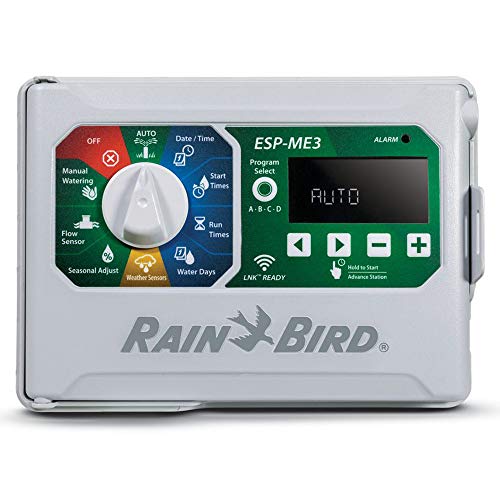
Rain Bird ESP-ME3 4 Station Controller
Orbit Outdoor Controller Cabinet 57095

Irritrol RD600-EXT-R Rain Dial Controller

Rain Bird ARC8 App-Based Smart Controller

HiOazo 4-Zone Smart Sprinkler Controller
Taking A Closer Look At The Options
Eight zones cover most suburban lots, and the ESP-TM2 ships ready to run either as a standalone timer or as the base of a WiFi system when you add a Rain Bird LNK module later. Compared with the smaller TM2-6 below, this unit gives you two extra stations out of the box, which matters if your yard is split into distinct watering areas like a front lawn, a side strip, and a backyard garden bed.
The large back-lit LCD screen reads clearly in direct sun and at dusk, and programming is a three-step flow that most homeowners can finish in a single sitting. For a yard that needs a few zones now and a couple more down the road, this strikes a sensible middle ground.
What It Does Well
- Eight stations handle front, back, and side yards without extra modules
- WiFi-ready design lets you add app control later without replacing the unit
- Back-lit display stays readable in bright sun and low light
- Quick three-step programming gets a schedule running the same day
- Contractor Default feature saves a backup schedule for easy reset
Points To Keep In Mind
- WiFi module is sold separately, raising the real cost for app control
- Indoor-rated enclosure may need a weatherproof cabinet in exposed spots
Who It Suits Best
Homeowners with a mid-size yard who want a flexible base controller that can grow into smart features without starting over.
Look Elsewhere When
You’d rather skip the modular step and have full app control from day one; the Rain Bird ARC8 already ships with built-in WiFi and EPA WaterSense certification.
Six stations hit the sweet spot for a smaller lawn with a flower bed or two, and the familiar Rain Bird menu structure carries over from the larger ESP series. The TM2-6 keeps things simple with a traditional interface rather than an app, which makes it approachable for anyone who just wants the sprinklers to run on a schedule.
You get a master valve or pump start circuit for properties with a booster pump, and a rain sensor input with a bypass switch for skipping cycles during wet stretches. A nonvolatile memory chip (designed to hold settings for roughly a century, per the spec sheet) means power outages don’t wipe your schedule.
Advantages To Know
- Lower entry cost than eight-zone siblings while keeping the same interface
- Rain sensor input with manual override for dry-weather scheduling
- Nonvolatile memory preserves settings through power loss
- Remote accessory port supports Rain Bird-approved add-ons
Trade Offs
- No built-in WiFi, so app control requires a separate module
- Six stations may feel tight if a future landscape expansion adds beds
- Display is functional but smaller than the ESP-TM2’s back-lit screen
Made For
Owners of modest lawns who want reliable scheduling without paying for zones they won’t use.
Consider Something Else When
Your yard is likely to grow with new planting beds; the Rain Bird ESP-ME3 expands from 4 to 22 stations and is a more forgiving starting point.
Hunter’s X-Core line has a long track record in professional irrigation, and the XC800i brings that heritage to an indoor-rated package. With eight zones and no WiFi built in, it leans toward the “set it and let it run” crowd rather than the app crowd. The face plate is plain but the scheduling logic underneath is more flexible than the price suggests.
For properties with heavy clay soil or sloped sections, the Cycle and Soak feature breaks a long run time into shorter bursts with absorption windows in between, which reduces runoff. Compared to the Rain Bird TM2-6, you trade a slightly less polished interface for finer control over how each zone applies its water.
What Works In Its Favor
- Cycle and Soak logic helps prevent runoff on slopes and dense soils
- Eight stations support larger residential layouts
- Memory backup retains programming through outages
- Officially indoor-rated but often paired with a weatherproof cabinet
Honest Caveats
- No native app, so remote changes require being in front of the unit
- Wall-mount bracket and conduit entry may need extra parts for some installations
Best Suited To
Homeowners or contractors who want pro-style scheduling flexibility and don’t need cloud features.
Skip It When
App-based control matters to your daily routine; the Rain Bird ARC8 or the HiOazo four-zone unit both run schedules from a phone.
The ESP-ME3 starts at four stations and grows with your yard. Plug-in expansion modules (sold separately) let you add zones in blocks, up to twenty-two total, without pulling the controller off the wall or losing power to the system. That modular path is the headline feature, and it makes the unit a comfortable long-term home for evolving landscapes.
Like the smaller TM2 models, the ESP-ME3 is WiFi-ready: adding the LNK module turns it into a smart controller that meets EPA WaterSense criteria. The combination of indoor or outdoor mounting and a contractor-friendly interface explains its frequent appearance on both residential and light commercial sites.
Useful Strengths
- Scales from 4 to 22 stations through add-on modules
- Modules install without powering down the controller
- Upgrades to a WaterSense-certified smart controller with the LNK add-on
- Suitable for both indoor and sheltered outdoor installation
Some Limits To Know
- WiFi module and expansion modules raise the total spend quickly
- More involved programming menu than the simpler TM2 series
Right Fit For
Property owners who expect to add zones over time, or installers who want one controller platform that handles both small and larger projects.
A Better Fit Elsewhere
You want the full smart controller out of the box with no module shopping; the Rain Bird ARC8 arrives with app control already integrated.
The Orbit 57095 isn’t a controller, it’s the housing that lets you mount an indoor controller outdoors. A weather- and UV-resistant ABS shell protects the timer inside, while a hinged door and keyed lock keep curious hands and accidental bumps from disturbing the schedule. For most homeowners who already own an indoor-rated timer, this is the missing piece that frees up garage wall space.
A built-in GFCI receptacle (a ground-fault outlet that trips quickly to reduce shock risk near moisture) handles the power connection, and the interior dimensions, roughly 10-3/4 inches wide, 9-1/4 inches tall, and 3-1/4 inches deep, fit common residential timers from Orbit, Rain Bird, and Hunter.
Bright Spots
- Weather-resistant ABS shell holds up to sun and rain exposure
- Built-in GFCI receptacle simplifies safe outdoor power
- Keyed lock adds a layer of tamper resistance
- Hinged door swings open for easy programming access
Practical Considerations
- You still need to supply the indoor controller separately
- Check interior dimensions against your specific timer’s footprint before mounting
Whose Shelf It Belongs On
Anyone who already has an indoor timer they want to relocate outside, or anyone pairing a budget indoor unit with a proper outdoor enclosure.
Swap It Out When
You’d rather skip the two-piece setup; the Irritrol RD600-EXT-R is an outdoor-rated controller that doesn’t need an extra cabinet.
The Rain Dial series has been a familiar sight on professional installs for years, and the RD600-EXT-R brings that lineage to a six-zone outdoor package. Where basic timers offer one or two programs, this one runs three independent programs, which is genuinely useful for a yard that mixes lawn, ornamentals, and a drip zone with very different water needs.
A rain sensor terminal with a bypass switch sits on the board, and the unit is remote-ready for the Irritrol CRR handheld remote (sold separately). Owners commonly report the dial interface feels old-school compared to a touchscreen or app, but the layout is fast to learn once you set the first program.
A Strong Showing
- Three independent programs handle mixed plant types
- Sensor-ready terminal with manual bypass for dry cycles
- Remote-ready for an optional handheld controller
- Outdoor-rated enclosure mounts directly to an exterior wall
Where It Is Less Suited
- Dial interface feels dated next to app-driven models
- Six stations is the ceiling; no modular expansion
Perfect Match For
Yards with diverse plantings where running separate programs for lawn, beds, and drip saves water and hassle.
Another Choice May Suit
You’d rather manage everything from a phone; the Rain Bird ARC8 brings app control and weather-aware scheduling to the same eight-zone footprint.
The ARC8 is the app-first sibling in the Rain Bird lineup, and the spec sheet calls out EPA WaterSense certification, which matters if your utility offers a rebate for qualifying controllers. The Rain Bird app handles setup, schedule changes, manual runs, and rain delays from anywhere, and you can share access with a family member or a landscaping pro without handing over a physical remote.
Eight stations cover a typical suburban yard, and unlike the ESP-TM2 above, the WiFi is built in rather than sold as a separate module. The practical upside is that you skip the add-on step entirely, while the trade-off is a slightly higher starting cost.
What Pays Off
- Built-in WiFi skips the need for a separate module
- EPA WaterSense certification may qualify for local utility rebates
- App-based control works from anywhere with cell or WiFi signal
- Shared access lets multiple users manage the schedule
Things To Consider
- Higher upfront cost than non-smart Rain Bird models
- Reliance on app and account means a firmware or server hiccup can affect remote access
Who Should Grab It
Tech-comfortable homeowners who want full app control, weather-aware scheduling, and a path to potential water-bill savings.
Not Your Match When
You want a simple wall timer without phone dependency; the Hunter X-Core XC800i handles scheduling with on-unit controls only.
Key Product Details
The HiOazo lands at the entry-level end of the smart-controller market, pairing a four-zone capacity with app control on a 2.4 GHz WiFi network (a common router frequency that reaches farther through walls than 5 GHz). The companion app stores up to sixteen preset plans, which is enough flexibility to run different schedules for new sod, established lawn, and seasonal beds.
Weather-skip logic automatically pauses cycles when rain, freezing temperatures, or high winds are detected, which is a meaningful water-saving feature for an inexpensive unit. If your setup is small and your priority is keeping the schedule in your pocket, this is a sensible first step into smart irrigation.
Everyday Advantages
- Low cost entry into app-controlled irrigation
- Sixteen preset plans cover common lawn and bed scenarios
- Weather-skip feature pauses cycles for rain, freeze, or wind
- Compact form factor fits in tight utility rooms
Potential Drawbacks
- Only four zones limits larger or split yards
- 2.4 GHz WiFi only, so older routers may need a quick network check
- App ecosystem is smaller than the established Rain Bird platform
Built With In Mind
First-time smart irrigation shoppers with a small lawn who want phone-based control without a big commitment.
Where A Sibling Pick Shines
Your yard needs more than four zones; the Rain Bird ESP-TM2 covers eight stations in a similarly approachable package.
What Matters Most Before Choosing Outdoor Sprinkler Controllers
Station Count Versus Yard Size
A “station” is the wire that controls one valve, and each valve typically runs a group of sprinkler heads. A small front lawn with a side strip and a backyard bed may only need three or four stations, while a quarter-acre lot with drip irrigation on shrubs can push past eight. Counting zones honestly before you shop keeps you from overpaying for capacity you won’t use, or worse, under-buying and needing a second controller.
Indoor Versus Outdoor Mounting
Indoor-rated controllers cost less and work fine in a garage or covered porch, but if the only convenient mounting spot is an exposed exterior wall, an outdoor-rated unit like the Irritrol RD600-EXT-R or a cabinet like the Orbit 57095 is the safer call. UV, rain, and temperature swings shorten the life of indoor enclosures in outdoor conditions.
Smart Features And Water Savings
WiFi-ready models like the ESP-TM2 gain app control with a separate module, while the ARC8 and the HiOazo arrive with app control built in. Weather-skip logic, the ability to pause cycles based on local conditions, is the practical feature that often justifies the upgrade, especially in regions with frequent summer storms or watering restrictions.
Power, Sensors, And Expandability
Master valve or pump start circuits matter if your property uses a booster pump. Rain sensor inputs with a bypass switch let you honor a sensor during wet stretches without unplugging anything. And modular units like the ESP-ME3 give you room to grow without replacing the entire controller in a year.
Key Considerations Across These Picks
Common Buying Traps
A frequent slip is choosing a controller with fewer stations than the yard actually needs, then discovering that the cheap fix is a second controller. Another is buying an indoor-rated unit and planning to mount it under an eave, only to find that “sheltered” still means humidity, wasps, and morning sun. Measure twice, count zones honestly, and confirm the enclosure rating before clicking through.
When Paying More Pays Off
The gap between a basic timer and a smart controller usually comes down to weather awareness, app control, and certification. For a small lawn with predictable weather, a value pick is plenty. For a larger property in a region with watering restrictions, a WaterSense-certified smart controller like the ARC8 can pay for itself through avoided water waste and potential utility rebates.
Frequently Asked Questions
How many stations do most homes actually need?
A typical suburban lot with a front lawn, back yard, and one or two beds usually falls between four and eight stations. Larger properties with drip irrigation on shrubs may need ten or more, which is where modular controllers like the ESP-ME3 earn their keep.
Do I need a weatherproof cabinet if the controller is indoor-rated?
If the only mounting option is an exposed exterior wall, yes. Either pick an outdoor-rated controller like the Irritrol RD600-EXT-R or pair an indoor unit with a cabinet such as the Orbit 57095 to keep moisture and UV off the housing.
What is EPA WaterSense certification?
It’s a program that labels products meeting certain water-efficiency criteria, including weather-aware scheduling. Controllers carrying the label, like the Rain Bird ARC8, may qualify for rebates from local utilities that participate in the program.
Can a smart controller skip watering when it rains?
Yes. Models with weather-skip logic, including the ARC8 and the HiOazo, can automatically pause a scheduled cycle when local conditions call for rain, freezing temperatures, or high winds.
Is WiFi necessary, or is a basic timer enough?
For a small, predictable yard, a basic timer like the Rain Bird TM2-6 handles the job without a phone. For households that travel, share lawn care, or live in regions with frequent rain, app control tends to earn its place quickly.
Closing Remarks
The right outdoor sprinkler controller comes down to matching zones, mounting, and smart features to your actual yard, not the largest one in the catalog. A small lawn with predictable weather is well-served by a value pick, while a larger or evolving property tends to benefit from modular or app-based hardware. Pick the option that fits today, leave a little room for the yard you’ll have next year, and the watering schedule takes care of itself.
