

Pine needles pile up fast under evergreen trees, and a regular leaf rake just pushes them around. Narrow, flexible fan-style rakes dig into the carpet of needles and lift them cleanly without gouging the soil or scattering the mess. The right tool turns an hour-long chore into a quick weekend sweep, whether you manage a small suburban yard or several mature pines.
The Leading Options At A Glance

Walensee 15-Inch Thatch Rake 19-Tine Dethatcher

YEELOR Artificial Turf Rake Long Handle
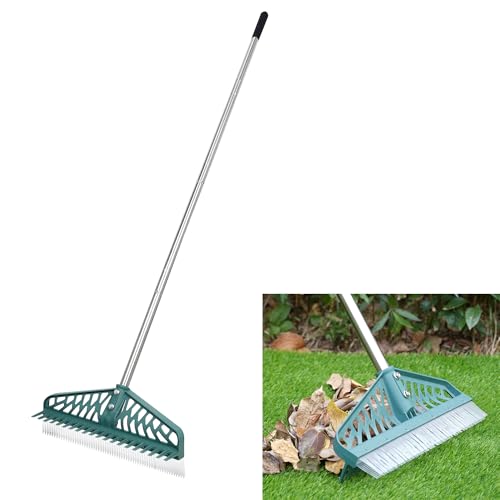
YEELOR Artificial Grass Rake Dual-Sided

DIIG 63″ Bow Rake 17 Tines Stainless Handle
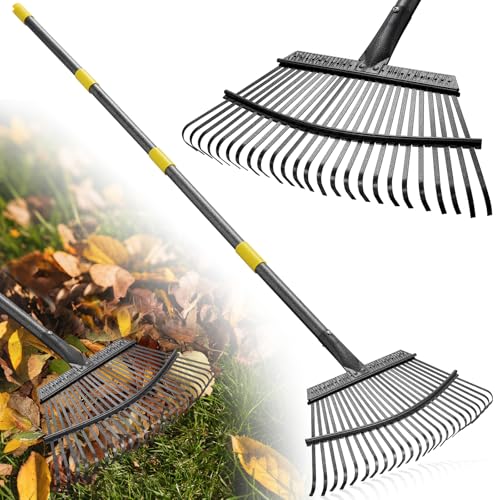
Lilyvane 18″ Metal Leaf Rake 25 Tines

Yard Tuff Pine Straw Rake 60-Inch Tow-Behind

TCBWFY Adjustable Metal Leaf Rake

joyhalo 18″ Adjustable Garden Rake 25 Tines
The Picks, Examined More Closely
The Walensee thatch rake lands in a different category than the lighter fan rakes on this list. Thatch is the spongy layer of dead roots and stems that builds up between grass and soil, and this tool’s job is to rip it loose so water and nutrients can reach the roots again. For homeowners with a thick layer of thatch under their pines, that’s a meaningful upgrade over a basic sweeper.
The 15-inch head with 19 curved steel tines pulls up the dead material aggressively, while the flip side loosens topsoil in the same pass. A 70-inch handle keeps your back upright during the deeper pulling strokes. This is not the rake to grab for a quick Sunday cleanup, but it earns its place in a seasonal lawn-renewal routine.
A Favorable Mix
- Two working sides, thatching on one face and cultivating on the other, replace two single-purpose tools.
- The 15-inch head covers a wide strip per stroke, so a typical yard takes fewer passes.
- Twist-lock handle sections break down for storage in a crowded shed or garage.
- Curved steel tines grip the thatch layer instead of skating over it like flat tines tend to.
Worth Bearing In Mind
- This is a working tool, not a light sweeper, so expect real effort on thick thatch layers.
- Owners commonly report the aggressive tines can catch in uneven ground, so a smooth lawn gives the best results.
Built With In Mind
Homeowners tackling a yearly thatch-removal project under mature pines, or anyone refreshing a tired lawn in early spring.
A Better Fit Elsewhere
The YEELOR Artificial Turf Rake suits synthetic lawns better, since stiff thatch tines would damage artificial grass fibers.
The YEELOR turf rake earns its spot for a very specific audience: anyone with synthetic grass. Stiff metal tines are the wrong tool for artificial turf, since they pull at the fibers and shorten the lawn’s lifespan. Soft PA nylon bristles instead lift debris and stand the grass blades back up, which is exactly what keeps synthetic lawns looking fresh.
Where this rake differs from the Walensee is flexibility. The handle adjusts to three lengths (about 33, 47, and 61 inches), so a shorter user can stop crouching while a taller one avoids overreaching. A stainless steel core keeps the shaft from flexing under pressure, even with the longer extension.
Well-Handled Touches
- The three-position handle fits a range of heights without forcing anyone to bend or stretch.
- PA nylon bristles resist breakage better than budget plastic, so the head holds its shape across many sessions.
- Stainless steel core keeps the shaft stiff at full extension, a common weak point in adjustable tools.
Trade-Offs To Consider
- Soft bristles work beautifully on synthetic turf but are not the right tool for thick natural thatch.
- Pet owners commonly report that embedded pet hair still needs a second pass with a stiff broom.
Whose Shelf It Belongs On
Households with artificial grass lawns, putting-green installations, or covered patios that need regular fluffing.
Reach For A Different Pick When
The Walensee thatch rake is the stronger choice for natural lawns with real thatch buildup under mature pines.
Where the single-sided YEELOR turf rake focuses on fluffing, this dual-sided sibling splits the work between fine and coarse plastic teeth. The fine-tooth face handles lightweight litter, while the coarse face tackles larger debris that tends to settle into the turf pile. For households that deal with a mix of leaves, twigs, and shorn branches, that two-face design avoids tool-swapping mid-cleanup.
Assembly is a short two-screw connection, with no extra hardware or proprietary fittings to track. Owners commonly appreciate the simple connection because it makes seasonal takedown painless.
Bright Spots
- Two distinct tooth patterns cover fine debris on one side and heavier material on the other.
- Two-screw assembly means no special tools or complicated instructions.
- Plastic teeth treat synthetic turf gently, so fibers stay upright rather than getting bent.
Some Limits To Know
- The plastic construction is lighter than metal alternatives, so very heavy debris may take extra passes.
- Designed primarily for synthetic grass, so it has limited use on real lawns.
Made For
Synthetic lawn owners juggling multiple debris sizes, from fine leaves to small branches, on a regular cleanup schedule.
Look Elsewhere When
The joyhalo 18-Inch Adjustable Garden Rake is a better everyday choice for natural lawns with mixed leaf litter.
The DIIG bow rake is a different beast from the rest of this list, so it’s worth pausing on what it actually does. A bow rake has short, rigid metal tines designed for breaking soil, leveling gravel, and gathering heavier debris. It is not a leaf or needle rake, but for homeowners who want one tool that also handles soil prep, the dual role is genuinely useful.
The 17-tine head, combined with a stainless steel handle and anti-corrosion coating, handles ground that would fold a fan-style rake. Compared to the lighter Lilyvane model, this one trades agility for raw strength.
Where It Helps
- Stainless steel handle resists rust, a common failure point in standard steel tools.
- 17 short, rigid tines break up compacted soil and level gravel with confidence.
- Multi-section pole lets users dial the length to fit their height and the task.
Points To Note
- The rigid tines are the wrong shape for sweeping fine pine needles off a soft lawn.
- Owners commonly report the head is heavier than fan rakes, so longer sessions tire the arms faster.
Best Suited To
Homeowners who need a single tool for soil prep, gravel work, and rough debris pickup around established garden beds.
Swap It Out When
The Lilyvane 18-Inch Metal Leaf Rake handles soft pine needle sweeping more efficiently on open lawn areas.
This is the classic fan-style leaf rake, and Lilyvane builds it for the specific job of sweeping loose debris from a lawn. An 18-inch head with 25 metal tines covers a wide strip, which matters more than people expect when you’re working under several mature pines that drop continuously through fall and winter.
The 65-inch adjustable handle reaches most adults without forcing a stoop, and the steel tines are a clear step up from plastic alternatives, since plastic tines can bow or snap on heavy loads. Compared to the DIIG bow rake earlier, this tool trades rigidity for the flexibility that needle-sweeping actually demands.
Positive Points
- The 18-inch head covers a wide path per stroke, which shortens the time under a dropping pine.
- 25 steel tines flex just enough to follow lawn contours without gouging soil.
- The longer handle keeps your back upright during extended sessions.
Honest Caveats
- Steel tines are tougher than plastic but still bend out of shape if you hit a buried root.
- Wider heads are harder to maneuver between closely planted shrubs.
Right Fit For
Suburban homeowners with open lawn areas under a few pines, who want a single tool for most of the year.
Not Your Match When
The TCBWFY Adjustable Leaf Rake suits tight garden beds and shrub borders better, thanks to its expanding head.
The Yard Tuff takes the conversation in a completely different direction. This is not a handheld tool. It’s a 60-inch-wide tow-behind rake that hitches to an ATV, UTV, or utility tractor, with 24 spring steel tines that gather pine straw into a tidy windrow as you drive.
For a homeowner with a quarter acre of pines, this is overkill. For someone managing acreage, orchards, or a tree farm, the math changes completely. One slow pass replaces hours of hand raking, and the standard pin-style hitch keeps attachment painless on most utility vehicles.
What Earns Its Place
- The 60-inch working width clears large areas in a single pass.
- 24 spring tines flex on uneven ground without bending permanently.
- Standard pin hitch fits common ATVs, UTVs, and compact tractors.
Practical Considerations
- Requires a tow vehicle, so it’s not a fit for walk-behind homeowners.
- Best suited to open ground rather than tight lawn edges or near garden beds.
Who Should Grab It
Property owners managing large lots, pine plantations, or rural acreage with a tow vehicle on hand.
Where Another Pick Suits Better
The Lilyvane 18-Inch Metal Leaf Rake is the practical answer for typical suburban lawns under a few trees.
The TCBWFY adjustable rake answers a problem most homeowners run into at some point: a fixed-width rake is great on the lawn and useless between shrubs. This one expands from 8 to 15 inches, so a narrow head slips between perennials while a wide head handles open ground. The handle telescopes from 33 to 69 inches, covering shorter users and taller reach jobs.
Compared to the Lilyvane fixed 18-inch model, the trade is clear. You give up some maximum width, but you gain access to corners and beds that a wide rake can’t enter without trampling plants.
The Practical Payoff
- The expanding head reaches into tight garden beds without damaging established plants.
- Handle telescopes from 33 to 69 inches, covering a wide range of user heights.
- Metal tines handle dense leaf piles better than plastic alternatives.
- One tool replaces the wide rake and the narrow shrub rake for many users.
Less Ideal Details
- Adjustable mechanisms introduce more moving parts, so storage in damp sheds can lead to stiffness over time.
- Wider expansion settings are noticeably less rigid than a fixed head under heavy load.
Perfect Match For
Homeowners with mixed terrain: open lawn, perennial beds, and tight borders where one fixed-width rake falls short.
Consider Something Else When
The Lilyvane 18-Inch Metal Leaf Rake suits open-lawn cleanup under mature pines more efficiently.
The joyhalo lands as a comfort-focused take on the classic fan-style rake. The 18-inch head with 25 metal tines mirrors the working geometry of the Lilyvane above, so coverage per stroke is comparable. Where it differs is in the grip: an extended rubber handle reduces hand fatigue on longer sessions, which matters when you’re cleaning up after several pines in one go.
For users who find standard rake handles uncomfortable, the rubberized section is the main reason to choose this one. For everyone else, the working performance looks similar to other 18-inch metal rakes in this list.
What Pays Off
- The rubber grip section eases hand fatigue on long cleanup sessions.
- 25 metal tines handle heavy needle coverage without bowing.
- The 65-inch length suits most adults without adjustment.
Factors To Consider
- Wider heads are harder to maneuver in tight spaces between shrubs.
- Fixed width offers less flexibility than the TCBWFY adjustable alternative.
Who It Suits Best
Homeowners who want a comfortable everyday rake for open-lawn pine needle cleanup, especially during long weekend sessions.
A Better Fit Elsewhere
The TCBWFY Adjustable Leaf Rake handles tight garden beds and varied terrain more gracefully.
What Matters Most Before Choosing Pine Needle Rakes
Tine Design And Head Width
The single biggest factor is how the tines interact with the needles. Fan-style rakes with flexible metal or plastic tines sweep needles off the surface without digging in. Bow rakes with rigid tines are soil tools, and thatch rakes with curved steel teeth are seasonal lawn-renewal tools. For most homeowners, a fan-style head between 15 and 18 inches balances coverage with maneuverability.
Handle Length And Material
A handle that reaches your chin or higher keeps your back upright during long sessions. Wood handles feel traditional but weather over time, while steel handles last longer but transmit more vibration. Adjustable handles add versatility for shared tools, though they introduce more connection points that need occasional checking.
Real-World Use Scenarios
Pine needles fall year-round under evergreens, not just in autumn. A rake used weekly under a single mature pine sees very different wear than one used seasonally after a windstorm. Weight, grip comfort, and tine flexibility matter more for the weekly user than for someone clearing once a season.
Reader Profile Fit
Casual homeowners with a few pines do well with a simple 18-inch fan rake. Households with synthetic lawns need soft-bristle turf rakes, and property managers with acreage benefit from tow-behind options. The right tool depends less on brand and more on what your yard actually demands.
Key Considerations Across These Picks
Common Shopping Slip Ups
A frequent mistake is grabbing a bow rake or thatch rake expecting it to handle pine needles like a fan rake. Different tools exist for different jobs. Another is choosing the widest head available without considering maneuverability around plantings and narrow garden paths. Width and access have to balance.
What The Higher Tier Buys
Premium rakes tend to use stainless steel handles, anti-corrosion coatings, and reinforced tine connections. Those features matter most for users who store tools outdoors or rake in damp conditions year-round. For a casual homeowner who stores the rake indoors, mid-tier options typically perform the same job at a more approachable price point.
Frequently Asked Questions
What Width Rake Works Best For Pine Needles?
A head between 15 and 18 inches covers ground efficiently while staying maneuverable around plantings. Wider heads clear faster, narrower heads reach tighter spots.
Can A Regular Leaf Rake Handle Pine Needles?
Standard fan-style leaf rakes with flexible tines work well for dry needles on the surface. Wet or matted needles may need a stiffer tine or a second pass.
How Often Should Pine Needles Be Raked?
Under a mature pine, monthly during the active drop season keeps buildup manageable. Letting needles mat down invites thatch and can smother grass underneath.
Are Metal Tines Better Than Plastic?
Metal tines last longer under heavy use and resist bending, but they can scratch delicate surfaces. Plastic tines are gentler on synthetic turf but wear faster on rough ground.
Do Adjustable Handles Hold Up Over Time?
Adjustable mechanisms introduce more connection points than fixed handles. Keeping the tool stored dry and occasionally checking the locks extends its working life considerably.
Wrap Up
The right pine needle rake comes down to matching head design and width to your yard. Open lawns under a few mature pines do well with a classic 18-inch metal fan rake, while mixed terrain benefits from adjustable models, and synthetic lawns need soft-bristle turf tools. Pick the geometry that matches your ground, and the rest takes care of itself.
