

Reservoir chemistry is the silent variable behind every hydroponic run. When pH drifts, nutrient uptake drops, and the first sign is usually a pale leaf or a stalled root. A reliable meter turns that invisible shift into a number you can act on. The picks below cover handhelds, pens, soil probes, and a continuous monitor, so you can match a tool to the size of your grow and the kind of decisions you actually want to make each week.
A Fast Comparison Of The Options

YINMIK 4-in-1 pH EC Meter for Hydroponics

AC Infinity pH Meter Kit, High Precision Digital pH Pen

GIDIGI Digital pH Tester for Hydroponic Water

AC Infinity pH Meter PRO Kit, High Precision Digital pH Pen

EZTOCH Hydroponic pH EC Meter, Water pH TDS PPM
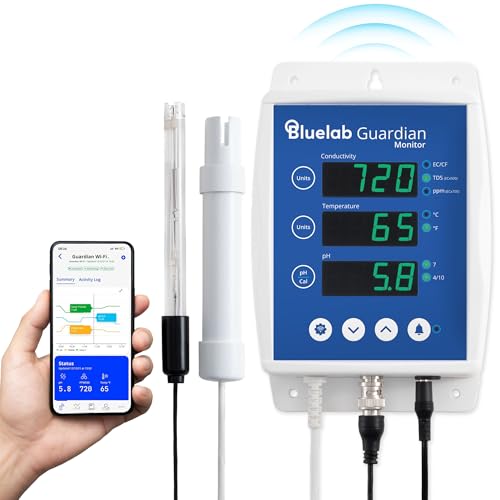
Bluelab Guardian Monitor Wi-Fi for Real-Time Monitoring

Bluelab TRUNCOMV2 Commercial Truncheon Nutrient Meter

Bluelab Pulse Meter Handheld Digital Soil Meter
Meet The Standout Selections
The YINMIK 4-in-1 lands in that sweet spot where most home growers start: one handheld body that reads pH, total dissolved solids, electrical conductivity, and temperature without juggling three devices. The dual-mode layout lets you flip between reservoir pH plus EC and reservoir pH plus parts per million, which matters because nutrient schedules are often written in either EC or ppm, not both. Compare that to a single-parameter pen and you stop doing mental math every time you refill a tank.
For a small NFT (nutrient film technique) rail or a couple of DWC (deep water culture) buckets, the unit covers what you need. You may find the probe a little fussier than the AC Infinity pen in harder water, but the calibration routine is standard for this class.
Everyday Perks
- Four measurements from one probe session, so you spend less time swapping tools mid-check.
- Dual display modes for EC and ppm cover most feeding charts without conversion.
- Built-in temperature read means the pH value is easier to interpret in a warm tent.
- Handheld form factor fits a small grow bag or shelf drawer without a dedicated case.
Honest Caveats
- The glass probe benefits from a calibration check every few weeks, otherwise drift becomes noticeable.
- Storage solution is the usual habit owners skip, and skipping it shortens probe life in most home setups.
Who It Suits Best
New hydroponic growers running one or two small reservoirs who want every key reading in a single dip.
Skip It When
You grow in soil or coco, where the Bluelab Pulse Meter reads the root zone directly without slurry mixing.
AC Infinity’s pH pen is built for the conditions a grow tent throws at it. The body carries an IP-67 seal (meaning it is rated to survive full dust exposure and temporary water immersion), so humidity and stray splash from a top-off bottle are not a constant worry, and the glass-membrane probe pulls a reading in seconds. While the YINMIK covers four measurements, this unit keeps the focus tight on pH plus temperature, which is a useful trade if your nutrient schedule already lives on an EC meter.
It is a natural fit alongside a controller that already logs EC, and it slots into a pocket or a small wall holster between checks. For growers who measure daily, the rapid read time is the real payoff.
Positive Takeaways
- IP-67 sealing gives the body real survival odds in a damp, humid tent corner.
- Fast pH and temperature readouts are useful during a quick morning walk-through.
- Glass-membrane probe (a thin glass bulb that responds to hydrogen-ion activity) tends to stabilize quicker than flat-surface designs.
Points To Keep In Mind
- Single-parameter design means you need a second tool if you also want EC and ppm.
- Probe life is the usual pencil-thin glass story, so handle the tip with care during storage.
Feature Snapshot
Made For
Growers in hot or humid tents who need a sealed pen and fast pH readouts without extra modes.
A Better Fit Elsewhere
Want replaceable glass in a more serviceable package, the AC Infinity pH Meter PRO Kit swaps the probe without replacing the whole pen.
The GIDIGI 4-in-1 stretches further on the high end of the scale than most budget pens, which is the kind of detail that matters if you ever check runoff from a heavy feed. Automatic temperature compensation (ATC, which adjusts the reading for water temperature) keeps the value honest in a warm reservoir, and the broad EC plus TDS (total dissolved solids, the dissolved nutrient weight in parts per million) range makes it useful beyond the tent, including aquarium and pool water.
Compared to the YINMIK, the GIDIGI trades a bit of handheld simplicity for a wider measurement ceiling. For a hobbyist who sometimes tests tap water and other times drains a salt-heavy reservoir, that range does real work.
A Few Highlights
- Automatic temperature compensation across a 0 to 50 °C range keeps readings stable in warm summer reservoirs.
- Wide pH range (0.1 to 14.0) handles both acidic and alkaline runoff without a special probe.
- Four readings in one dip covers pH, EC, TDS, and temperature for mixed-use testing.
Minor Gripes
- The dense spec sheet can feel like overkill if you only grow one reservoir with one nutrient line.
- Battery changes are an extra maintenance step some simpler pens skip.
Right Fit For
Multi-use growers who split time between a hydroponic reservoir, an aquarium, and a pool.
Look Elsewhere When
You want a single-purpose pH tool for a small tent, where the AC Infinity pH Meter Kit is leaner and just as accurate.
Where the standard AC Infinity pen is a sealed single-use tool, the PRO Kit makes the probe field-replaceable. The body keeps the same IP-67 shell, but you unscrew the tip and drop in a fresh glass-membrane probe when the old one drifts, instead of binning the whole unit. For a multi-year setup, that detail turns the pen from a consumable into a longer-lived instrument.
It still focuses on pH and temperature only, so you will pair it with a separate EC pen or the YINMIK if your feeding schedule depends on conductivity. The trade is intentional: a narrower tool that lasts longer.
The Helpful Details
- Replaceable glass probe extends the working life of the pen body.
- IP-67 sealing keeps the electronics safe in humid and dusty rooms.
- Same fast response profile as the standard AC Infinity pH Meter Kit.
A Few Limitations
- Replacement probes are an extra purchase, so budget for one if the original wears out.
- pH and temperature only, so plan on a second tool for EC and ppm.
Key Product Details
Best Suited To
Long-term hydroponic growers who want a serviceable pH pen rather than a sealed disposable.
Reach For A Different Pick When
You need EC and ppm from one body, where the YINMIK 4-in-1 pH EC Meter keeps everything in a single dip.
EZTOCH’s pH EC meter is built for the first few months of a hydroponic setup, when you are still learning what your reservoir should look like at the start of a week versus the end. The display flips between pH plus EC plus temperature and pH plus ppm plus temperature, and a hold function keeps the number on screen so you can lift the pen, set it down, and log the value without rushing. The conductivity range tops out at 19.99 mS/cm, which covers most vegetative and bloom feeding strengths without saturating.
It is not the pick for a multi-room commercial run, but for a single reservoir on a kitchen counter, the unit does the job without a learning curve.
Where It Delivers
- Simultaneous three-parameter display (pH, EC or ppm, temperature) reduces guesswork during the first few grows.
- Hold function lets you read the screen without holding the probe in the solution.
- 0.01 mS/cm resolution gives a more useful read for low-EC vegetative mixes than coarser pens.
Room For Improvement
- Plastic-bodied probes do not match the chemical resistance of glass over a long timeline.
- Calibration vials and solution are not always bundled, so plan on picking up standard buffer fluid.
Feature Snapshot
Who Will Love This
First-time growers building their first reservoir who want fewer steps between mixing and reading.
Swap It Out When
You scale to a larger system with continuous dosing, where the Bluelab Guardian Monitor Wi-Fi handles the alert work automatically.
Stepping away from handheld pens, the Bluelab Guardian Monitor is a stationary in-line unit that lives at the reservoir edge. It reads pH, conductivity, and temperature continuously and pushes the data over Wi-Fi to the Edenic app, which is the part that changes the workflow: a pH swing at 2 a.m. becomes a phone alert rather than a morning surprise. Compared to a pen you only use a few times a week, the Guardian’s value shows up in the time you don’t spend staring at a glass probe.
It is overkill for a single DWC bucket and the right call for a multi-room setup where you can’t physically be at every reservoir each day.
What Makes Sense
- Continuous monitoring catches drift between manual checks, which matters for recirculating systems.
- Wi-Fi push to a phone app turns reservoir chemistry into something you can check from anywhere.
- Three readings on one display simplify the daily walk-through of a multi-room setup.
Where It Is Less Suited
- Setup and network configuration add a step that handheld pens skip entirely.
- Replacement pH probes are part of long-term ownership, and the cost stacks up across years.
Perfect Match For
Growers managing multiple reservoirs who want alerts before a pH swing becomes a ruined feed.
Not Your Match When
You run a single small reservoir and only need a daily reading, where the EZTOCH pH EC Meter is plenty.
The Truncheon is the long yellow stick of hydroponic nutrient meters for a reason. The probe end sits at the bottom of a mixing tank, the readout sits at the top above the water line, and you can stir a fifty-gallon drum while reading conductivity in real time. The range stretches from 0.4 to 6.0 EC and 200 to 3000 ppm on the 500 scale, which covers bloom-strength feeds that saturate most pens.
It only measures conductivity and temperature, not pH, so it pairs with a separate pH tool. In a commercial or high-volume home setup, the time saved on mixing more than covers the gap.
What Earns Its Place
- Built for direct tank mixing, with the readout held above the waterline for easy reading.
- Wide conductivity range covers the strongest bloom feeds without clipping.
Potential Drawbacks
- No pH channel, so you will still need a pen for the full reservoir check.
- The size is awkward for a small tent; the stick is meant for tanks, not jars.
Feature Card
Built With In Mind
Commercial growers and serious home mixers who stir large tanks by hand and want a readout while they work.
Where A Sibling Pick Shines
You mainly mix in buckets, not drums, where the YINMIK 4-in-1 pH EC Meter handles the dip-and-read in a smaller space.
The Pulse shifts the focus from reservoir to root zone. The probe pushes directly into soil, coco coir, or a potting mix and reads moisture, nutrient (TDS), and temperature where the roots actually are, not in a sample cup. It pairs over Bluetooth with the Bluelab app, which logs the history so you can see how a feeding affected the substrate the next day. For a soil or coco grower, that is more useful than dipping a slurry.
It is not a pH meter, so for full chemistry on a media-based grow you would still want a separate pH pen. The honest read is that this tool answers a different question than the rest of the list.
Useful Touches
- Direct root-zone readings remove the slurry-mixing step that reservoir pens require.
- Bluetooth sync to a phone app builds a feeding history without manual notes.
- Moisture plus nutrient plus temperature in one probe suits a soil or coco schedule.
Trade Offs
- No pH channel, so media-based growers still need a separate pen for full chemistry.
- Phone compatibility depends on the Bluetooth version, so older handsets may not connect.
Whose Shelf It Belongs On
Soil, coco, and potting-mix growers who want root-zone data without brewing a slurry sample.
Consider Something Else When
You run a pure hydroponic system with no substrate, where the Bluelab Guardian Monitor Wi-Fi covers the reservoir live.
What Matters Most Before Choosing Ph Meters For Hydroponics
Match The Tool To Your Grow Medium
Reservoir growers live in water, so any pen with a sealed body and a pH plus EC channel handles the daily check. Soil and coco growers need a probe that reaches the root zone directly, which is where a meter like the Bluelab Pulse earns its keep. Picking a media that doesn’t match your grow medium is the most common mismatch in this category.
Decide Between Handheld And Continuous Monitoring
Handheld pens are cheaper, simpler, and require you to remember to test. Continuous monitors cost more up front and push alerts to your phone, which suits a multi-room setup or anyone who travels. For a single small reservoir, a handheld is plenty. For a recirculating system that runs while you sleep, the continuous monitor earns the upgrade.
Calibration And Probe Care
Every glass-membrane probe drifts over time, and the drift shows up first in pH. Buying a buffer solution (a reference liquid of known pH used to recalibrate the probe) and a storage solution, then using both on a monthly cadence, is what separates a meter that lasts two seasons from one that lasts five. Replaceable probes on units like the AC Infinity pH Meter PRO Kit turn that maintenance step into a planned part swap instead of a full replacement.
Resolution And Range Matter More Than Brand
EC resolution of 0.01 mS/cm and a pH range that covers both your feed and your runoff are the practical specs to compare. A pen that saturates at a heavy bloom feed is useless exactly when you need it most. Match the range to the strongest mix you actually pour, not the average.
Where Shoppers Go Wrong And When Paying More Pays Off
Pitfalls Shoppers Hit
The most common miss is buying on impulse without checking whether the meter is sealed for a humid grow room. Many cheap pens work fine on a kitchen counter and fail in a tent within a few months because the body is not rated for moisture. A second miss is skipping calibration fluid to save a few dollars, which guarantees a wandering reading within weeks. A third is choosing a pen that only does pH when your feeding schedule is written in EC, or vice versa, and then doing manual conversion forever.
When Paying More Pays Off
The jump to a higher-tier pick usually buys three things: a replaceable probe, a sealed body, and a wider measurement range. A replaceable probe means the meter outlives its first sensor, which is where most low-cost pens die. A sealed body survives the actual environment of a grow tent. A wider range stays useful as you push harder feeds during bloom. For a single-bucket lettuce setup, the cheaper tier is fine. For a multi-room or recirculating system, the extra cost buys fewer surprises and longer service life, which is where the math turns in favor of the upgrade.
Frequently Asked Questions
What Is The Ideal Ph Range For Hydroponic Nutrient Solutions?
Most hydroponic crops thrive between pH 5.5 and 6.5, where nutrient availability peaks. Lettuce and herbs sit comfortably in the middle, while fruiting plants often prefer the lower half during heavy bloom feeding.
How Often Should I Calibrate A Ph Meter For Hydroponics?
A monthly two-point calibration with fresh buffer solution is the standard cadence for active growers. Pen-style meters that are stored dry or used in hard water benefit from a quick check every couple of weeks.
Can One Meter Handle Both Ph And EC?
Yes, several 4-in-1 pens like the YINMIK and EZTOCH read pH, EC, ppm, and temperature from a single probe. The trade is a slightly fatter body and a probe that handles more wear than a single-parameter pen.
Do I Need Wifi Monitoring For A Small Grow Room?
For a single small reservoir, a handheld pen is enough. Wi-Fi monitoring earns its cost when you run multiple reservoirs or want alerts when a pH swing happens overnight.
How Long Does A Ph Probe Typically Last?
A glass-membrane probe used and stored properly usually lasts 12 to 24 months before drift becomes noticeable. Hard water, dry storage, and skipped calibration all shorten that window.
Wrap Up
Pick the tool that matches your medium, your reservoir size, and the time you actually want to spend on chemistry. A sealed pen with a replaceable probe covers most home growers for years, while a continuous monitor pays off the moment you scale past a single tank. The honest read is that any calibrated meter used consistently beats a fancier one sitting in a drawer.
