

Centipede grass thrives on a low-input, low-stress approach, so the wrong pre-emergent can undo a season of careful mowing. Many southern lawns start to yellow or thin when products like 2,4-D or atrazine heavy mixes hit their root zone. The picks below are filtered to active ingredients and formulations that work around centipede’s sensitivity. You get season-long crabgrass and goosegrass control without the risk of stunting the turf you actually want.
A Snapshot Of The Selections

Preen Extended Control Weed Preventer 10 lb.

Preen Garden Weed Preventer 31.3 lb. Bag
Quali-Pro Prodiamine Pre-Emergent 5 lbs

Prodiamine 65 WDG 5 lbs Generic Barricade

Preen Garden Weed Preventer 22 lb. Bag

Agrisel Sulfentrazone 4F 8 Ounces

Dimension Granular Pre-Emergent 50 lb Bag

The Andersons 18-0-4 Barricade Fertilizer 18 lbs

Scotts Turf Builder Halts Crabgrass Preventer

The Andersons Barricade Granular Pre-Emergent 18 lb
A Closer Look At Each Pick
Preen Extended Control Weed Preventer is a granular pre-emergent designed to keep landscape beds clean for roughly six months between applications. The 10-pound bag covers about 1,630 square feet, which suits a typical suburban front yard ringed with shrubs and seasonal color.
For centipede grass owners, the appeal is timing flexibility. The product targets weed seeds before germination, so it can be spread around established ornamentals without the agitation that post-emergent sprays cause. Where the earlier Preen Garden formula suits broad beds, this version extends the protection window and cuts the number of seasonal re-treatments.
Where It Excels
- Six-month residual reduces how often you reapply around beds.
- Granular format spreads evenly with a standard drop spreader.
- Targets a wide list of broadleaf and grassy weed seeds.
- Landscape-friendly when applied around mature ornamentals.
Things To Consider
- Labeled for landscape beds rather than turfgrass, so it should not be the primary line of defense for the lawn itself.
- Granules can track indoors on pet paws if applied heavily near walkways.
- Coverage per bag is modest, so multi-bed yards may need two bags.
Who It Suits Best
Homeowners with mature landscape beds bordering centipede grass who want a single spring application to carry through the season.
Where Another Pick Suits Better
Scotts Turf Builder Halts Crabgrass Preventer fits better when the priority is direct turf application rather than ornamental bed treatment.
The 31.3-pound Preen Garden bag is the bulk version of the original 22-pound formula, with coverage stretching to roughly 5,000 square feet of bed area. The active ingredient prevents weed seeds from germinating for about three months per application, and it can be applied in spring, summer, or fall.
For a centipede grass property, this is a perimeter solution. The label covers use around more than 200 established ornamentals, so a homeowner with long mulched borders can treat the whole bed line in one pass. Preen Garden Weed Preventer 22 lb. handles smaller yards; this bag picks up the slack on estates or heavily planted lots.
The Upside
- Single bag covers most residential bed layouts end to end.
- Flexible application window across three seasons.
- Works around an extensive list of established flowers, trees, and shrubs.
- Compatible with the flip-top applicator bottle for controlled spreading.
Honest Caveats
- Three-month residual means another application midseason for full coverage.
- Not labeled for direct turfgrass use.
- Bag is heavy; storage needs a dry corner of a shed or garage.
Feature Snapshot
Made For
Homeowners with sprawling landscape beds bordering centipede grass who prefer fewer reorders over a longer season.
Consider Something Else When
The Andersons 18-0-4 Barricade Fertilizer suits you better when you want a turf-safe product that combines feeding with weed prevention.
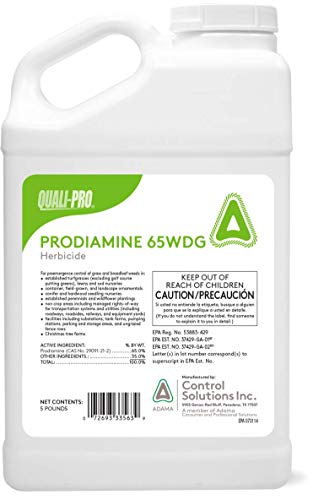
Quali-Pro Prodiamine 65 WDG is a water-dispersible granular herbicide that delivers the same active ingredient found in the Barricade brand. The yellow granules are designed for spray-tank application, which opens the door to mixing with fertilizers or other labeled products in one pass.
For centipede grass managers, prodiamine has a long track record as a turf-safe pre-emergent when applied at the right rate. Compared with Preen Garden Weed Preventer, this is a sprayer’s product rather than a granular spreader product, which is why it appeals to homeowners who already own a backpack or tow sprayer.
Notable Gains
- Prodiamine 65 WDG (water-dispersible granules) mixes cleanly in spray tanks.
- Works as a tank-mix partner with compatible fertilizers.
- Flexible spring and fall application windows for season-long control.
- Targeted at both grassy and broadleaf weed prevention.
Worth Noting
- Spray application demands a properly calibrated sprayer for even coverage.
- Overlapping applications can build residue that stresses sensitive turf.
- Container requires a cool, dry storage spot to keep granules free-flowing.
Quick Facts
Best Suited To
Homeowners comfortable with sprayer calibration who want a professional-grade prodiamine on a centipede lawn.
Look Elsewhere When
Prodiamine 65 WDG 5 lbs Generic Barricade fits better when you want the same active ingredient in a budget-friendly package.
Prodiamine 65 WDG Generic Barricade offers the same active ingredient and formulation as the Quali-Pro version above, typically at a friendlier price point. It is sold as a 5-pound container of water-dispersible granules suited for spray application.
For a centipede grass lawn, the savings show up quickly on multi-acre lots. Homeowners who already use Quali-Pro Prodiamine Pre-Emergent 5 lbs but want to stretch the lawn-care budget tend to consider this as a season refill rather than a step down in performance.
Features That Help
- Same prodiamine 65 WDG core as the branded alternative.
- Crabgrass control aligned with spring soil-temperature triggers.
- Broadleaf weed prevention alongside grassy weed suppression.
- Generic packaging keeps shelf price approachable.
Trade Offs
- Generic labeling means you verify rate charts against the centipede grass rate yourself.
- Still requires sprayer calibration for even turf coverage.
- Availability can fluctuate, so plan to stock up during the application window.
Feature Card
Perfect Match For
Cost-conscious homeowners managing a centipede lawn who already own a sprayer and understand rate charts.
Skip It When
Scotts Turf Builder Halts Crabgrass Preventer fits better when you want a granular, broadcast-spreader product with no mixing step.
The 22-pound Preen Garden bag sits between the 10-pound Extended Control tub and the 31.3-pound refill size. It covers roughly 3,520 square feet of bed area and prevents weed seeds from germinating for about three months per pass.
For a centipede grass property with a moderate bed footprint, this is a sensible mid-size option. Compared with Preen Extended Control Weed Preventer 10 lb., it offers a shorter residual but more coverage per dollar. Compared with the 31.3-pound bag, it is easier to handle and store.
A Few Strong Suits
- Right-sized bag for most suburban landscape bed layouts.
- Three-month residual with flexible seasonal application timing.
- Safe around more than 200 established flowers, vegetables, trees, and shrubs.
- Granular format reduces mixing and sprayer cleanup.
Points To Keep In Mind
- Three-month window requires a second pass for full-season coverage.
- Not labeled for use directly on turfgrass, including centipede.
- Granules should be watered in to activate, so plan around irrigation or rainfall.
Who Will Love This
Homeowners with mid-size landscape beds bordering a centipede lawn who want one bag per seasonal application.
Another Choice May Suit
The Andersons 18-0-4 Barricade Fertilizer fits better when you want a turf-safe product that delivers nitrogen alongside pre-emergent control.
Agrisel Sulfentrazone 4F is a liquid concentrate sold in an 8-ounce container. Sulfentrazone targets weed seeds at germination and also handles some early post-emergent pressure, which makes it useful for problem broadleaf patches that show up before the pre-emergent fully kicks in.
On a centipede grass lawn, sulfentrazone has a track record against tough weeds like creeping charlie and certain sedges. Compared with Quali-Pro Prodiamine Pre-Emergent 5 lbs, this is a smaller, more targeted product. Where prodiamine is a broad pre-emergent, sulfentrazone is the sharp tool for specific weed families.
Points In Its Favor
- Small 8-ounce bottle is easy to store and measure.
- Targets weed seeds during germination for a pre-emergent effect.
- Useful against tough broadleaf weeds like creeping charlie.
- Low use rate keeps the concentrate economical for spot treatment.
Some Limits To Know
- Concentrate requires careful sprayer mixing and rate calculation.
- Not a full-coverage substitute for a prodiamine-based program.
- Container is small, so larger yards need multiple bottles per season.
Key Product Details
Who Should Grab It
Homeowners with a centipede lawn who deal with stubborn broadleaf patches and want a targeted supplement to their main pre-emergent program.
Reach For A Different Pick When
The Andersons Barricade Granular Pre-Emergent 18 lb fits better when you want a broadcast granular program instead of a targeted spray.
Dimension Granular Pre-Emergent Herbicide is a 50-pound bag built around dithiopyr, an active ingredient known for controlling crabgrass before it germinates and even during very early growth. A single bag is rated to treat between 10,000 and 14,000 square feet depending on the application rate.
For a centipede grass property of an acre or more, the bulk format reduces the number of refills midseason. Compared with The Andersons 18-0-4 Barricade Fertilizer, this is a pure herbicide without fertilizer, so it slots into a custom fertility program rather than a combined one.
The Case For It
- Bulk 50-pound bag suits multi-acre centipede properties.
- Dithiopyr handles pre-emergent control plus early-stage crabgrass suppression.
- Granular format spreads with a standard broadcast spreader.
- Targets both grass and broadleaf weed species in established turf.
Possible Compromises
- Bag is heavy and awkward to lift into a spreader without help.
- Requires dry storage to keep granules from clumping.
- Centipede tolerance for dithiopyr depends on rate, so label reading is non-negotiable.
Right Fit For
Homeowners with large centipede grass properties who already run a separate fertility program and want a dedicated pre-emergent pass.
A Better Fit Elsewhere
The Andersons Barricade Granular Pre-Emergent 18 lb fits better when you want a smaller, easier-to-handle bag with the same professional framing.
The Andersons 18-0-4 Barricade Fertilizer pairs a small dose of nitrogen with prodiamine at 0.426% by weight. The 18-pound bag covers about 5,000 square feet, and the granules use a dispersible granule (DG) technology that breaks down quickly when watered in.
For centipede grass, a 2-in-1 fertilizer-and-pre-emergent is appealing because the turf prefers light, infrequent nitrogen. Where Dimension Granular Pre-Emergent Herbicide 50 lb. is herbicide-only, this product combines feeding with weed prevention in a single pass.
Bright Spots
- Combines pre-emergent control with a small spring nitrogen feed.
- Dispersible granule (DG) particles break down with irrigation for cleaner pickup.
- Targets 30 grass and broadleaf weeds including crabgrass and poa annua.
- Suited to early spring and fall application windows.
Trade-Offs To Consider
- Nitrogen rate may be lower than what some centipede programs call for, so supplemental feeding may still be needed.
- Will not eliminate existing weeds, only prevent new ones from germinating.
- DG particles dissolve fast, so spread promptly after opening the bag.
Whose Shelf It Belongs On
Homeowners running a two-in-one early spring program on a centipede lawn who want weed prevention plus a light feeding pass.
Swap It Out When
Preen Garden Weed Preventer 22 lb. Bag fits better when your target is landscape beds, not the turf itself.
Scotts Turf Builder Halts Crabgrass Preventer combines a starter fertilizer with a pre-emergent aimed at crabgrass. The 5,000-square-foot bag is sized for the typical suburban lawn, and the formulation is designed to keep working through rain or a light cold snap after application.
For a first-time centipede grass owner, the simplicity of a broadcast-spreader application is the main draw. Where The Andersons 18-0-4 Barricade Fertilizer targets 30 weeds, Halts focuses on crabgrass plus a feeding pass, which lines up with how a beginner typically plans their first season.
Where It Helps
- Forgiving performance after rain, snow, or freezing conditions post-application.
- Combined fertilizer plus crabgrass pre-emergent in a single pass.
- Granular format works with a standard broadcast spreader.
- Label supports spring and early-season application timing.
Soft Spots
- Targets crabgrass specifically, so broader weed spectra need supplemental products.
- Watering window of a few days after application should be respected.
- Coverage assumes standard spreader settings, which you may need to confirm.
Spec Overview
Built With In Mind
First-time centipede grass owners who want a forgiving, broadcast-spreader product with a feeding component included.
Not Your Match When
Quali-Pro Prodiamine Pre-Emergent 5 lbs fits better when you want a spray-applied professional-grade prodiamine with broader weed coverage.
The Andersons Barricade Professional-Grade Granular Pre-Emergent delivers prodiamine at 0.48% in a dispersible granule (DG) carrier. The 18-pound bag covers up to 5,800 square feet, and the granules are designed to dissolve quickly once watered in to avoid the gritty pickup that bothers barefoot lawns.
For a centipede grass lawn, this is the herbicide-only counterpart to The Andersons 18-0-4 Barricade Fertilizer. You skip the feeding pass, which keeps nitrogen low if your fertility plan calls for it. Compared with the 50-pound Dimension bag, it is far easier to handle for a single-family yard.
Reasons It Performs
- Professional-grade prodiamine at 0.48% for season-long prevention.
- DG (dispersible granule) carrier reduces post-application tracking and pickup.
- Covers up to 5,800 sq. ft. from a manageable 18-pound bag.
- Targets grassy and broadleaf weeds including crabgrass, poa annua, and henbit.
Where It Is Less Suited
- Will not eliminate existing weeds, only prevent new ones from emerging.
- Pairs with a separate fertility plan since it carries no nitrogen.
- Centipede-specific rates should be confirmed against the current label.
The Right Fit
Disciplined turf managers who already run a custom fertility program and want a clean, herbicide-only pre-emergent pass on centipede.
Where Another Pick Suits Better
Scotts Turf Builder Halts Crabgrass Preventer fits better when you want a combined fertilizer and crabgrass pre-emergent in one bag.
What Matters Most Before Choosing Pre-Emergents For Centipede Grass
Match The Active Ingredient To Centipede’s Sensitivity
Centipede grass handles prodiamine, dithiopyr, and labeled rates of sulfentrazone without major disruption, while 2,4-D and certain atrazine blends can yellow or thin the stand. Confirm the active ingredient on the bag or jug before you buy, and avoid products designed for cool-season turf unless the label specifically allows warm-season use.
Pick A Format That Matches Your Equipment
Granular products work with a broadcast or drop spreader and tend to be more forgiving for beginners. Sprayable water-dispersible granules (WDG) and liquid concentrates offer more precise coverage but require a calibrated sprayer. Mismatching the format to your gear is the fastest way to get streaky results.
Time The Application Around Soil Temperature
Pre-emergents stop weed seeds from germinating, so the application needs to land before the target weeds break dormancy. Soil temperatures in the 55°F range for several days typically signal crabgrass startup, and that window is the right trigger for spring pre-emergent passes.
Choose The Right Coverage For Your Footprint
Preen Garden Weed Preventer 31.3 lb. Bag and Dimension Granular Pre-Emergent Herbicide 50 lb. suit sprawling properties, while the 18-pound Andersons bags and 5-pound prodiamine jugs fit mid-size lawns. Overbuying wastes product; underbuying leads to missed strips along property edges.
Key Considerations Across These Picks
Common Shopping Slip Ups
Many homeowners grab a general broadleaf weed preventer without checking the label, then watch their centipede lawn thin out within weeks. Others apply pre-emergent after weeds have already emerged and expect control, which misses how these products work. Match the product to the weed, the format to the equipment, and the timing to the soil temperature, and the program usually runs cleanly.
Why Top Tier Costs More
Professional-grade products like The Andersons Barricade Granular Pre-Emergent and Quali-Pro Prodiamine 65 WDG cost more because of the dispersible granule (DG) carriers, tighter particle sizing, and labeled tank-mix compatibility. The Andersons 18-0-4 Barricade Fertilizer layers in nitrogen, so the price covers feeding as well. For most home lawns, the upgrade pays off in cleaner pickup and fewer midseason re-treatments, especially on centipede grass where overapplication stress shows up fast.
Frequently Asked Questions
When Should Pre-Emergents For Centipede Grass Be Applied?
Apply in early spring once soil temperatures hold around 55°F for several days, which is the signal that crabgrass and other summer annuals are about to germinate. A second pass in early fall targets winter annuals like poa annua and henbit.
Are These Products Safe For Established Centipede Turf?
Prodiamine, dithiopyr, and labeled rates of sulfentrazone are widely used on established centipede grass. Always follow the centipede-specific rate on the product label and avoid overlap passes that can stress the stand.
How Long Does The Weed Prevention Last?
Most products on this list hold coverage for about three to six months per application. Sulfentrazone-based and prodiamine products tend to sit on the longer end, while basic Preen Garden granules offer a three-month window that pairs with a follow-up pass.
Can Pre-Emergents Be Used In Landscape Beds Near Centipede Lawns?
Yes, products like Preen Extended Control Weed Preventer and the Preen Garden bags are designed for landscape beds and will not harm nearby centipede turf when applied per label. Keep granules off the grass blade itself, since most bed products are not labeled for direct turf use.
Do These Products Kill Existing Weeds?
No, pre-emergents prevent new weeds from germinating rather than killing mature plants. Existing weeds need a labeled post-emergent treatment, used carefully to avoid centipede stress, before the pre-emergent barrier goes down.
The Takeaway
Run a pre-emergent pass matched to your centipede lawn’s footprint, your equipment, and the local soil-temperature trigger, and the rest of the season gets noticeably easier. The products above cover most combinations of format, coverage, and budget, so pick the one that lines up with how you actually maintain the lawn. Treat the label as the final word on rate and timing, and your centipede turf will reward you with a cleaner, denser stand.
