

A greenhouse runs on balance. Temperature swings, humidity dips, and stale air can undo months of careful work, and most growers don’t notice a problem until a tray of seedlings tells them. The right sensors turn invisible climate shifts into numbers you can actually act on. This roundup walks you through ten options for backyard hobbyists, indoor growers, and remote operations, so you can match a sensor to the scale and style of your setup without overbuying or missing key data.
A Snapshot Of The Selections

KETOTEK Digital Thermostat Timer Plug Outlet

X-Sense Wi-Fi Thermometer Hygrometer with LCD

Inkbird ITC-308 Digital Temperature Controller

MICREEN 2-Pack Waterproof Temperature Sensor Kit

BaldrTherm Solar-Powered Indoor Thermometer 2-Pack
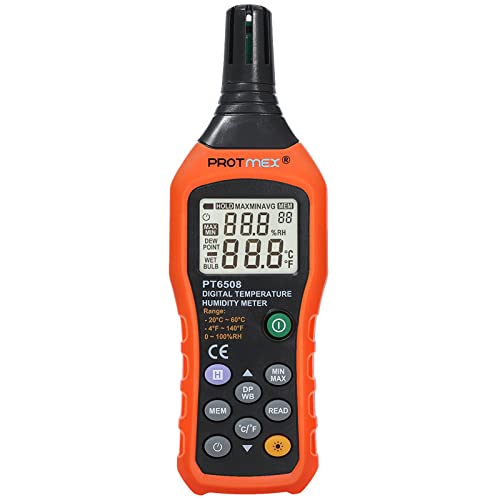
Protmex PT6508 Temperature Humidity Meter

SwitchBot Meter Pro Hygrometer Thermometer

BaldrTherm Smart WiFi Hygrometer 3-Pack

HATUSOKU Digital Thermometer Hygrometer 2-Pack

NECTO Cellular Temperature and Humidity Monitor
Inside Each Recommended Option
If your greenhouse runs on a small fan, a heat mat, or a string of grow lights, this plug-in thermostat handles the orchestration for you. It plugs into a standard 120V outlet and switches whatever you plug into it on or off based on temperature, time, or both.
Three modes cover the common growing patterns: constant temperature, day/night dual setpoints, and a simple 24-hour timer. The 3-meter probe reaches into a tent or propagation dome without dragging the whole unit off the wall. Growers running a small greenhouse or a few seed-starting trays will appreciate that one outlet replaces both a timer and a thermostat.
Useful Highlights
- Day/night dual setpoints let cool-loving crops rest at lower temps without manual switching.
- The probe cable is long enough to read canopy-level air while the body stays at eye level.
- Switching between modes takes seconds, so a quick seasonal adjustment isn’t a chore.
- Backlit LCD remains readable in dim greenhouses where most displays wash out.
Points To Note
- A single outlet means you’ll want a power strip if you’re running multiple devices.
- The probe tip sits in still air, so position it away from direct heater blasts for steady readings.
Quick Facts
Who It Suits Best
Backyard growers and seed-starting hobbyists who want set-and-forget climate control without rewiring.
Skip It When
The Inkbird ITC-308 suits you better when you need a dedicated dual-relay controller for a larger, year-round greenhouse.
Walk-in growers who hate guessing what happened overnight lean on Wi-Fi sensors like this one. It pushes live temperature and humidity readings to your phone and triggers alerts when conditions drift outside the band you set.
The Swiss-made sensing element is the headline here. Compared to the KETOTEK plug above, this isn’t a controller, it’s an observer. That makes it a great companion to a separate automation system, or a standalone monitor for someone who just wants data without switches clicking on and off. The base station is sold separately, which matters if you want app features, the LCD alone still works for at-a-glance checks.
A Few Strong Suits
- Swiss-grade sensor delivers tighter readings than most budget hygrometers at this level.
- App alerts let you catch a vent failure or heater stall before plants notice.
- Low-battery warning reaches your phone, so you’re never caught off guard by a silent monitor.
- Adjustable alarm volume on the base station suits both bedrooms and noisy greenhouses.
Trade-Offs To Consider
- The base station required for app features is a separate purchase, a real budget consideration.
- Wi-Fi-only means dead spots in metal-frame greenhouses can disrupt reporting.
The Right Fit
Tech-forward growers who want remote alerts and are already invested in a Wi-Fi ecosystem.
Consider Something Else When
The NECTO Cellular Temperature Monitor suits you better when your greenhouse sits far from a stable Wi-Fi signal.
The Inkbird ITC-308 is the controller many hobbyist greenhouse builders graduate to after outgrowing a basic plug. It has two relays, so it can run a heater in winter and a fan in summer from the same box, switching automatically as conditions demand.
For growers in climates with real seasonal swings, that dual-relay setup saves buying two separate controllers. The dual display shows both your setpoint and the live reading, which keeps calibration honest at a glance. A high-low buzzer covers both extremes, useful when a stuck-open vent dumps cold air onto tender seedlings. It skips the Wi-Fi route entirely, so reliability is rock-solid in a metal greenhouse that punishes wireless signals.
Positive Takeaways
- Dual relays handle heating and cooling from a single unit.
- Buzzer alarm catches both overheating and freeze-risk scenarios.
- Display readout in Celsius or Fahrenheit suits either audience.
- Wired probe design avoids the dead-battery problem common in Wi-Fi sensors.
Things To Weigh Up
- 1100W output ceiling means high-wattage heaters may need a contactor.
- No remote alerts, so you’ll want a secondary monitor if you travel often.
Who Should Grab It
Year-round growers in four-season climates who need both heating and cooling on autopilot.
Look Elsewhere When
The X-Sense Wi-Fi Thermometer Hygrometer fits you better when remote phone alerts matter more than automation.
Tinkerers running a Raspberry Pi or Arduino climate logger reach for bare sensor probes, not plug-in displays. This two-pack gives you stainless-steel waterproof tips on a 1-meter cable, paired with adapter modules that drop onto GPIO pins.
Compared to the sealed consumer units on this list, this is a build-it-yourself component. That makes it a perfect fit for someone wiring up a custom greenhouse dashboard, or feeding temperature data into Home Assistant. The stainless probe tolerates humid environments and direct soil contact, so root-zone monitoring becomes an option, not just air readings.
Strengths Worth Knowing
- Waterproof stainless probe handles soil insertion and high-humidity air spaces.
- Two-pack pricing makes multi-zone logging affordable for a first build.
- 1-wire digital protocol simplifies wiring to most microcontroller boards.
Honest Caveats
- Requires programming skills, there’s no screen or app out of the box.
- Pull-up resistor is included, but wiring still demands basic soldering comfort.
Best Suited To
Makers and growers comfortable with Raspberry Pi or Arduino who want a custom data pipeline.
A Better Fit Elsewhere
The BaldrTherm Solar-Powered Indoor Thermometer suits you better when you’d rather skip the coding and read a screen.
A bright sunroom greenhouse kills batteries fast. This 2.2-inch solar-powered unit sidesteps that issue entirely, harvesting light from grow lamps or sun and refreshing itself throughout the day.
The curved body and three-sided ventilation keep the sensing element exposed to true room air rather than trapped in a stagnant pocket. Readings refresh on roughly a 10-second cycle, fast enough to catch a door-left-open moment. It arrives in pairs, handy for tracking two microclimates at once, propagation area versus main bench, for example.
Good Reasons To Consider
- Solar power means no battery swaps in well-lit growing spaces.
- Ventilated housing pattern improves response time over flat-faced designs.
- 2.2-inch screen stays legible from across a small greenhouse bench.
- Pairing covers two rooms without buying a hub or app subscription.
Softer Spots
- Dim greenhouses during winter may starve the solar cell of charge.
- No connectivity, so data lives on the screen only.
Who Will Love This
Sunroom and bright-indoor growers who want silent, cable-free monitoring without any app setup.
Swap It Out When
The SwitchBot Meter Pro fits you better when you want a Bluetooth-connected screen with historical data.
When a plain temperature and humidity readout isn’t enough, the PT6508 adds two professional-style metrics: wet-bulb and dew-point. Both matter in disease-prone greenhouses, where condensation on leaves fuels fungal outbreaks.
It’s a handheld, which means walking readings rather than a permanent install. The dual display handles temperature and humidity side by side, with MIN/MAX tracking to spot overnight swings. Data hold locks a reading for note-taking. For growers who understand evaporative cooling or who manage a propagation house where leaf wetness matters, this meter pulls weight that a basic sensor cannot.
The Value In It
- Wet-bulb reading supports evaporative cooling calculations.
- Dew-point metric flags condensation risk before disease takes hold.
- Data hold and MIN/MAX tracking help during spot inspections.
- Backlit LCD makes dawn and dusk readings painless.
Where It May Fall Short
- Handheld form factor means no unattended logging.
- Full 0-100% humidity range is overkill for most home greenhouses.
Right Fit For
Detail-oriented growers tracking disease pressure and evaporative cooling performance.
Reach For A Different Pick When
The BaldrTherm Smart WiFi Hygrometer 3-Pack fits you better when continuous unattended logging matters more than advanced metrics.
The SwitchBot Meter Pro covers five metrics on a 92-millimeter screen: temperature, humidity, time, date, comfort level, and weather forecast. That’s a lot of information surfaced without pulling out a phone.
Bluetooth links it to the SwitchBot app, which supports up to two external sensors for multi-point monitoring. If you’re building out a SwitchBot-driven greenhouse, this slides right in. The comfort-level face icon gives a glance-friendly read that non-technical family members can interpret, useful when you’re delegating weekend checks.
A Favorable Mix
- Five-in-one display keeps routine checks to a single glance.
- Multi-point monitoring handles separate propagation and finishing zones.
- Comfort face icon simplifies daily readouts for casual observers.
- Bluetooth app control requires no separate hub for basic features.
Some Limits To Know
- Bluetooth range limits real-time monitoring if you leave the greenhouse.
- Full feature set depends on the SwitchBot ecosystem.
Made For
Smart-home growers already running SwitchBot devices who want greenhouse data on the same dashboard.
Where Another Pick Suits Better
The X-Sense Wi-Fi Thermometer Hygrometer fits you better when you need off-property phone alerts rather than Bluetooth range.
A single greenhouse rarely lives in a single climate. A three-pack lets you put one sensor in propagation, one on the main bench, and one outside to track intake conditions, all from one app.
Historical data storage is the quiet win here. Spotting a pattern, like humidity spiking every afternoon, becomes possible when weeks of data sit in your phone rather than scrolling past on a screen. The professional-grade sensor inside each unit points toward tighter readings than typical budget Wi-Fi sensors, a meaningful upgrade for growers who fine-tune ventilation timing.
A Few Highlights
- Three units cover propagation, canopy, and outdoor reference points.
- App alerts catch drift across any zone, not just the one you’re watching.
- Historical data storage surfaces patterns a basic screen can’t.
- Remote tracking works from anywhere with internet access.
Practical Considerations
- Three devices on one Wi-Fi network can crowd older routers.
- App-dependent, so a phone glitch temporarily blinds you to alerts.
Perfect Match For
Multi-zone growers managing propagation, growing, and reference environments simultaneously.
Not Your Match When
The MICREEN 2-Pack Waterproof Temperature Sensor Kit fits you better when root-zone logging matters more than air readings.
Some growers don’t want an app. The HATUSOKU unit leans fully into analog simplicity: a compact body, a clear number readout, and a comfort face icon that signals conditions at a glance.
It includes a stand, a magnet, and a hanging hole, so placement options cover most greenhouse setups. The comfort face goes beyond just numbers, helping less technical household members interpret whether the air is in a healthy range. No cables, no Wi-Fi, no batteries to think about often. Two units ship together, useful for tracking the seed-starting corner and the main growing bench.
The Helpful Details
- Comfort face display turns numbers into a quick visual judgment.
- Stand, magnet, and hanging hole cover three placement styles.
- Two-pack pricing fits a starter greenhouse on a budget.
- Compact white body blends into most greenhouse interiors.
Points To Keep In Mind
- No connectivity, so you’ll need to walk over and read it.
- Smaller display can be tough to read from across a large greenhouse.
Whose Shelf It Belongs On
New growers and anyone who wants honest readings without configuring a single setting.
Another Choice May Suit
The BaldrTherm Smart WiFi Hygrometer 3-Pack fits you better when phone alerts matter more than visual comfort icons.
Some greenhouses sit far from any router, an outbuilding, a barn loft, a remote cabin. The NECTO monitor sidesteps that entirely with a built-in cellular radio and a multi-network SIM.
Unlike the Wi-Fi-bound options above, this one reports over 4G LTE. The power outage alarm adds a layer most sensors skip: when the greenhouse loses electricity during a storm, you’ll know within minutes. Two years of cellular service ship in the box, removing the most common reason people skip cellular sensors. After that term, a monthly renewal keeps the signal alive, which is worth factoring into long-term planning.
The Good Stuff
- Cellular signal works where Wi-Fi can’t reach.
- Power outage alarm catches storms and breaker trips.
- 24/7 remote monitoring through the companion app.
- Two-year service bundle included out of the box.
Details To Watch
- Subscription renewal kicks in after the included service period.
- Cellular coverage is required at the greenhouse location, worth checking a coverage map first.
Built With In Mind
Remote or off-grid greenhouse owners who need alerts without depending on a home Wi-Fi network.
Not Your Match When
The Inkbird ITC-308 fits you better when your greenhouse already has stable power and Wi-Fi and you want dual-relay automation.
Factors Worth Weighing Before Choosing Sensors For Greenhouse Monitoring
Match the Sensor to Your Automation Goals
A monitor tells you what happened. A controller changes what happens next. Decide upfront whether you want a sensor that logs data, one that triggers alerts, or one that switches equipment on and off. The KETOTEK plug and Inkbird ITC-308 are controllers. The X-Sense, BaldrTherm Wi-Fi pack, SwitchBot, and NECTO sit in the alert-and-log camp. Pure readers like the HATUSOKU and Protmex PT6508 give you numbers without any switching at all.
Think About Connectivity in Your Specific Location
Metal-frame greenhouses, basements, and remote buildings all punish wireless signals. Wi-Fi sensors work beautifully in homes with strong routers but struggle in outbuildings. Bluetooth sensors like the SwitchBot Meter Pro are limited to roughly the range of a smartphone. Cellular sensors like the NECTO sidestep both, provided the location has coverage. Walk your greenhouse with your phone before choosing a wireless sensor.
Check Probe Placement and Ventilation
Sensors read what they’re exposed to. A probe sitting in direct sun reports greenhouse air temperature plus solar bias. A sensor stuck behind a leaf pile reports a stagnant pocket. Look for ventilated housings (like the BaldrTherm solar unit’s three-sided design) and plan to mount sensors in shaded, airy spots that represent your crop’s actual microclimate, not the corner nearest the door.
Plan for Multi-Zone Growing From the Start
Most greenhouses don’t have one climate. Propagation runs warmer and wetter than the finishing bench. A multi-pack like the BaldrTherm 3-Pack, or sensors that accept external probes, lets you build a multi-zone picture from day one. Adding a second sensor later often means juggling two apps or two accounts, so a starter multi-pack usually saves hassle.
Where Shoppers Slip Up With Greenhouse Sensors
Putting Sensors in the Wrong Spot
The most common mistake is hanging a sensor above the door where it catches every gust of outside air. Mount sensors at canopy height in a representative spot, away from heaters, vents, and direct sun. A shaded middle-of-the-room location gives readings closer to what your plants actually feel.
Confusing “Accurate” With “Calibrated”
Even good sensors drift over time. Hygrometers especially lose calibration in humid environments. Look for sensors that document recalibration intervals, or plan to validate yours against a reference meter (like the Protmex PT6508) once a year. A reading that has drifted five points relative humidity is worse than no reading at all, because it gives false confidence.
Skipping the Power Question
Battery sensors die quietly. Solar sensors starve in dim greenhouses. Plug-in sensors tie you to an outlet. Match the power source to your greenhouse reality. Sunroom growers do well with solar units. Remote greenhouses do well with cellular sensors that include their own power strategy. Shaded winter greenhouses do well with replaceable batteries, since solar cells won’t help much during the short days of January.
Where The Extra Money Goes
Higher-tier sensors buy three things: tighter accuracy, longer data history, and more robust connectivity. A Swiss-made sensor in the X-Sense unit reads more accurately than a generic chip, which matters for growers managing close temperature bands. App-connected sensors that store weeks or months of data let you spot patterns a single-screen sensor cannot. Cellular connectivity opens up monitoring locations Wi-Fi cannot reach. Whether those upgrades pay off depends on how much control you actually want over your greenhouse climate, and how much data you need to make better decisions.
Frequently Asked Questions
How many sensors does a typical home greenhouse need?
Most backyard greenhouses do well with two to three sensors. One in the propagation area, one at canopy height in the main growing space, and one outdoors as a reference for intake conditions. Multi-packs like the BaldrTherm 3-Pack cover that setup without juggling separate purchases.
Do greenhouse sensors need Wi-Fi to work?
Not at all. Plug-in controllers like the KETOTEK and Inkbird units run on simple outlet power with no internet connection. Standalone readers like the HATUSOKU and BaldrTherm solar units work entirely on local displays. Wi-Fi and cellular add remote alerts and data history, but they’re optional features, not requirements.
What’s the difference between humidity and dew point readings?
Humidity is the percentage of moisture currently in the air. Dew point is the temperature at which that moisture condenses into water. Dew point matters more for disease prevention, because leaf surfaces reach dew point first on cool evenings, and condensation fuels fungal growth.
Can a single sensor both monitor and control equipment?
Only controller-style units do both. The KETOTEK plug and Inkbird ITC-308 switch equipment based on readings. Standard hygrometers like the X-Sense, SwitchBot, and HATUSOKU units only monitor; you’d pair them with separate smart plugs or relays if you want automation.
How often should greenhouse sensors be recalibrated?
Most manufacturers suggest an annual check. Compare your sensor’s humidity reading against a reference meter, or against a salt-test calibration kit. Temperature sensors drift less than humidity sensors, but a yearly validation catches drift before it skews your decisions.
The Takeaway
Greenhouse sensors come in three flavors: controllers that switch equipment, monitors that log and alert, and readers that simply display numbers. Backyard growers often start with a controller like the KETOTEK plug and add a Wi-Fi monitor later. Larger or year-round setups benefit from a dual-relay controller paired with multi-zone Wi-Fi logging. Remote or off-grid greenhouses lean toward cellular sensors that work without a home network. Pick the flavor that matches your greenhouse size, your connectivity, and how much remote visibility you actually need, and you’ll spend less time guessing and more time growing.
