

A bonsai lives or dies by its root zone. Pile the wrong medium under a juniper and the roots sit in a soggy, oxygen-starved blanket that slowly suffocates the tree, no matter how carefully you water. Run it through the wrong gravel-heavy mix and the opposite happens, with moisture slipping past before the roots can drink. The right blend hits the narrow middle, holding just enough water to keep the tree hydrated between waterings while letting air move freely through the substrate.
This list rounds up ten well-regarded mixes for bonsai and bonsai-adjacent trees, from a household-name potting soil that doubles as a beginner-friendly base to specialty blends built for conifers, tropicals, and true soil amendments you mix yourself. Each pick includes a clear sense of who it suits, what it costs you in trade-offs, and when a different option on this list is the smarter call.
The Essentials At A Glance

FoxFarm Ocean Forest Potting Soil, 1.5 cu ft
Bonsai Jack Universal Organic Bonsai Soil Mix #221, 2 Gallons

Tinyroots All Purpose Bonsai Soil Mix, 2.25 Quarts

Bonsai Outlet Tinyroots Premium Bonsai Soil, 2.25 Quarts
Tinyroots Conifer Bonsai Soil Blend, 2.25 Quarts

GARDENWISE Organic Olive Tree Potting Mix, 3 Quarts

Spike & Bloom High Drainage Bonsai Soil Mix, 4 Quarts

Spike & Bloom High Drainage Succulent Soil, 4 Dry Quarts

Spike & Bloom High Drainage Cactus Soil, 8 lb / 4 Quarts

NOHOBE Hard Akadama Bonsai Soil, 2.5 lb, 1/8–1/4 in
Inside Each Recommended Option
FoxFarm Ocean Forest is the closest thing to a default container mix for hobbyists, and the bonsai world has borrowed it more times than anyone will admit. It comes ready to use, so a first-time owner does not have to weigh pumice against akadama on day one. The texture is light and airy without feeling like gravel, which makes it forgiving for anyone still learning the wet-dry rhythm of a small pot.
That said, this is a general-purpose potting soil rather than a true bonsai substrate, and it will hold more moisture than mixes built specifically for shallow root zones. Most growers who reach for it end up cutting it with pumice, lava, or a specialty blend like Bonsai Jack once their trees mature.
Benefits That Matter
- Ready to use straight from the bag, no sifting or washing required
- Light, fluffy texture that breathes well for newly potted trees
- 1.5 cu ft size covers several small repots or one large specimen
- Familiar to many gardeners, easy to find at most retailers
Trade-Offs Worth Considering
- Holds more water than a true bonsai substrate, which can invite root rot in shallow pots
- Breaks down faster than inorganic mixes, often needing replacement within a couple of seasons
- Not a stand-alone solution for pines, junipers, or other moisture-sensitive species
Who It Suits Best
New bonsai owners working with tropicals like ficus who want a forgiving starting medium before moving into specialist substrates.
A Better Fit Elsewhere
Owners committed to conifers or refined deciduous trees should reach for the Bonsai Jack Universal Organic Bonsai Soil Mix #221 instead, since its screened particles and balanced drainage handle those species more cleanly.
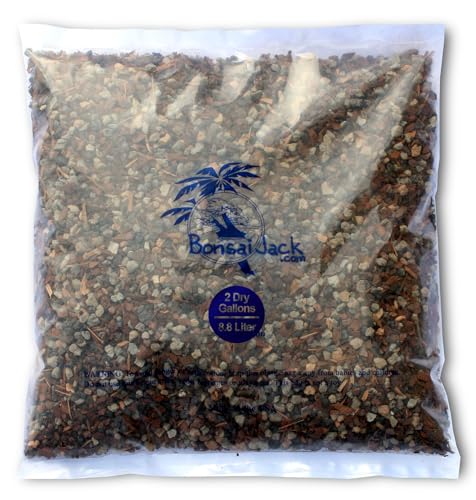
Bonsai Jack is the substrate most enthusiasts mention when asked what they actually keep in their own benches. The #221 blend arrives screened and pre-washed, so dust and fine particles that typically clog drainage are already gone. That single step saves the mess of running a bag through hardware cloth before you can use it.
The mix is built around a roughly 6.4 pH target, which keeps it friendly for the majority of temperate and tropical bonsai. In a real-world repotting session, you can pour it from the bag into a 6-inch training pot and the particle size stays consistent from the top to the bottom of the root mass.
Real Benefits
- Pre-screened and pre-washed to eliminate the fine dust that suffocates roots
- Targeted pH around 6.4 works across most tropical and deciduous species
- Particle size optimized for water absorption, evaporation, and bulk density
- 2-gallon size covers multiple medium repots without constant restocking
Things To Consider
- Premium price per quart compared to DIY blends of akadama and pumice
- Organic content means the mix will still break down over a long growing season
- Heavier bag, so shipping cost is worth weighing against picking it up locally
Best Suited To
Intermediate hobbyists managing a mixed collection of tropicals and deciduous trees who want one bag that handles most species without custom blending.
Look Elsewhere When
Specialist conifer growers will find the Tinyroots Conifer Bonsai Soil Blend a more natural fit, since its pine-bark component mirrors the slightly acidic, well-aerated conditions junipers and black pines prefer.
The Tinyroots all-purpose mix sits in a sweet spot for indoor bonsai collections where a tree might be a ficus today and a small maple tomorrow. It arrives blended for fast drainage, which protects roots from the most common indoor failure, and it carries enough structure to anchor a tree in a shallow pot without collapsing.
At 2.25 quarts, the bag is sized for someone repotting a few trees at a time rather than a full bench overhaul. That scale makes it approachable for a small urban collection where shelf space matters as much as the substrate itself.
What Earns Its Place
- Dust and fine particles removed during blending, protecting delicate roots
- Fast-draining texture supports both tropical and deciduous indoor species
- Compact 2.25-quart bag fits a closet, drawer, or small potting bench
- Formulated by working bonsai growers, not repurposed from general garden use
Points To Note
- Smaller volume means restocking more often for owners with larger collections
- All-purpose framing can feel generic if you specialize in conifers or pines
Made For
Indoor bonsai hobbyists rotating between ficus, schefflera, and small deciduous trees who want one bag that handles a varied bench without reblending.
Consider Something Else When
Owners running a serious conifer program will get a better result from the Tinyroots Conifer Bonsai Soil Blend, which is built around pine bark and river sand for the specific demands of junipers and Japanese black pines.
This Premium blend is the bonsai-substrate version of a classic Japanese trio: genuine akadama (a fired clay granule prized for its balance of moisture retention and airflow), red lava rock for structure, and pumice for lightweight porosity. Each component does a different job in the root zone, and together they form a substrate that feels almost engineered for finished trees.
The mix is positioned for finished bonsai, the kind of refined tree that has already been through years of training and now lives in a small display pot. In that context, water retention matters because the pot holds very little volume and the tree cannot tolerate swings.
Points In Its Favor
- Genuine akadama delivers reliable moisture buffering in shallow pots
- Red lava rock adds weight and structure so display trees sit stable
- Pumice keeps the mix light and prevents compaction over time
- Trusted by established bonsai schools for refined, finished trees
Honest Caveats
- Akadama breaks down over time and will need refreshing at each major repot
- Heavier price per quart than simpler peat-based mixes
- Overkill for young nursery stock that is still in development pots
Whose Shelf It Belongs On
Owners of finished deciduous or tropical bonsai who have moved past the development stage and want a substrate that mirrors what Japanese growers have used for decades.
Skip It When
Beginners working with young stock should start with the Bonsai Jack Universal Organic Bonsai Soil Mix #221, which forgives overwatering more readily while skills catch up to the tree.
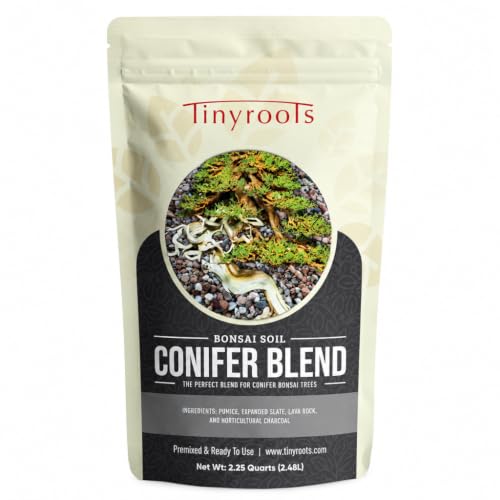
Conifers ask for something different from tropicals, and this blend is built around that reality. The mix leans on double-sifted pine bark fines, coarse river sand, calcine clay, and pumice, all of which work together to create the well-drained, slightly lean environment junipers and pines evolved to thrive in.
The hand-mixed, dried, and screened process is visible the moment the bag opens: particles are uniform, dust is minimal, and the texture feels closer to a gritty garden soil than a peat-heavy potting mix. For anyone growing Japanese black pine, juniper, cedar, or cypress, that is the texture you are aiming for.
Practical Pluses
- Component blend mirrors the soil profile conifers actually grow in
- Pre-sifted heavy particles protect fine conifer roots from abrasion
- Pine bark adds slow nutritional value as it breaks down
- Works for juniper, Japanese black pine, white pine, cedar, and cypress
Small Caveats
- Not a universal pick, less suitable for tropicals or moisture-loving deciduous trees
- Smaller bag means restocking for owners with many conifers in rotation
The Right Fit
Collectors focused on conifers, especially junipers and pines, who want a substrate formulated for the slightly acidic, fast-draining conditions those species prefer.
Another Choice May Suit
Owners running a mixed bench of tropicals and conifers will find the Bonsai Jack Universal Organic Bonsai Soil Mix #221 a more flexible everyday option, since it handles both groups without reblending.
Olive trees technically count as bonsai candidates, and the GARDENWISE mix is built to match their Mediterranean home. The blend balances drainage with enough moisture retention to keep a small pot hydrated between waterings, then layers in organic components like worm castings, compost, and limestone to support steady growth.
For a sunny patio or a bright indoor corner where an olive bonsai spends most of its life, the fast-draining profile prevents the soggy-feet problem that finishes off most container olives. The 3-quart bag covers a couple of small repots with a bit leftover for top-dressing.
Well-Handled Touches
- Fast-draining profile mirrors the rocky Mediterranean soils olives evolved in
- Organic worm castings and compost provide slow-release nutrition
- Limestone supports the balanced pH olives prefer
- Equally suited to indoor and outdoor container placement
A Few Limitations
- Specialized for olives and similar Mediterranean species, not a general bonsai substrate
- Organic content means refreshing the top layer each year in long-term plantings
Who Will Love This
Owners of olive bonsai or other Mediterranean-style species who want a substrate that handles both indoor and outdoor placement without constant tweaking.
Reach For A Different Pick When
Anyone growing classic bonsai subjects like juniper, pine, or maple will be better served by the Bonsai Jack Universal Organic Bonsai Soil Mix #221, which is tuned for the broader bonsai spectrum.
Spike and Bloom built this mix around a slightly acidic pH and a gritty particle profile, then added mycorrhizal fungi, beneficial microorganisms that form a symbiotic relationship with bonsai roots and help them access water and nutrients more efficiently. In a long-lived tree, that relationship can compound over the years into noticeably better root mass and steadier top growth.
At 7 pounds across 4 quarts, the bag carries real weight, which is helpful for top-heavy trees that need a stable anchor in a shallow pot. The mix reads as serious substrate the moment you open it, more gravel than peat, and that is the point.
Real-World Strengths
- Includes mycorrhizal fungi to support long-term root development
- Slightly acidic pH suits juniper, ficus, maple, and most common bonsai
- Gritty texture drains quickly and resists compaction in shallow pots
- 7-pound bag gives enough volume for several medium repots
Where It May Fall Short
- Beneficial fungi have a shelf life, so older bags lose some of their edge
- Heavier to ship and store than lighter peat-based blends
Perfect Match For
Owners of established junipers, ficus, and maples who want to invest in root-zone biology rather than just mineral content.
Swap It Out When
Collectors building a finished display tree from scratch will get a more traditional result from the Bonsai Outlet Tinyroots Premium Bonsai Soil, since the akadama, lava, and pumice trio is the long-established standard for refined work.
The succulent version of the Spike and Bloom line borrows the same slightly acidic, gritty base as the bonsai mix, then folds in coffee compost for organic content. That addition gives the substrate a richer aroma and a darker color, and it adds slow nutritional value that purely mineral mixes lack.
For bonsai subjects that lean succulent, like portulacaria, certain euphorbias grown as bonsai, or jade, this blend is a smart crossover. The 4 dry quarts cover a couple of small repots or one larger specimen with a bit leftover.
Noteworthy Benefits
- Coffee compost adds slow-release organic nutrition alongside mineral drainage
- Gritty base protects against the root rot succulents are notorious for
- Slightly acidic pH supports common succulent and semi-succulent species
- Mycorrhizal fungi included for stronger root establishment
Practical Considerations
- Coffee compost breaks down faster than pure mineral components, shortening the lifespan of the mix
- Not the right call for moisture-loving deciduous bonsai
Built With In Mind
Hobbyists growing succulent-style bonsai like jade or portulacaria who want a gritty base with a bit of organic nutrition built in.
Where A Sibling Pick Shines
For traditional juniper, pine, or maple bonsai, the Bonsai Jack Universal Organic Bonsai Soil Mix #221 is the safer everyday choice, since its particle sizing better matches the watering rhythm of those species.
Spike and Bloom’s cactus mix sits at the gritty end of the family, with a target pH around 6.5 and a particle profile built for fast drainage. At 8 pounds across 4 quarts, it is denser than the succulent sibling, which translates into real anchoring weight in shallow display pots.
The mycorrhizal inclusion is the same as the other Spike and Bloom products, so the underlying biology matches the rest of the line. For someone repotting several trees at once, the larger 8-pound bag spreads out into more usable substrate per dollar than the smaller formats.
The Practical Payoff
- 8-pound weight anchors top-heavy trees without top-dressing stone
- Fast-draining profile is well matched to drought-tolerant bonsai subjects
- pH near 6.5 keeps it inside the comfort zone for most species
- Larger bag format stretches further per repot than smaller competitors
Points To Weigh
- Heavier bag is harder to ship and store in tight spaces
- Overkill for tropicals that prefer more organic, moisture-retentive substrates
Who Should Grab It
Collectors repotting multiple trees in a single session who want a heavy, gritty substrate that doubles as a long-term anchor in shallow pots.
Not Your Match When
Beginners running a small indoor collection will find the Tinyroots All Purpose Bonsai Soil Mix easier to work with, since the smaller bag fits a closet or drawer and the all-purpose framing forgives a wider range of species.
NOHOBE ships pure akadama in a small 1/8 to 1/4 inch grain, which is the size most hobbyists use for finished deciduous and tropical bonsai. Hard akadama, the fired clay Japanese growers have trusted for generations, holds its shape longer than softer grades and resists breaking down in the pot.
One practical bonus of pure akadama is its color change when wet. The grains darken as they absorb water and lighten as they dry, which gives a visual cue for when it is time to water. For beginners, that built-in feedback loop is genuinely helpful.
The Value In It
- Pure hard akadama in a finished-friendly 1/8 to 1/4 inch grain
- Darkens when wet, providing a visual watering cue
- Mixes cleanly with pumice and lava for custom substrates
- Works for bonsai, cactus, and succulents when used straight
Trade-Offs To Consider
- 2.5 pounds is a starter amount, larger collections will need multiple bags
- Single-component means you typically blend it with pumice or lava for the best result
Right Fit For
DIY-minded hobbyists who already know the akadama, pumice, lava ratio they want and prefer to buy raw components rather than a finished blend.
A Better Fit Elsewhere
Anyone who would rather skip the math and open a bag will find the Bonsai Outlet Tinyroots Premium Bonsai Soil a friendlier starting point, since the three-component blend is already measured and mixed.
What Matters When Choosing Soils For Bonsai Tree
Drainage is the single most important attribute to evaluate, because bonsai live in shallow pots where the margin between moist and waterlogged is razor thin. A substrate that holds too much water for too long invites root rot, the leading cause of death in container-grown bonsai. Look for mixes that drain within a few seconds when you pour water through and that show dry, light-colored particles at the surface within a day of watering in summer.
Particle size matters almost as much as drainage. Uniform, larger particles create the air pockets that roots need to breathe, while fine dust settles into the gaps and chokes them off. That is why pre-screened mixes like Bonsai Jack and the Tinyroots blends earn their keep: the manufacturer has already removed the fines that would otherwise compact the root zone.
pH and organic content depend on the species. Most bonsai prefer a slightly acidic to near-neutral pH somewhere between 6.0 and 7.0, and the substrate either supports that range or fights it. Conifers like juniper and pine lean toward leaner, faster-draining mixes with a touch of organic content, while tropicals like ficus tolerate richer, more moisture-retentive substrates.
For indoor collections, weight and storage also come into play. A 7-pound or 8-pound bag is meaningful when you carry it up three flights of stairs to a small apartment, so smaller 2 to 4 quart formats are often a smarter first buy until you know which species you want to commit to.
Key Considerations Across These Picks
Common Shopping Slip Ups
Picking a general-purpose potting soil and expecting it to behave like a true bonsai substrate is the most frequent error. Soils like FoxFarm Ocean Forest work fine for tropicals, but they hold too much water for conifers and finished deciduous trees, and the substrate breaks down faster than mixes built from mineral components. The shortcut is to start with a screened, bonsai-specific blend even if it costs a bit more per quart.
Overpotting, planting a small tree in a pot that is far too large, is the second trap. A large pot holds more substrate, which holds more water, which drowns the roots. The substrate and the pot size have to work together, and chasing a particular mix without adjusting the pot will still leave the tree in trouble.
What The Higher Tier Buys
Premium blends earn their cost by replacing peat and compost with mineral components like akadama, pumice, and lava. Those components do not break down, they drain consistently across multiple growing seasons, and they create the air-filled porosity roots need. Lower-tier mixes can keep a tree alive, but the premium tier is what lets a refined bonsai develop the fine root mass that supports dense ramification (the repeated branching that gives a finished tree its silhouette).
Paying more also buys the screening and pre-washing step that the cheaper DIY route skips. For anyone who has not yet built a sifting station at home, that pre-screened bag is well worth the difference in mess saved.
Frequently Asked Questions
How often should I repot a bonsai and change the soil?
Most bonsai benefit from fresh substrate every two to four years, depending on species and growth rate. Younger trees in development need more frequent repotting, while mature, refined trees can go longer between refreshes. Watch for water that runs straight through the pot without absorbing, a sign the substrate has broken down.
Can I reuse old bonsai soil when repotting?
Most growers do not reuse old soil as-is, since organic components have broken down and the structure has compacted. Some will sift out the larger mineral particles and reuse the akadama or pumice portion, then mix it with fresh material. Straight reuse without reblending tends to produce disappointing results.
Do I need a different soil for tropical versus temperate bonsai?
Yes, the moisture needs are different enough to justify different mixes. Tropicals like ficus tolerate and prefer more moisture retention, while temperate species like juniper and pine want a faster-draining, leaner substrate. The all-purpose mixes on this list sit in the middle, but a specialist blend for conifers or a richer mix for tropicals will give better results.
What grain size should I use for small bonsai pots?
Smaller pots and smaller trees generally want smaller grain, often in the 1/16 to 1/4 inch range, so the substrate sits evenly around fine roots. Larger training pots can handle larger grain. The akadama and conifer mixes on this list use 1/8 to 1/4 inch particles that work for most small-to-medium bonsai.
Is it okay to mix different bonsai soils together?
Yes, mixing is a normal part of advanced bonsai practice. Many growers blend akadama, pumice, and lava in custom ratios for specific species. The all-purpose and specialist blends on this list are already balanced, but adding akadama to a peat-based mix or pumice to a richer substrate is a reasonable way to fine-tune drainage.
Closing Remarks
The right substrate is the part of bonsai care that quietly does the most work, and switching from a generic potting mix to one of the screened, bonsai-tuned blends on this list is often the single upgrade that turns a struggling tree into a steady one. Match the mix to the species, mind the watering rhythm, and the rest of the hobby gets noticeably easier.
