

New grass seed is needy. It needs light, frequent watering, and harsh jets of water will scatter seed, puddle, or wash it into low spots before roots take hold. The right sprinkler turns a fragile seed bed into a steady, even mist that keeps the top quarter-inch of soil moist without disturbing the seed itself.
You want a sprinkler that lays down fine droplets, holds a consistent pattern, and won’t need babysitting through the three to four daily watering cycles germination usually demands. The nine picks below cover the common shapes you’ll see on the shelf: impact rotors, oscillating bars, spot sprinklers, a traveling unit, and a wand for hand-watering patches the hose can’t reach.
Your Options, Compared

NexLogi Heavy Duty Pulsating Impact Lawn Sprinkler with Metal Base

Orbit 55069 Saturn III Gear-Drive Rotor Water Sprinkler
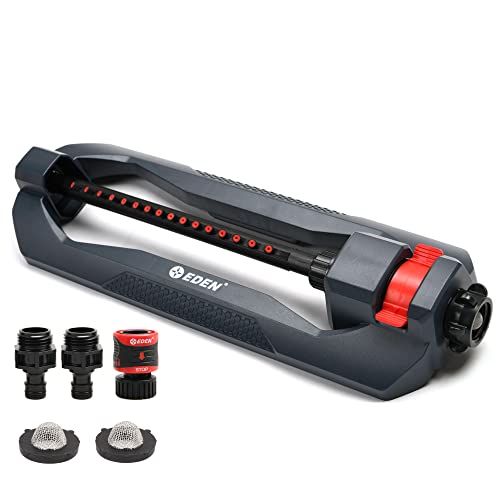
Eden 96213 Weighted Essential Oscillating Sprinkler

Eden 94110 Heavy-Duty Metal Oscillating Sprinkler
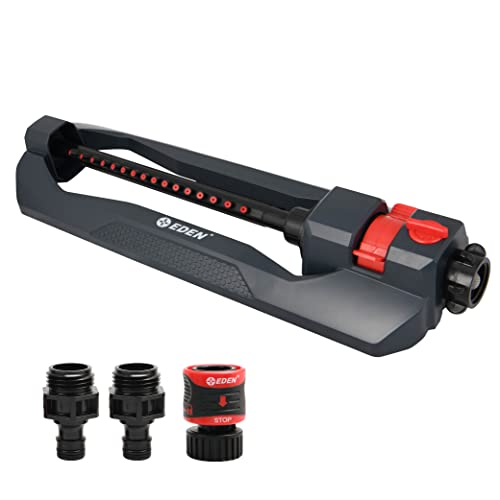
Eden 94105 Weighted Oscillating Sprinkler

SYOOY 360 Degree Metal Spot Sprinkler

Nelson Rain Train Traveling Sprinkler, Cast Iron
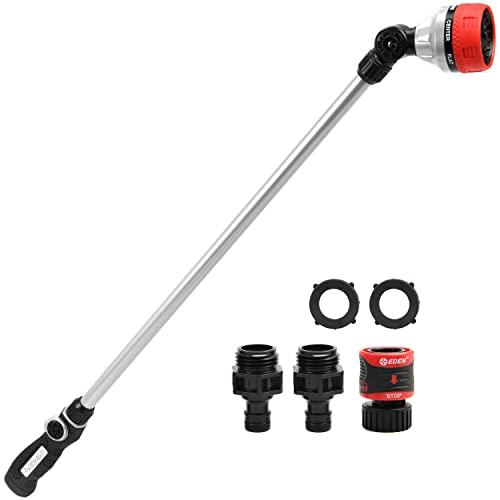
Eden 96618 Metal Thumb-Control Watering Wand

QVS 004113 Naan Irrigator Sprinkler 30′ Round
What Each Pick Brings To The Table
An impact sprinkler throws water in a single jet that rotates around a fixed circle, so unlike the oscillating units that follow it on this list, you get distance before you get density. The NexLogi model uses a brass nozzle paired with a zinc alloy body and base, materials chosen to shrug off the kind of weather that chews through plastic heads after two seasons.
On a freshly seeded yard, you’d dial the rotation back to a wide arc to keep droplets from hammering one strip too hard. For most suburban lots the adjustable spray lets you aim at a corner bed or swing the full 360° on an open patch without moving the base. The metal weight also resists tipping when hose tension pulls sideways.
The Practical Payoff
- Brass nozzle and zinc alloy head resist rust through repeated wet-dry cycles
- Adjustable rotation from a partial arc to full 360° for oddly shaped lots
- Solid metal base stays put when a dragging hose tries to pull it over
- Suited to larger open areas where single-jet reach beats fine mist
Points To Keep In Mind
- Single-stream impact pattern can disturb loose seed if run at full pressure
- Heavier body makes repositioning a small chore between watering cycles
At A Glance
Made For
Homeowners with a mid-size or large open lawn who want a sprinkler that’ll survive several seasons of outdoor storage without flaking apart.
Look Elsewhere When
You’re working with a narrow, rectangular lawn where the Eden 96213 oscillating bar will lay down gentler, more even coverage without overshooting the edges.
Gear-drive rotors run on a small set of internal gears rather than the impact-and-spring mechanism of the NexLogi above. That difference gives you a slower, quieter rotation and finer control over how far each drop travels before hitting the ground. A gear-drive head is what professional irrigation systems bury in the lawn, and the Saturn III puts that pattern in a hose-thread body.
For new seed, the appeal is the low flow rate combined with a longer throw. You can keep the stream gentle by setting the arc tight and backing off your household water pressure, which matters when topsoil has just been raked loose. Most owners use these in a small group on the same hose line so multiple rotors share pressure evenly.
Bright Spots
- Gear-drive rotation produces steady, predictable coverage with less splash-back than impact heads
- Adjustable arc from 40° to 360° for tight corners or full-circle patterns
- Throw distance up to 25 feet covers a meaningful patch from one position
Honest Caveats
- Best performance depends on consistent household water pressure, which varies by neighborhood
- Pop-up style requires a small cut or trench if you want it flush with the lawn
Who It Suits Best
Homeowners comfortable with light setup work who want a low-flow rotor that can stay in one spot for weeks of daily watering cycles.
Consider Something Else When
You’d rather just set a sprinkler on the grass and walk away, in which case the Eden 94105 oscillating unit skips the gear head and gets you running in seconds.
An oscillating sprinkler sprays a fan of water through a row of nozzles while a small turbo motor rocks the bar back and forth. The result is a rectangular pattern that mirrors most lawn shapes, which is why this style dominates the seed-watering market. The Eden 96213 runs 16 nozzles across a weighted sled-style base.
On freshly raked seed, the bar’s gentle fan pushes droplets downward rather than outward, so the seed stays put while the topsoil stays damp. Sliding range tabs let you shorten the throw on either end to avoid wasting water on the driveway or sidewalk. For most new-lawn owners this is the kind of sprinkler you set out, drag the hose once a day, and forget about.
Points In Its Favor
- Rectangular pattern matches typical lawn geometry better than circular spray
- Sixteen nozzles spread droplets evenly across the full bar length
- Adjustable range tabs let you trim coverage on either side
- Weighted base keeps the unit planted when a hose tugs
Trade-Offs To Consider
- Plastic sled body can crack if dragged across concrete during repositioning
- Lacks built-in flow control for fine-tuning droplet intensity
Feature Snapshot
Best Suited To
First-time seeders working with a roughly rectangular yard who want a no-fuss sprinkler that runs the moment you hook up a hose.
A Better Fit Elsewhere
Your lawn curves around features or has multiple narrow side strips, in which case the SYOOY 360 Degree Metal Spot Sprinkler covers tight pockets the oscillating bar will skip.
The 94110 takes the same oscillating concept as the 96213 above and rebuilds it with a metal body and tube assembly. Where many oscillating sprinklers flex or crack at the hose connection after a season of being dragged around, this one keeps its shape. For new seed that’s a quieter win: you want a unit that stays put when the hose shifts and doesn’t leak from a hairline split mid-cycle.
Eighteen nozzles is one more row of spray than its sibling, which spreads the load slightly finer across the bar. For most backyards this matters less than the build quality, but it does help on a wider rectangle. Pair it with the quick-connect bundle and you can swap heads in seconds when moving from front to back yard.
Well-Handled Touches
- Metal tube and sled resist the cracking that ends most plastic oscillating heads
- Eighteen nozzles lay down a fine, even spray across the full width
- Sliding range tabs trim overshoot on driveways and walkways
- Turbo drive keeps the bar sweeping at a consistent pace
Room For Improvement
- Heavier metal body adds weight to reposition between watering runs
- Listed coverage area is slightly smaller than the 96213 sibling model
Quick Facts
Right Fit For
Shoppers planning to use the same sprinkler season after season and tired of replacing cracked plastic sleds every couple of years.
Swap It Out When
You’re on a tight budget and the Eden 94105 covers your rectangular yard just as well, especially if flow control matters more than metal build to you.
The 94105 sits between Eden’s two siblings reviewed above, with the same weighted sled layout as the 96213 but adds a flow-control dial on the hose side. That single knob lets you dial droplet intensity from a fine mist to a heavier shower without walking back to the spigot. For new seed, fine mist is what you want during germination, then slightly heavier once the blades start to emerge.
The 16 precision nozzles and turbo drive handle the distribution, while the weighted base keeps it planted when the hose pulls. Quick connect compatibility also means you can swap heads without unscrewing. You may find the sled lighter than the all-metal 94110, so dragging it across turf can leave a faint track.
Everyday Advantages
- Built-in flow control adjusts spray intensity from one position
- Sixteen nozzles with turbo drive motor for smooth oscillation
- Quick connect fitting snaps to standard garden hose accessories
- Coverage up to 3,600 sq. ft. handles typical suburban lots
Things To Consider
- Plastic sled is lighter than the metal 94110 and may shift on uneven ground
- Flow dial takes a few test runs to learn the right setting for seed stage
Who Will Love This
First-time seeders who want one adjustment knob instead of walking back to the spigot every time they need a softer spray.
Where Another Pick Suits Better
You expect rough outdoor storage and want the heavy-duty metal body of the Eden 94110 to take the abuse over multiple seasons.
Spot sprinklers are the small, ground-staked units you drop into a flower bed or a corner of new seed where a wide oscillating bar would waste water on pavement. The SYOOY is a metal-bodied unit with a polished finish, which puts it ahead of plastic spot heads when the sun bakes it for a season. Spray distance shifts with your household water pressure, so on a low-pressure day the throw pulls in close.
For patch seeding a bare spot under a tree or along a fence line, this kind of small sprinkler keeps the water exactly where you want it. Pair several of them across a stubborn yard for tricky shapes the big-bar sprinklers can’t reach.
What It Does Well
- Compact body fits in tight spaces that big oscillating bars overshoot
- Metal head resists cracking from sun exposure and accidental kicks
- 360° spray pattern fills a small circle evenly
- Useful as a supplement to a main sprinkler on odd-shaped lawns
Worth Noting
- Throw distance depends entirely on household water pressure
- Not practical as a sole sprinkler for any yard above a few hundred square feet
Key Product Details
Perfect Match For
Gardeners reseeding small patches or watering narrow border strips where a wide oscillating bar would drench the sidewalk instead.
Skip It When
Your main job is watering a full rectangular lawn, where the Eden 96213 oscillating bar covers the same area in a single pass.
A traveling sprinkler rides along a hose path you lay out across the lawn, spraying as it goes. The Nelson Rain Train uses a cast iron body, which gives it the weight to stay upright on the hose track and the durability to survive a few seasons of rough yard work. Coverage scales with the hose you can lay down, reaching up to 13,500 square feet in the larger path setting.
The unit’s arms adjust the spray pattern and arc, throwing anywhere from 15 to 56 feet depending on how you set them. For most large lawns this means you set the hose once and let the sprinkler do the walking, which is a relief during the multi-daily watering cycles new seed demands.
Notable Gains
- Travels a preset hose route for hands-off watering of large or irregular yards
- Cast iron body shrugs off the bumps and scrapes of yard life
- Adjustable arms let you dial the spray from fine to broad
- Covers up to 13,500 sq. ft. on a wider hose layout
Practical Considerations
- Spray may be too forceful for very loose seed bed if arms are set wide
- Heavier than stationary sprinklers, so lifting between runs is a workout
Built With In Mind
Owners of large, irregular lawns who would rather lay out a hose path once than keep moving a sprinkler by hand three times a day.
Reach For A Different Pick When
You’re working with a small yard or a narrow strip, where the Eden 96213 oscillating bar covers the area in less time and without setting up a hose track.
A watering wand isn’t a sprinkler in the traditional sense, but for new seed in tight or awkward spots it does the same work as one. The Eden 96618 is a 33-inch metal wand with a thumb-control valve on the grip and a spray head that pivots 180°. You stand at the edge of the bed, squeeze the thumb lever, and lay down a soft shower exactly where the seed sits.
Seven spray patterns cover everything from a fine mist for seedlings to a flat fan for washing off a tool. For most homeowners this wand earns its place after germination too, watering hanging baskets and shrubs without dragging out a ladder. During the seed stage it’s the right tool for patches the broad-coverage sprinklers miss.
Positive Takeaways
- 33-inch reach lets you water seed beds without stepping on fresh soil
- Thumb-control valve gives one-handed flow adjustment on the fly
- Seven spray patterns include a fine mist ideal for new seed
- 180° adjustable head targets awkward angles around shrubs or fences
Small Caveats
- Manual operation means standing with the wand through each watering cycle
- Not a substitute for a broad-coverage sprinkler on any full-size lawn
Whose Shelf It Belongs On
Anyone reseeding small patches or reaching into raised beds where a free-standing sprinkler can’t aim reliably.
Not Your Match When
You need to water a full yard on a timer, since the QVS Naan Irrigator can stay in one spot while you go inside.
The Naan Irrigator is a no-frills impulse sprinkler that spreads water in a wide 30-foot round. It’s the kind of unit you lay on the lawn, hook up to a hose, and leave running for a few hours. The simple two-arm rotor design has been around for decades because it works at low pressure and doesn’t need much beyond water and a flat patch of ground.
For a freshly seeded yard, this sprinkler earns its spot when you want gentle, even coverage and don’t need to fuss with adjustable arcs. On a small lawn the 30-foot round covers the entire area in one placement, and you may find its slow rotation gentler than the impact spray of the NexLogi.
Good Reasons To Consider
- Wide 30-foot round covers a small lawn in a single placement
- Works at low household pressure without a pressure booster
- Simple two-arm design is easy to clean if nozzles clog with mineral buildup
- Light enough to reposition without dragging a hose across fresh seed
Points To Note
- No arc adjustment means you can’t trim overshoot on one side
- Plastic body won’t survive rough storage the way the cast iron Nelson can
Who Should Grab It
Seeding a small, square lawn where a single full-circle sprinkler placement covers everything without setup hassle.
Where A Sibling Pick Shines
You want adjustable arc control to avoid wasting water on the driveway, in which case the NexLogi Heavy Duty Impact Sprinkler gives you the same circular pattern with twist-to-adjust ends.
Picking A Sprinkler That Suits A Fresh Seed Bed
Seed germination lives or dies in the top quarter-inch of soil. You want droplets light enough to land without cratering the seed bed, frequent enough to keep that layer damp, and gentle enough to run three or four times a day without puddling. Match the sprinkler pattern to your lawn shape before worrying about anything else.
Match The Pattern To The Lawn Shape
Rectangular yards pair best with an oscillating bar like the Eden 96213 or 94105, since the back-and-forth sweep mirrors the lawn edge and reaches corners the circular sprinklers miss. Square or open lawns do well with a circular rotor like the QVS Naan or the Orbit Saturn III, where one placement covers the whole patch. Curved or irregular shapes benefit from a spot sprinkler like the SYOOY filling the gaps that wider patterns skip. Get the geometry wrong and you’ll either waste water on pavement or leave dry strips that germinate late.
Droplet Size And Pressure Matter Most
Seed is light. A high-pressure stream from an impact sprinkler will redistribute seed into low spots before roots anchor it. Most oscillating bars and impulse heads can be softened by turning down the spigot, but a built-in flow control like the Eden 94105’s makes that adjustment precise. The QVS Naan Irrigator works well at low pressure without any knobs, which is a relief when your household supply already runs soft.
Build Material Tracks How Long It Will Last
Plastic sleds like the Eden 96213 are light, cheap, and fine for a single season. Metal bodies, whether the NexLogi’s zinc alloy head or the Nelson’s cast iron frame, pay back the extra weight when the sprinkler lives outside through summer and winter. Dragging any sprinkler across concrete is the fastest way to break it, so think about storage and how often you’ll move it between cycles.
Key Considerations Across These Picks
Where Shoppers Go Wrong
The most common mistake is buying the sprinkler with the largest listed coverage and expecting it to perform at that number on day one. Real coverage depends on your household water pressure, which can vary by neighborhood and time of day. Test a spot first before committing the unit to the middle of a seed bed. Another misstep is setting an impact sprinkler to full rotation on bare soil: the jet kicks up seed and creates thin patches that show up weeks later.
Where The Extra Money Goes
Higher-tier metal bodies, built-in flow control, and gear-drive rotors all address the same underlying issue: keeping the water where you want it at the intensity the seed needs. The Eden 94110 over the 96213 is mostly a build-quality upgrade that survives seasons. The Eden 94105 adds flow control, which matters more for first-time seeders still learning how much water the bed actually needs. The Orbit Saturn III costs more because it’s a low-flow gear-drive rotor, and that efficiency shows up in lower water bills over a month of daily cycles.
Frequently Asked Questions
How often should a sprinkler run on new grass seed?
Water two to four times a day for the first two weeks, keeping the topsoil damp but not soggy. Short, frequent cycles beat one long soak because seed needs moisture in the surface layer, not deep saturation.
Are oscillating sprinklers better than impact sprinklers for new seed?
Generally yes, because the fan-style spray pushes droplets down rather than out. Impact heads throw a single jet that can disturb loose seed, especially on full pressure. If you use an impact head, dial the rotation wide and reduce pressure at the spigot.
How long does it take grass seed to germinate?
Most common lawn grasses sprout within 7 to 21 days, depending on the seed type and soil temperature. Cool-season grasses like fescue and ryegrass tend to come up faster than warm-season blends like Bermuda.
Can I leave a sprinkler running overnight on new seed?
It’s not ideal, since overnight watering without inspection can lead to pooling, runoff, or fungal growth. Daytime cycles let you check the soil and reposition the sprinkler as needed.
What water pressure do these sprinklers need?
Most oscillating and impulse units run well on standard household pressure between 30 and 50 PSI. Low-flow rotors like the Orbit Saturn III perform better at the higher end of that range, while the QVS Naan Irrigator works at lower pressure without a booster.
Final Verdict
For a typical rectangular lawn, the Eden 96213 or 94105 oscillating sprinkler is the safe starting point: gentle fan spray, easy setup, and coverage that fits most seed projects. If your lawn is large and open, step up to the NexLogi impact head or the Nelson Rain Train for reach and durability. For the awkward patches around corners and beds, keep a SYOOY spot head or an Eden watering wand within reach. Match the pattern to the shape, dial the pressure down for seed stage, and the rest of the germination battle is mostly about consistency.
