

Cold months, short days, and a covered growing space don’t have to mean slow growth. The right lighting setup keeps seedlings compact, herbs fragrant, and fruiting plants productive when outdoor sun disappears. This list covers nine lighting options built for greenhouse shelves, tents, and rack systems, ranging from compact panels to linkable strip bars that scale across a 4×4 footprint. Each pick handles a different combination of coverage area, mounting style, and spectrum control, so you can match hardware to the way you actually grow.
A Snapshot Of The Selections

Uallhome 2 Pack LED Grow Light Panel Full Spectrum
Uallhome 2 Pack LED Grow Light Panel 200W

yentbokj LED Grow Light with Adjustable Tripod Stand

SDOVUERC 16” 6 Bars Grow Light Strips

Bstrip Indoor Greenhouse with Grow Light, 4-Tier

Hlite 16in Hanging Full Spectrum Linkable 4 Pack

Hlite 16in Hanging Full Spectrum Linkable 2 Pack
Hlite 16in Hanging Full Spectrum Linkable 4 Pack

FREELICHT 2Pack 4FT Grow Light, 40W Full Spectrum
The Details Behind The Selections
A pair of flat panel fixtures is often the simplest way to add supplemental lighting to a starter greenhouse or a small indoor seed-starting shelf. The Uallhome 2 Pack LED Grow Light Panel Full Spectrum covers the visible range from blue through red, which is what most leafy greens, herbs, and young seedlings need to stretch into compact, sturdy transplants rather than leggy, weak stems.
For hobbyists running a single 2×4 propagation shelf, the two-panel bundle spreads light across a wider area than a single bulb, though you’ll want to keep trays within roughly a foot of the panel face for the strongest effect.
The Case For It
- Full-spectrum output supports both vegetative and flowering stages
- Two-panel pack covers a propagation shelf without buying extras
- Lightweight flat form factor mounts on shelves with basic hardware
- Operates cool enough to sit close above tender seedlings
Things To Consider
- Smaller coverage footprint than the 200W sibling reviewed next
- Lacks the daisy-chain or linkable feature found on strip-style fixtures
Right Fit For
Beginner growers running a small seed-starting rack or herb shelf who want a no-fuss, no-frills panel without spectrum controls.
A Better Fit Elsewhere
Skip the Uallhome 2 Pack LED Grow Light Panel Full Spectrum in favor of the yentbokj LED Grow Light with Adjustable Tripod Stand when your plant collection sits at mixed heights and needs repositionable heads.
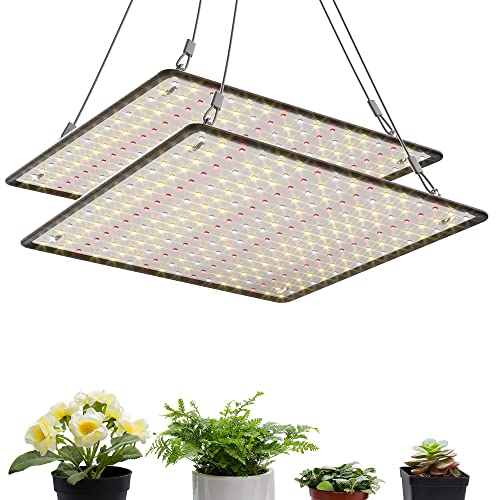
Step up to the 200W variant and the same Uallhome platform becomes a tent-friendly workhorse. Each panel combines white, blue, red, UV, and IR (infrared) LEDs, which means the light reaches deeper into a leafy canopy and supports later-stage plants that need extra red to push out flowers or fruit.
Run a 4×4 grow tent and you’ll appreciate how two panels can hang from corner mounts to spread output corner to corner, though you may find light intensity drops at the very edges.
Noteworthy Benefits
- UV and IR chips extend the spectrum beyond basic red and blue
- Targets 4×4-foot coverage, well-matched to standard grow tents
- Higher wattage class penetrates thicker plant canopies
- Two-panel design creates even light from multiple angles
Honest Caveats
- Higher wattage means more heat under the canopy, so spacing matters
- No built-in timer, which a few competing panels now include
- Panels are bulkier than the entry-level Uallhome pair
Key Specs
Made For
Growers running a 4×4 tent with mixed veg and bloom plants who want a stronger, deeper-penetrating spectrum than a basic panel can provide.
Not Your Match When
Swap to the FREELICHT 2Pack 4FT Grow Light, 40W Full Spectrum if you need long, narrow tube-style coverage across 4-foot shelves rather than broad tent lighting.
Floor-standing grow lights fill a gap that hanging panels can’t: a room with no ceiling hooks, a rental where drilling isn’t an option, or a corner of the living room that doubles as a winter plant hospital. The yentbokj LED Grow Light with Adjustable Tripod Stand uses a telescoping tripod and flexible gooseneck-style heads, so you can raise the bar from roughly 15 inches up to about 63 inches as plants grow.
The bundled remote and timer handle day-to-day scheduling, which is genuinely useful for anyone who travels and needs the light to run unattended for stretches.
A Few Strong Suits
- Adjustable height range fits everything from microgreens to taller houseplants
- Built-in timer (4/8/12 hour settings) automates daily cycles
- Four heads spread light across a wide floor footprint
- Spectrum modes include red-blue, white, and a combined option
- No permanent installation required
Small Caveats
- Tripod base takes up floor space, awkward in tight apartments
- Light intensity is lower than a dedicated 200W panel
- Heads can drift downward over time, requiring periodic readjustment
Quick Facts
Whose Shelf It Belongs On
Houseplant hobbyists with mixed-height collections who can’t or don’t want to mount fixtures to a ceiling or shelf.
Look Elsewhere When
Pick the SDOVUERC 16” 6 Bars Grow Light Strips instead if you have a multi-tier shelf and want a fixed, low-profile strip that disappears into the rack frame.
Strip-style lights earn their place in any greenhouse that runs on shelves rather than open benches. The SDOVUERC 16” 6 Bars Grow Light Strips package six 16-inch bars running a 380 to 800 nanometer wavelength range, the same general spread of light that natural noon sun offers, and the bars mount along the underside of a wire rack to bathe each shelf evenly.
For anyone starting seeds on a 4-tier wire shelf, this kind of multi-bar layout is genuinely more practical than a single overhead panel because the light reaches all four corners of each tier.
Strengths Worth Knowing
- Multi-bar design eliminates the bright center, dim edges problem
- Wavelength range covers both warm and cool spectrums plus red
- Low profile fits under standard wire-shelf frames
Points To Note
- Fixed mounting means no repositioning mid-grow
- No integrated timer; an outlet timer is a worthwhile add-on
Best Suited To
Vertical propagators running tiered wire shelves who need each tier lit evenly rather than relying on a single overhead source.
Skip It When
Choose the yentbokj LED Grow Light with Adjustable Tripod Stand if you’d rather avoid mounting bars and want a single freestanding unit you can move between rooms.
For growers who don’t want to shop for a frame, a cover, and a light separately, the Bstrip Indoor Greenhouse with Grow Light, 4-Tier arrives as a single unit with the lighting already integrated. The 4-tier frame uses four full-spectrum LED panels that draw roughly 15W each, and a multi-function switch cycles between yellow, white, and mixed spectrum modes.
The honest read is that this is a starter greenhouse rather than a serious fruiting setup, and the plastic cover fabric does a decent job of trapping humidity for cuttings and seedlings.
Positive Points
- All-in-one design removes the guesswork of matching components
- Four-tier frame multiplies growing area without a larger footprint
- Switchable spectrum modes for different plant stages
- Low 15W-per-panel draw keeps electricity costs modest
Where It Is Less Suited
- Plastic cover material tears more easily than rigid polycarbonate panels
- Light output is modest compared to a 200W hanging panel
- Frame is built for small plants, not tall fruiting crops
Perfect Match For
Apartment dwellers and basement gardeners who want a turnkey indoor greenhouse without assembling separate components.
Where Another Pick Suits Better
Reach for the Uallhome 2 Pack LED Grow Light Panel 200W when you already own a tent and need stronger light, since the Bstrip 4-Tier unit’s lighting tops out well below 200W per panel.
Linkable fixtures (meaning individual bars that connect end-to-end to share one power source) are the secret to a clean greenhouse install. The Hlite 16in Hanging Full Spectrum Linkable 4 Pack ships four 16-inch bars you can daisy-chain into a longer run, drawing roughly 20W total rather than 20W per bar. That low draw is the real story, since four-bar layouts usually multiply power bills, and here they don’t.
Hang them parallel across a 2×4 or 4×4 tray and you get even coverage with only one outlet in use.
Key Advantages
- Daisy-chain design reduces cord clutter to a single outlet
- Low total wattage (20W) keeps operating costs down
- Four-bar layout fills rectangular trays without dead spots
Trade-Offs
- 20W total is modest, so don’t expect tent-filling intensity
- Linkable cables limit how bars can be spaced apart
Who It Suits Best
Greenhouse growers running multiple 2×4 trays who want a clean, single-outlet install with even coverage across the bench.
Swap It Out When
Consider the FREELICHT 2Pack 4FT Grow Light, 40W Full Spectrum if your benches are 4 feet long and you prefer one continuous tube rather than a chain of short bars.
The two-bar version of the Hlite 16in Hanging Full Spectrum Linkable design is a smart way to step into the platform without buying a four-bar kit you may not need. Two 16-inch bars still cover a 2×2 tray comfortably for microgreens, herbs, or seedling starts, and the linkable end caps mean you can add a second pair later without re-wiring.
Compared with the four-bar sibling reviewed just above, the trade-off is simply coverage area, since the wattage per bar is the same.
Standout Benefits
- Two-bar starter size fits a single 2×2 tray
- Expandable: add a second pair using the same outlet
- Same full-spectrum output as the larger Hlite packs
Honest Caveats
- Limited coverage outside the 2×2 footprint
- Lower total output than the 200W Uallhome panel option
Who Should Grab It
Growers starting a small herb or microgreens tray who want a system they can scale up later by adding a second two-pack.
Reach For A Different Pick When
Move to the Hlite 16in Hanging Full Spectrum Linkable 4 Pack if you already know you’ll need broader coverage and don’t want to daisy-chain two separate two-packs.
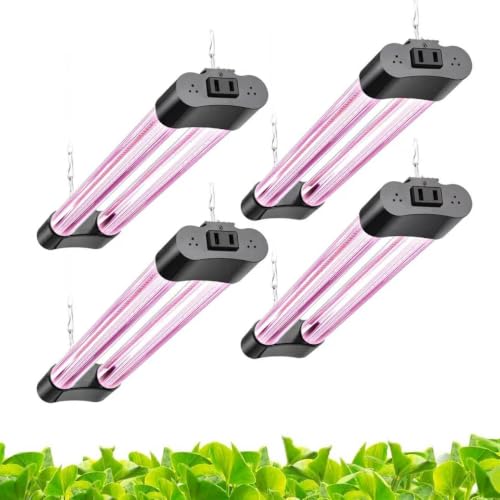
The second four-bar Hlite entry on this list targets a slightly different layout. Run all four bars end-to-end in a single chain and you get a continuous 64-inch strip of light, ideal for a long bench of seedling trays. Spread them across a 2×4 layout and the same kit creates a denser overhead grid.
For anyone whose greenhouse has a long, narrow bench rather than a square tent, this format covers more of the actual bench length than a square 4×4 panel setup would.
Positive Takeaways
- End-to-end chaining creates a long, continuous light bar
- Even coverage along the full length of a propagation bench
- Single power connection simplifies wiring
Small Caveats
- 20W total is shared across all four bars
- Mounting hardware is basic, so plan to add proper hanging kit
Built With In Mind
Greenhouse growers with long, narrow benches who need continuous coverage along the bench length rather than concentrated square coverage.
Consider Something Else When
Pick the Bstrip Indoor Greenhouse with Grow Light, 4-Tier if you don’t already own a frame and want shelving and lighting in one purchase.
Tube-style 4-foot fixtures are the format that fits standard wire shelving the way it was designed to be lit. The FREELICHT 2Pack 4FT Grow Light, 40W Full Spectrum ships two 4-foot tubes with 168 LEDs each across a balanced spectrum of warm white, cool white, and red, drawing 40W per tube while claiming the output equivalent of a 250W traditional bulb.
Mount a pair across a 4-foot shelf and you get evenly distributed light from end to end with no center hot spot, which is exactly what trays of microgreens and salad greens prefer.
Features That Help
- 4-foot length matches standard wire shelf dimensions
- 168 LEDs per tube spread light across the entire bar
- Full-spectrum blend supports seedling-to-flower growth
- Two-pack covers both sides of a single shelf
Less Ideal Details
- Tubes are fixed-spectrum, with no red-blue toggle
- Higher wattage than linkable bar kits, so electricity use adds up on long benches
Feature Snapshot
Who Will Love This
Greenhouse growers using standard 4-foot wire shelves who want a single light bar to span the whole shelf in one clean run.
Where A Sibling Pick Shines
Switch to the yentbokj LED Grow Light with Adjustable Tripod Stand when you have plants scattered on the floor at different heights rather than on shelves.
Choosing Greenhouse Grow Lights That Actually Fit Your Setup
The right greenhouse grow light depends on three things: the size of the growing area, what you’re growing, and how permanent you want the install. Spectrum comes first, since full-spectrum output covers the widest range of plants from leafy herbs through fruiting tomatoes, while a red-blue only setup saves money if you’re strictly running vegetative crops. Coverage area matters next, because a 200W panel in a 2×2 closet wastes energy while a 20W linkable kit in a 4×4 tent underfeeds the corners.
Mounting style rounds out the decision. Hanging panels suit tents and framed structures, while strip and tube formats work best on wire shelves. Tripod-style floor units skip installation entirely, which is helpful in rentals or shared spaces. Most home growers overbuy wattage and underbuy coverage area, so measure your bench or shelf footprint before deciding on a kit.
Coverage Area vs. Wattage
The wattage number on the box tells you how much power the fixture draws, not how much usable light reaches your plants. Coverage area is the spec that actually matters for plant health, and it depends on how high you hang or mount the fixture. For leafy greens and herbs, a low-watt linkable strip placed 6 to 12 inches above the canopy usually performs better than a high-watt panel mounted 24 inches away, because intensity falls off with distance.
Spectrum Modes and Why They Matter
Full-spectrum LEDs, meaning diodes covering the full visible range plus useful UV and IR, are the most flexible choice for mixed greenhouses where you grow herbs, flowers, and fruiting crops side by side. Red-blue-only fixtures (sometimes called “blurple”) cost less and work fine for vegetative growth, but the purple light makes it hard to inspect plants for pests or diseases. Most growers using a greenhouse space rather than a sealed tent will want full-spectrum simply for visibility.
Mounting and Daily Use
Hanging panels require ceiling hooks or tent poles, which is a permanent install. Strip lights and tube fixtures attach to the underside of wire shelves with basic clips and can come down for cleaning. Tripod stands need floor space but require zero installation, which is why they show up in apartments and rental homes. An outlet timer is a worthwhile add-on for any fixture that doesn’t ship with one, because consistent day length matters more than absolute brightness for most indoor crops.
Key Considerations Across These Picks
Common Shopping Slip Ups
The most common mistake is buying a single high-watt panel to cover an entire greenhouse, when the same budget spent on multiple lower-watt linkable bars would actually distribute light more evenly. A 200W panel in the center of a 4×8 space leaves dim corners, while four 40W tubes spread across the same footprint give every tray the same intensity. The second mistake is ignoring the spectrum detail: a “white” LED isn’t automatically full-spectrum, and bare cool-white diodes lack the red wavelengths that drive flowering and fruiting.
Where The Extra Money Goes
Higher-tier greenhouse grow lights typically cost more because of denser diode counts, more sophisticated drivers, and inclusion of UV and IR chips beyond basic red and blue. That extra spend translates to deeper canopy penetration and more useful light at the edges of the coverage area. For a hobbyist running a 2×2 herb shelf, the upgrade rarely pays back, but for anyone growing fruiting plants through to harvest, the higher-tier output is genuinely worth the difference.
Frequently Asked Questions
How far should greenhouse grow lights hang above plants?
Most greenhouse grow lights perform best 6 to 18 inches above the canopy, depending on wattage. Low-watt strip and tube fixtures can sit closer, while high-watt panels need more distance to avoid leaf burn.
Do greenhouse grow lights use a lot of electricity?
LED grow lights use a fraction of the electricity older HID (high-intensity discharge) systems consumed, so a typical home greenhouse setup with two to four LED fixtures usually adds only a modest amount to a monthly bill.
Can one grow light cover a whole greenhouse?
A single fixture rarely covers a full residential greenhouse evenly, since light falls off with distance. Multi-bar kits or multiple hanging panels produce more uniform coverage across a full bench or tent.
What’s the difference between full-spectrum and red-blue grow lights?
Full-spectrum lights cover the entire visible range plus useful UV and IR, while red-blue lights (sometimes called “blurple”) focus only on the wavelengths plants use most heavily. Full-spectrum setups double as task lighting, which is helpful in a working greenhouse.
Do greenhouse grow lights work for seedlings?
Yes, and seedlings are actually one of the best use cases, since young plants respond strongly to gentle, consistent light. Lower-watt fixtures placed 6 to 10 inches above seedling trays produce compact, sturdy transplants.
Closing Remarks
The right greenhouse grow light depends on the space you have and what you want to grow, not on any single spec on the box. For most home growers, a balanced full-spectrum setup that fits the actual bench or shelf footprint will outperform a more powerful fixture mounted in the wrong place. Start with the layout, match the light format to it, and you’ll spend less on hardware while keeping plants healthier through the darker months.
