

Apartment dwellers without south-facing windows, basement growers running tents, and seed-starting gardeners chasing spring before the frost all face the same question: which light actually moves plants forward. These nine picks cover everything from a small herb garden on a kitchen counter to a full 4×4 tent bloom phase, with options that fit different budgets, layouts, and experience levels.
The Picks In Brief

VIPARSPECTRA 150W Full Spectrum Grow Light

Uallhome 2 Pack Full Spectrum Grow Panel
Uallhome 2 Pack 200W Sun-Like Panel

Beelux 1000W Dual-Chip Grow Light

yentbokj Tripod Floor Grow Lamp

TATU 1000W Full Spectrum Plant Light

SDOVUERC 16″ 6-Bar Shelf Grow Light

Hlite 16″ Linkable Hanging Grow Light 4-Pack

Hlite 16″ Linkable Hanging Grow Light 2-Pack
The Details Behind The Selections
The VIPARSPECTRA XS1500 Pro steps into a crowded field with one feature that genuinely separates it from a basic panel: optical lenses. Those lenses concentrate each diode’s output, which translates into stronger canopy penetration without forcing you to crank up the wattage. You get 150 watts of full spectrum light that aims to spread evenly across a tent rather than dumping intensity in the center and fading at the corners.
PPFD, short for photosynthetic photon flux density, measures how much usable light actually reaches the plant. Higher PPFD at the edges means fewer weak shoulders and more even canopies. For someone running a dedicated tent with multiple racks, that even spread matters more than raw wattage.
Real-World Strengths
- Optical lens design concentrates output for better edge-to-edge coverage
- Daisy-chain up to 20 units from a single dimmer, useful in larger commercial runs
- 150W full spectrum covers both leafy growth and flowering stages
- Lower heat output than older HPS or MH setups, which simplifies ventilation
Honest Caveats
- Single-unit daisy-chain control means you need a compatible dimmer for full control
- Lens-focused beam can feel intense in a 2×2 closet at close range
- Owners commonly report that the included hanging hardware is serviceable but basic
Key Product Details
Who It Suits Best
Tent growers running a single dedicated space who want professional-style light distribution without stepping up to a 300W+ fixture.
Where Another Pick Suits Better
For casual houseplant shelves, the Hlite 16″ Linkable 2-Pack is a friendlier entry point at lower output and easier install.
Uallhome’s two-pack panel setup targets a different shopper than the VIPARSPECTRA above. Instead of one focused, lens-driven fixture, you get a pair of broad-spectrum panels you can split between two shelves, a long countertop, or a small seed-starting rack. The full spectrum covers UV through red and infrared, which is more than a casual grower usually needs, but it does keep options open for the day you decide to push a plant to bloom.
For someone who wants to start herbs in the kitchen and a pothos in the bedroom from a single purchase, the two-panel approach is a practical fit. You may find the per-panel intensity lighter than a tent-rated fixture, which is the expected trade-off for an entry-level price.
Bright Spots
- Two-panel bundle covers multiple rooms or a long shelf at once
- Full spectrum from UV to infrared supports every growth stage
Points To Keep In Mind
- No daisy-chain or external dimmer, so each panel is controlled independently
- Per-panel output is modest for high-demand fruiting plants
- Mounting hardware is minimal, so plan on separate clips or stands for clean install
Right Fit For
Houseplant collectors and first-time growers who want one purchase to cover two or three spots around the home.
Skip It When
You need concentrated bloom-phase light, in which case the Uallhome 200W Sun-Like 2-Pack delivers much heavier output for roughly the same footprint.
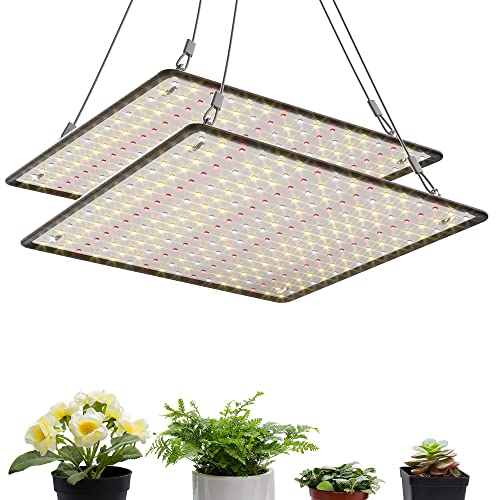
Where the smaller Uallhome two-pack plays it safe, the 200W sun-like version pushes into real tent territory. White, blue, red, UV, and IR diodes work together to mimic midday sun, and the warm-white appearance means the room doesn’t glow purple when you walk in. That’s a small thing until you run a tent in a shared living space and want to peek at plants without sunglasses.
The two panels aim to cover a 4×4 footprint when hung at a proper distance, which suits hobbyists stepping up from a single small setup. For most growers running leafy greens, seedlings, and a modest flower attempt, the output balance lands in a useful middle ground.
The Practical Payoff
- Higher 200W per panel drives meaningful bloom-phase results
- Warm-white appearance keeps the grow space livable indoors
- Includes UV and IR diodes for fuller spectrum coverage
- Two panels handle a 4×4 tent without needing a third fixture
Trade-Offs
- Heat rises with output, so passive tents may need an intake fan
- Power draw is heavier than the entry-level Uallhome pack
Best Suited To
Hobbyists with a 4×4 tent who want sun-like light without the purple glow of older blurple panels.
Not Your Match When
You only need to start a flat of seeds, in which case the SDOVUERC 6-bar shelf strip does the job at a fraction of the power draw.
The Beelux 1000W is a classic mid-size tent fixture, and the marketing number deserves a quick read: it draws around 110 watts from the wall while delivering output comparable to older 1000W HPS (high-pressure sodium) or MH (metal halide) lamps. That gap between nameplate wattage and actual draw is normal in the LED world, but worth knowing when you’re budgeting your electric bill. The dual-chip design means more diodes per square inch, which spreads output across the panel instead of relying on a few bright spots.
A separate veg and bloom switch lets you toggle spectrum intensity without swapping fixtures, and the red-heavy output aims to push flowering yields meaningfully higher than vegetative-only settings. For most growers, this single-fixture design covers a 4×4 footprint from seed to harvest.
What Works In Its Favor
- Veg and bloom switches let you tune the spectrum to growth stage
- Actual draw sits around 110W despite the 1000W nameplate rating
- Dual-chip layout spreads intensity across the panel for more even canopies
Less Ideal Details
- Cooling fans run continuously and are audible in quiet rooms
- Single-fixture coverage caps at a 4×4, so larger tents need a second unit
- No external dimmer knob, which limits fine-tuning
Feature Snapshot
Made For
Mid-size tent growers who want one fixture to handle seedlings through flower without swapping hardware.
Consider Something Else When
You run a quiet living-room closet, since the TATU 1000W offers similar output with a quieter thermal profile for noise-sensitive spaces.
Most of the lights in this roundup assume a tent or shelf setup. The yentbokj tripod is built for the opposite case: a tall plant in a corner, a fiddle leaf fig that refuses to thrive, or a windowsill garden that needs a supplement during short winter days. The stand extends from 15 to 63 inches, and the gooseneck arms rotate a full 360 degrees, so you can aim light exactly where the canopy needs it.
The remote-controlled timer offers 4, 8, or 12-hour cycles, and three spectral modes (red and blue, white, or a mix) let you tune for either leaf growth or flowering. For someone without a dedicated grow space, this is the closest thing to a plug-and-grow light in the entire roundup.
The Helpful Details
- Adjustable tripod grows with the plant, useful for tall specimens
- 360-degree gooseneck arms let you cover multiple plants at once
- Built-in timer with remote control removes daily manual switching
Worth Noting
- Output is modest compared to a panel fixture, so fruiting plants may struggle
- Tripod footprint can be awkward in tight corners
Quick Facts
Perfect Match For
Apartment growers with tall potted plants who don’t have the space or interest in a tent setup.
A Better Fit Elsewhere
For dense propagation trays, the SDOVUERC 6-bar shelf strip lays flat and covers more seedlings per square foot.
The TATU 1000W lands in the same general category as the Beelux above, with full-spectrum white, blue, and red diodes arranged to support every growth stage. The 660nm red pushes flowering speed, and 430nm blue tightens up vegetative leaf development. For most kitchen herb gardens or small flower tents, that combination is enough to cover a full seed-to-harvest cycle.
The draw sits low enough that a standard household circuit handles it without complaint, and the unit runs quieter than older fan-cooled designs in this class. Depending on your tent ventilation, the heat load is manageable.
What It Does Well
- Full spectrum output supports every stage from seed to harvest
- Red and blue diodes are tuned to flowering and vegetative growth
A Few Limitations
- No separate veg or bloom switch, so the spectrum is fixed
- Coverage claim assumes proper hanging height, which can vary room to room
Whose Shelf It Belongs On
Beginners and intermediate growers who want a single light for herbs, leafy greens, and modest flower runs.
Look Elsewhere When
You need stage-specific control, in which case the Beelux 1000W’s dual switches give you the same wattage with finer spectrum tuning.
The SDOVUERC strip changes the shape of the problem entirely. Instead of hanging a single square panel, you mount six 16-inch bars across a shelf or bookcase, turning any flat surface into a propagation station. The 360 LEDs mix warm white, cool white, and 660nm red to cover a useful spectrum for seedlings and greens. Wavelength output spans 380 to 800nm, which mimics roughly the noon sunlight range that most plants evolved under.
For seed-starting gardeners who already own shelves and want a clean, low-profile install, this is a quieter, more elegant approach than wrestling with hanging kits. The trade-off is that fruiting crops will need a stronger overhead light once they outgrow the shelf.
Noteworthy Benefits
- Six-bar layout spreads light evenly across a shelf without hot spots
- Low profile fits under standard bookshelves and propagation racks
- Full 380 to 800nm range covers the key photosynthesis bands
Potential Drawbacks
- Not strong enough for heavy bloom or fruiting plants
- Bars are fixed-length, so odd-sized shelves may need creative mounting
Feature Rundown
Who Should Grab It
Seed-starting gardeners and propagation enthusiasts who already have a shelf and want clean, even light without a hanging kit.
Another Choice May Suit
For taller plants, the yentbokj tripod grow lamp gives you height and angle flexibility that fixed shelf bars cannot match.
The Hlite 4-pack is what you reach for when one bar isn’t enough. Each 16-inch unit draws only 20 watts, so four together stay under 100W, yet the full spectrum is designed to replace a 120W general plant light per bar. The linkable design chains them end-to-end from a single outlet, which keeps cord clutter under control on a multi-shelf rack.
For garage racks, basement seed stations, and propagation walls, the 4-pack turns into a single integrated system. Light output per bar is modest, so this works best for greens, herbs, and seedlings rather than high-light bloomers.
Good Reasons To Consider
- Linkable design simplifies multi-bar installs
- Low 20W per bar keeps total power draw modest
Where It May Fall Short
- Per-bar output is light, so heavy bloomers need supplemental coverage
- Hanging hardware sold separately on some configurations
Built With In Mind
Garage rack growers and basement propagators who want clean, modular light across multiple shelves.
Swap It Out When
You only need a 2-shelf start, since the Hlite 2-Pack covers that footprint at lower total cost.
The 2-pack version of the Hlite 16-inch light targets the smallest viable setup: one or two seed-starting shelves where a full 4-pack would be overkill. Two linkable bars give you roughly 40 watts of full spectrum, which handles trays of herbs, microgreens, and young seedlings with room to spare. You may find the output borderline for anything past the early vegetative stage, but that’s the expected trade for a compact two-bar system.
For most beginners running a single shelf, this is a friendlier starting point than committing to a 4-bar setup, and the linkable design leaves room to add two more bars later as the operation grows.
Standout Benefits
- Compact 2-bar bundle is sized for single-shelf setups
- Expandable to a 4-bar system later through the linkable chain
Possible Compromises
- Limited output for anything past early vegetative growth
- Two-bar coverage leaves a noticeable light gap on wider shelves
The Right Fit
New growers starting a single herb or microgreens shelf who want room to expand without replacing their first setup.
Reach For A Different Pick When
You need a single overhead panel for a small tent, in which case the TATU 1000W is a stronger one-light solution.
Factors To Consider When Choosing Grow Led Lights
Spectrum Coverage And Plant Stage
Plants use light in the 400 to 700nm range, often called PAR (photosynthetically active radiation). Blue wavelengths in the 430 to 470nm band drive tight vegetative growth, while red wavelengths around 660nm fuel flowering and fruiting. Full spectrum lights blend both, so the same fixture can take a plant from seedling to harvest without swapping bulbs. Dedicated blue-heavy or red-heavy panels are sharper tools, but they need swapping between stages.
Wattage, Draw, And Coverage
A fixture’s nameplate wattage is not the same as what it pulls from the wall. LED diodes are typically driven below their max rating, so a “1000W” light may draw 100 to 200W. Coverage claims depend on hanging height. For a 4×4 tent, a 100 to 200W actual-draw fixture usually hits the sweet spot. Smaller shelves and propagation trays can run on 20 to 50W per bar.
Form Factor And Install Style
Panel fixtures suit tents and wide shelves, while strip lights and bars shine on propagation racks and bookcases. Tripod floor lamps fit tall houseplants in living spaces. Mounting hardware matters more than people expect. Bars that need separate hanging kits or shelf clips can become an afternoon project rather than a ten-minute install.
Heat, Noise, And Ventilation
LEDs run cooler than older HPS or MH lamps, but higher-wattage panels still push meaningful heat into a small tent. Fan-cooled fixtures add background noise, which can be a problem in shared spaces. Passive-cooled designs with large heatsinks trade some maximum output for quiet operation.
Key Considerations Across These Picks
Common Shopping Slip Ups
The most frequent mistake is buying a fixture that covers a smaller footprint than the grow space. A single panel rated for 2×2 will leave a 4×4 tent dim at the edges, even if the center is bright. Equally common is choosing wattage over spectrum. A high-wattage blurple light without enough red will push leafy growth but stall flowering. Always match the light to the plant’s intended stage and the actual shelf or tent dimensions.
What The Higher Tier Buys
Stepping up to a premium panel typically adds optical lensing, daisy-chain dimming, and better thermal management. The VIPARSPECTRA XS1500 Pro is a clear example. The lens array pushes even coverage to the edges of the canopy, which translates to more uniform harvests in commercial-style setups. For a hobbyist with one tent, the premium tier pays off when you push flowering plants hard, but a mid-tier panel is plenty for herbs, greens, and casual flower runs.
Frequently Asked Questions
How Many Watts Do I Need For A Small Grow?
For a 2×2 closet or shelf, 50 to 100W of actual draw covers herbs and leafy greens comfortably. A 4×4 tent wants 100 to 200W of actual draw for full-coverage flowering. Match wattage to the footprint, not the marketing number.
What’s The Difference Between Full Spectrum And Targeted Spectrum?
Full spectrum covers the entire PAR range, so one light handles every growth stage. Targeted spectrum panels emphasize either blue or red, which can boost specific stages but usually need swapping or supplementing as plants mature.
How Close Should The Light Hang To The Canopy?
Most LED panels run best 12 to 24 inches above the canopy, depending on wattage. Higher-wattage panels need more distance to prevent light burn. Seedlings prefer the upper end of that range until they toughen up.
Do Grow Lights Use A Lot Of Electricity?
A 100W fixture running 16 hours a day adds roughly $5 to $10 per month to a typical electric bill, depending on local rates. LEDs pull significantly less power than older HPS or MH lamps, which is why most growers see lower utility costs after switching.
Can I Use A Grow Light For Regular Houseplants?
Yes, and many houseplants benefit during low-light months. Set the timer to 8 to 12 hours and keep the fixture 12 to 18 inches above the foliage. Watch for leaf bleaching, which signals the light is too close or too intense for the species.
Wrap Up
The right grow light depends on where you grow, what you grow, and how hands-on you want to be. A seed-starting shelf, a 4×4 flower tent, and a tall pothos in a living room corner each call for a different shape of light, and this roundup covers all three. Pick the fixture that matches your actual space, and the rest tends to fall into place.
