

Starting seeds indoors changes the gardening calendar completely. You can coax tomatoes, peppers, basil, and flowers through their most delicate stage without staring out the window waiting for a sunny windowsill that never gets enough light. The right grow light seed starter kit handles the three variables that make or break germination: consistent moisture, a humidity-controlled dome, and full-spectrum light close enough to the soil to keep seedlings from getting leggy. Most home growers waste a season learning that last lesson the hard way, watching pale stems stretch toward a window that just cannot compete with a 12-hour LED cycle. Pick the right kit once, and you’ll start seeds for years.
How The Shortlist Stacks Up

Patigrow 60-Cell Self-Watering Seed Starter Tray with Grow Light

Patigrow 120-Cell Self-Watering Seed Starter Tray with Grow Light

80-Cell Seed Starter Tray with Grow Light and Humidity Dome (2 Pack)

GROWFRIEND 40-Cell Seed Starter Kit with Grow Lights and Heat Mat
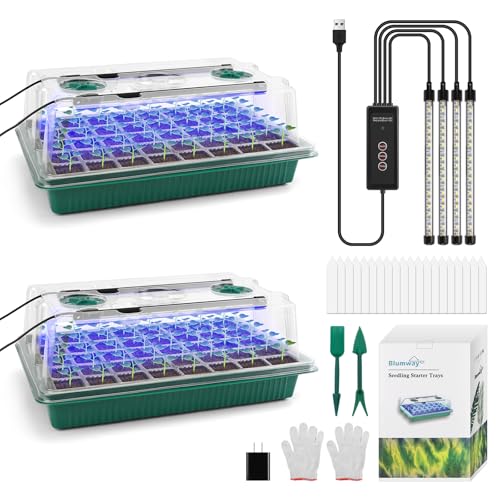
BlumWay Seed Starter Tray with Grow Light, 2 Pack 80 Cells

VIVOSUN 1-Pack Seed Starter Kit, 40-Cell Tray, LED and Heat Mat
Guioiby 120-Cell Seed Starter Kit with Grow Light, 2 Pack

Ryscam 96-Cell Seed Starter Kit with Grow Light and Humidity Domes

Ryscam 5-Pack Seedling Starter Trays, Black

Ryscam 192-Cell Seed Starter Kit with Grow Light and Humidity Domes
More On The Choices That Made The List
The Patigrow 60-cell kit is a friendly on-ramp for anyone starting seeds for the first time. Sixty cells hit a practical sweet spot, large enough for a real vegetable garden yet compact enough to live on a kitchen counter or a small shelf. The self-watering base pulls moisture up into the soil through a wicking mat, so forgetful waterers get a few days of grace before seedlings dry out.
For most beginners, this is the one to start with. The included full-spectrum LED strip runs on a timer, which removes one of the easiest things to mess up: remembering to turn the light on and off. Compared to the 120-cell Patigrow reviewed next, this version occupies less counter real estate and costs noticeably less, while still covering what a family of four might transplant in a single spring.
Useful Touches
- Self-watering base keeps soil evenly moist for several days, a real time-saver for working gardeners.
- Full-spectrum LED with adjustable brightness and a built-in timer covers germination through early leaf growth.
- 4.07″ humidity dome traps moisture during germination, then vents as seedlings harden off.
- Reusable cells make this a multi-season tray rather than a one-and-done disposable.
Worth Noting
- Sixty cells fill quickly once tomatoes and peppers enter the rotation, so plan to stagger plantings.
- The dome’s plastic can fog heavily in the first week; wiping it down weekly prevents light-blocking buildup.
Quick Facts
Who It Suits Best
First-time indoor seed starters working with a small kitchen, apartment shelf, or a single south-facing window.
Look Elsewhere When
You’re filling an entire backyard from scratch; the Patigrow 120-Cell Self-Watering Seed Starter Tray with Grow Light doubles the capacity for serious transplant volume.
When a small kitchen tray will not cut it, the Patigrow 120-cell version doubles the same self-watering and LED system for gardeners starting dozens of tomatoes, peppers, and flowers at once. The footprint grows accordingly, so expect to dedicate a shelf or a sturdy table rather than a corner of the counter.
For most backyard growers, the bigger tray is the one you wish you had started with. Each cell is still a manageable size for transplanting, and the wicking base prevents the uneven watering that often plagues larger trays. Compared to the 60-cell above, the only meaningful difference is scale, and the light bar reaches across the wider canopy without leaving edge seedlings in shadow.
Standout Benefits
- 120 cells handle a full spring garden in a single sowing window.
- Self-watering reservoir reduces the daily chore of checking moisture across so many small cells.
- Full-spectrum LED strip is wide enough to cover the entire tray evenly.
- Same dome and reusable plastic as the 60-cell, so parts are interchangeable if you own both.
Trade Offs
- Footprint is large; measure your shelf before buying.
- Filling 120 cells with soil is a real prep task, so set aside time.
- Heavier when fully watered, which matters on flimsy shelving.
Feature Snapshot
Made For
Serious backyard growers and small-scale homesteaders who want to skip nursery trips and start everything indoors.
Swap It Out When
You only need a handful of herbs for the windowsill; the Patigrow 60-Cell Self-Watering Seed Starter Tray with Grow Light handles that workload in less space.
The YJXFON two-pack delivers 80 reusable cells per tray and a green base that visually separates it from the sea of plain black plastic. Two trays stacked side by side give you enough room to sow warm-season crops on one side and cool-season crops on the other, which matters when germination temperatures diverge by 10°F or more.
For most seasonal planters, the dual-tray format is the practical winner. The full-spectrum light bar includes adjustable brightness and a timer, and unlike the Patigrow options above, this kit comes in a green base that some growers find easier to spot on a crowded shelf. Expect to hand-water, since this tray does not include a self-watering reservoir.
What Works In Its Favor
- Two 80-cell trays let you stagger plantings or run different crops in parallel.
- Reusable cells reduce plastic waste over multiple seasons.
- Adjustable brightness and timer cover germination through early growth stages.
- Humidity dome holds moisture during the critical first week.
Small Caveats
- No self-watering base, so daily checks are part of the routine.
- The green base shows water stains more visibly than dark plastic.
Best Suited To
Recurring seasonal planters who start a fresh batch every few weeks and want two trays running in parallel.
Another Choice May Suit
You travel often and need a tray that survives a few missed waterings; the Patigrow 60-Cell Self-Watering Seed Starter Tray with Grow Light has a wicking base that buys you time.
The GROWFRIEND kit stands out by bundling a waterproof heat mat with the standard 40-cell tray and dual LED bars. Bottom heat is the secret weapon for warm-season crops like peppers and eggplants, which germinate slowly in a chilly basement. You can think of the heat mat as turning a 70°F room into a 78°F root zone, which is often the difference between 14-day germination and 21-day germination.
For most cool-room growers, the extras justify the cost. The bundle also includes a soil moisture meter, sticky gnat traps, and a humidity dome, which together cover the most common seed-starting pitfalls. The 40-cell layout is smaller than the YJXFON two-pack above, but the inclusion of bottom heat compensates if you’re starting notoriously slow-germinating crops.
Practical Pluses
- Waterproof heat mat speeds germination for peppers, tomatoes, and other warm-season crops.
- Soil moisture meter takes the guesswork out of watering.
- Sticky gnat traps address fungus gnats before they become a real infestation.
- Dual LED bars provide even light coverage across the 40-cell tray.
A Few Limitations
- The heat mat draws constant power, so factor that into placement near outlets.
- 40 cells fill quickly during peak spring sowing season.
Who Will Love This
Cool-room germinators starting heat-loving crops in basements, garages, or unheated sunrooms where soil temperatures hover below 70°F.
Where A Sibling Pick Shines
You need more capacity than 40 cells; the Patigrow 120-Cell Self-Watering Seed Starter Tray with Grow Light doubles down on volume for larger gardens.
BlumWay’s 360° full-spectrum grow light is the most distinctive lighting design on this list. The light strip wraps around the dome rather than sitting flat above the tray, which delivers light to seedlings from multiple angles. The result is sturdier, more uniform stems, especially in the corners where single overhead bars tend to leave seedlings reaching sideways.
For most light-hungry seedlings, the geometry actually matters. Three lighting modes and three timer settings (3, 6, and 12 hours) cover a full spectrum of crop needs, from leafy greens to flowering annuals. The two 80-cell trays match the YJXFON above in capacity, but the lighting design is the reason to choose this one.
The Upside
- 360° light distribution reaches corner seedlings that overhead bars miss.
- Three lighting modes allow tuning the spectrum to different growth stages.
- Three timer settings (3H, 6H, 12H) cover leafy, fruiting, and flowering crops.
- Two 80-cell trays provide parallel planting capacity.
Honest Caveats
- Five brightness levels mean more knob-tuning than simpler kits.
- The 360° dome sits taller than flat overhead bars, so check ceiling clearance.
Perfect Match For
Light-hungry seedlings and growers starting varieties prone to leggy early growth, such as basil, lettuce, and zinnias.
Skip It When
You want a lower-profile setup under a cabinet; the GROWFRIEND 40-Cell Seed Starter Kit with Grow Lights and Heat Mat stays compact and adds bottom heat.
VIVOSUN brings a horticultural brand pedigree to a compact 40-cell setup that pairs LED light bars with a waterproof heat mat. The clear dome includes adjustable vents, which gives you manual humidity control during the trickiest week of a seedling’s life. The handle on top makes lifting the dome less disruptive to the environment inside.
For most methodical hobby gardeners, the VIVOSUN’s fundamentals feel familiar and well-executed. The 240-LED light bar provides even coverage across 40 cells without hot spots. Compared to the GROWFRIEND above, this kit skips the soil meter and gnat traps but offers the same heat-mat-and-LED combination in a slightly cleaner package.
Real Benefits
- Adjustable dome vents allow precise humidity control as seedlings mature.
- Heat mat supports reliable germination in cooler indoor temperatures.
- LED light bars with 240 LEDs deliver uniform light distribution.
- Top handle keeps the dome lifting motion smooth and controlled.
Possible Compromises
- 40 cells is on the small side for gardeners running a full spring rotation.
- No soil moisture meter means relying on feel or a separate tool.
Feature Rundown
Built With In Mind
Methodical hobby gardeners who appreciate VIVOSUN’s brand consistency and want a single-tray setup with heat and light.
Not Your Match When
You need extras like a soil meter and gnat traps; the GROWFRIEND 40-Cell Seed Starter Kit with Grow Lights and Heat Mat bundles those for a more complete first run.
The Guioiby two-pack delivers 120 cells per tray and a feature the others miss: detachable light bars that lift off the dome and stand on their own. That flexibility lets you use the same light as a small plant light after germination, supporting herbs or houseplants on a shelf long after the seedlings have moved outside.
For most mixed indoor and shelf growers, the modular lighting is the draw. The 5-level brightness and 3-timer settings (3H, 6H, 12H) match the BlumWay above, but the detachable design adds a second life to the hardware. Air vent humidity domes complete a thoughtful setup for gardeners who want hardware that keeps earning its keep.
The Value In It
- Detachable light bars double as standalone plant lights after germination.
- Two 120-cell trays total 240 cells across the kit.
- Air vent humidity domes allow manual humidity adjustment.
- Five brightness levels and three timer settings fit varied crop needs.
Where It Is Less Suited
- No self-watering reservoir; you will hand-water 240 cells across the two trays.
- Larger overall footprint requires dedicated shelf space.
Feature Card
The Right Fit
Mixed indoor and shelf growers who want a seed-starting system that doubles as a year-round herb light.
Where Another Pick Suits Better
You prefer one tray with self-watering; the Patigrow 60-Cell Self-Watering Seed Starter Tray with Grow Light handles that profile with less hardware to manage.
The Ryscam 96-cell kit slots between the smaller 60-cell options and the larger 120- and 192-cell trays, hitting a capacity that suits most backyard gardens without overwhelming a single shelf. The full-spectrum grow light runs on an automatic timer, which removes the manual on-off chore that catches out new growers.
For most balanced weekend gardeners, the 96-cell format is the right middle ground. The humidity dome with circular vents provides manual humidity control, and the adjustable light intensity means you can dial down brightness for shade-tolerant greens and crank it up for sun-loving tomatoes. Compared to the VIVOSUN reviewed above, this one trades the heat mat for a larger cell count, which matters more in mild indoor conditions than in cold basements.
Where It Helps
- 96-cell capacity balances footprint and seed-starting volume for medium gardens.
- Automatic timer runs the light without daily attention.
- Circular vents on the humidity dome support airflow adjustment.
- Adjustable light intensity suits a range of crops in the same tray.
Practical Considerations
- No heat mat, so germination relies on ambient room temperature.
- Plastic cells need gentle cleaning between seasons to prevent algae buildup.
Who Should Grab It
Balanced weekend gardeners with a modest backyard who want capacity without dedicating an entire room to seedlings.
Consider Something Else When
You start seeds in a chilly basement; the GROWFRIEND 40-Cell Seed Starter Kit with Grow Lights and Heat Mat adds bottom heat for stubborn warm-season crops.
No grow light here, and that is the point. The Ryscam 5-pack delivers five reusable trays with tall 4-inch humidity domes and adjustable vents, designed for growers with a genuinely sunny south-facing window. For window-sill seed starting, supplemental lighting is overkill if you already get six or more hours of direct sun.
For most south-facing window growers, the value of a five-tray pack with no electronics is hard to beat. The taller dome gives leggy-prone crops like tomatoes room to grow before they hit the cover. Compared to the Ryscam 96-cell kit above, this trade-off is straightforward: you give up the light and gain a more affordable, simpler setup that depends on natural sunlight.
What Pays Off
- Five trays in a single pack offer enough capacity for staggered sowings.
- Tall 4-inch dome accommodates fast-growing crops before transplanting.
- Adjustable vents give manual humidity control during hardening off.
- Sturdy tray base supports repeated use across multiple seasons.
Room For Improvement
- No grow light, so success depends on natural sunlight through a window.
- Plastic trays need careful cleaning to prevent algae between uses.
Whose Shelf It Belongs On
South-facing window growers who already have reliable natural light and want trays and domes without paying for LEDs they do not need.
Reach For A Different Pick When
Your windows face north or get filtered light; the Ryscam 96-Cell Seed Starter Kit with Grow Light and Humidity Domes adds the lighting you actually need.
At 192 cells, the largest Ryscam kit is built for gardeners running serious transplant production. Think community garden plots, plant sales, or feeding a large household from a single spring sowing. The polypropylene plastic is non-toxic and reusable, so the per-season cost drops once you factor in durability.
For most large-scale transplant producers, the capacity justifies the larger footprint. The full-spectrum LED light runs on an automatic timer with adjustable intensity, and the circular vents on the humidity dome support airflow control across a wide canopy. Compared to the Patigrow 120-cell kit above, this one trades the self-watering base for nearly 60% more cells, which matters when you are filling rows of garden beds.
Advantages To Know
- 192 cells support large transplant runs in a single sowing window.
- Non-toxic polypropylene plastic is reusable across many seasons.
- Automatic timer and adjustable intensity run the light unattended.
- Circular humidity vents let you control airflow at scale.
Points To Keep In Mind
- Large footprint requires a sturdy table or dedicated shelf.
- No self-watering reservoir, so hand-watering all 192 cells takes real time.
Core Details
Built With In Mind
Large-scale transplant producers, community gardeners, and households filling substantial vegetable beds from seed.
Where A Sibling Pick Shines
You want self-watering convenience at high volume; the Patigrow 120-Cell Self-Watering Seed Starter Tray with Grow Light wicks moisture across all cells automatically.
Choosing Grow Light Seed Starter Kits That Fit Your Space
The right kit depends less on brand and more on the match between your space, your climate, and the crops you want to grow. Cell count is the first decision: 40 cells handle a single herb garden, 60 to 96 cells fit a typical backyard, and 120 to 192 cells support ambitious transplant production. A tray that is too small becomes a bottleneck during peak spring sowing. A tray that is too large wastes soil and stretches your lighting coverage thin.
Lighting type matters next. Full-spectrum LEDs mimic natural sunlight and cover germination through early leaf growth. Look for adjustable brightness and a built-in timer, since seedlings need 12 to 16 hours of light daily and remembering to flip a switch gets old fast. “Full-spectrum” refers to LED output that covers the blue and red wavelengths plants use for photosynthesis, plus enough other wavelengths to keep seedlings from stretching unnaturally toward a single color.
Humidity control is the third pillar. A clear dome traps moisture during germination, when seeds are most vulnerable to drying out. Adjustable vents on the dome let you reduce humidity gradually as seedlings develop, which prevents the fungal disease called damping off that wipes out trays in still, moist conditions.
Bottom heat from a heat mat speeds germination for warm-season crops like peppers, tomatoes, and eggplants. In a chilly basement or garage, a heat mat can cut germination time by a week and improve uniformity. In a warm living room, the heat mat is optional.
A self-watering base is the fourth feature worth weighing. Wicking mats pull moisture up from a reservoir below the cells, giving you a two-or-three-day buffer if life gets busy. Without one, daily checks become routine, especially under bright LED lights that dry cells faster.
What To Look For In Tray Construction
Reusable polypropylene plastic outlasts flimsy polystyrene and avoids the warping that happens when cheap trays sit on a sunny windowsill. Sturdy base construction matters once the tray is fully watered; a 192-cell tray loaded with damp soil gets heavy fast, and a wobbly base on a wire shelf is a recipe for spills.
Dome fit is easy to overlook until the first windy day in the room. A dome that sits firmly on the tray base, rather than just resting on top, holds humidity more reliably and keeps the vent controls in the right position. Tall domes (4 inches or more) give leggy-prone crops like tomatoes headroom before transplanting.
Matching Capacity To Your Garden
Before buying, sketch out what you actually want to plant in spring. Six tomato plants, four peppers, and a flat of basil fits in a 40-cell tray with room to spare. A backyard vegetable garden feeding a family of four usually needs 60 to 96 cells. Anything above 120 cells makes sense when you are running a community plot, raising transplants for a school garden, or stocking multiple beds.
Key Considerations Across These Picks
Common Shopping Slip Ups
The most frequent mistake is buying a kit with a fixed-on light and no timer, then forgetting to turn it on or off, which leads to spindly seedlings either from under-lighting or light burn. A second trap is choosing a tray with too many cells and not enough light coverage; a 192-cell tray under a single 6-inch LED bar will leave the corners stretching. The third is buying a self-watering tray and then filling the cells with dense garden soil that does not wick well, which negates the reservoir’s whole point. Stick with a lightweight seed-starting mix, and the wicking system works as designed.
Where The Extra Money Goes
Higher-tier kits earn their cost through three upgrades: full-spectrum LEDs with timers instead of basic blue-red strips, sturdy reusable plastic instead of brittle disposable shells, and bundled accessories like heat mats and humidity domes that you would otherwise buy separately. For cool-room growers starting heat-loving crops, the heat mat alone justifies the upgrade. For sunny-window growers, a basic tray without electronics makes more sense, and the savings go straight into good seed-starting mix, which matters more than any hardware upgrade.
