

A frozen hose can shut down an RV trip, stall a winter chore, or leave livestock without water on the coldest morning of the year. The right cold-weather hose keeps flow steady when temperatures dip, and the wrong one cracks, kinks, or stops working the moment the mercury drops. This shortlist covers heated options that fight off deep freezes, plus all-weather non-heated hoses that hold their own through shoulder-season cold snaps. You’ll find picks for full-time RVers, weekend gardeners, and anyone needing a sturdy freshwater line that won’t quit in winter.
How The Shortlist Stacks Up

Camco 25-Ft Heated Water Hose for RV

HOHOMETIC 75FT Heated Water Hose for RV

CircleRiver RV Water Hose 100FT

PLYPLYE 100ft TPU Garden Hose

Flexi Hose Expandable 100FT

RVGUARD 25FT Heated Water Hose
RVGUARD 15FT Heated Water Hose
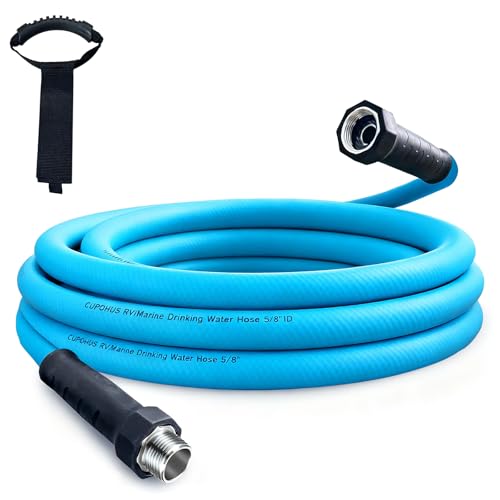
Cupohus 15FT RV Drinking Water Hose
The Camco heated drinking water hose has been on the market long enough to earn its reputation among full-time RVers. At 25 feet, it covers most hookup situations from a campground pedestal or residential outdoor faucet without excessive slack dragging across the ground. For travelers running between moderate-winter states, the -20°F rating covers the conditions most people will actually face.
Where this hose earns its stripes is in safety-minded construction. The inner hose carries an NSF/ANSI 61 drinking water certification (a third-party standard that verifies safe contact with potable water), and it’s made without lead, BPA, or phthalates, which matters because heated water sits in contact with the hose wall longer than cold water does. For anyone using it for livestock, a garden kennel, or a winterized cabin, that spec carries real weight.
Well-Handled Touches
- Built around a certified drinking-water liner, so the heated water stays safe for people and animals
- 25-foot length suits most standard RV hookups without leaving coiled slack to manage
- USA-made construction and a freeze threshold that covers the majority of populated winter zones
- Functions as a multi-purpose cold-weather hose for RVs, kennels, and garden taps alike
Things To Weigh Up
- Heavier than non-heated hoses because of the integrated heating cable
- Requires a standard electrical outlet at the hookup point to power the heating element
- Less ideal for run lengths above 25 feet since you’d need to chain additional hoses
Made For
RVers and property owners who need a no-fuss heated hose rated for typical winter freezes in most populated regions.
Look Elsewhere When
RVers stationed in far-north climates with extended sub-zero stretches should consider the HOHOMETIC 75FT Heated Water Hose for RV, which targets deeper cold thresholds.
HOHOMETIC’s 75-foot heated hose is built for the kind of cold that turns lesser hoses into ice plugs. The -45°F threshold, paired with an intelligent temperature adjustment feature that ramps the heating cable up as conditions drop, makes it the strongest defense on this list against deep-winter failures. The “4.0 Upgraded” tag points to refinements in the heating element and thermostat logic that older generations of heated hoses lacked.
The reach matters too. At 75 feet, it bridges the gap between distant water spigots and RV hookups in large campgrounds or rural properties. For full-timers wintering in the Rockies, the Dakotas, or interior Alaska, that extra cable length plus the lower freeze rating is the difference between running water and a frozen mess.
Strengths Worth Knowing
- Lowest freeze threshold in this roundup, engineered for arctic-grade conditions
- 75-foot length reaches spigots positioned far from the RV or cabin
- Self-regulating thermostat prevents constant power draw during milder spells
- Comes pre-fitted for direct RV hookup scenarios
Trade Offs
- Bulkier and heavier than shorter heated hoses, harder to coil neatly
- More expensive to run continuously because of the longer heated length
- Excess length can be cumbersome for short urban driveways
Key Specs
Right Fit For
Northern-tier full-time RVers and property owners who routinely deal with extended sub-zero temperatures.
A Better Fit Elsewhere
Anyone wintering in moderate climates will get more value from the Camco 25-Ft Heated Water Hose for RV, which costs less to run.
CircleRiver’s 100-footer trades a heating element for a wide temperature tolerance. The reinforced rubber hose stays flexible from -22°F up to 158°F, so it handles shoulder-season freezes and summer sun without cracking or stiffening. That’s a different solution to the winter-hose problem: rather than warming the water, it just refuses to fail across a broad weather range.
The 5/8-inch inner diameter gives it strong flow for RVs with larger tanks, and the 150 PSI burst rating means it’ll tolerate campsite pressure spikes that lesser hoses can’t. For travelers who spend winters in zones that dip below freezing but rarely stay there for weeks at a time, this is a sensible no-electricity option.
The Good Stuff
- Wide operating range covers everything from cold nights to hot summer afternoons
- Lead-free, BPA-free rubber liner keeps drinking water safe
- Aluminum fittings with sealing rings hold up under pressure variation
- 100-foot length bridges the longest hookup gaps at sprawling parks
Honest Caveats
- Not heated, so it won’t prevent freezing during sustained hard freezes
- Bulkier coil than smaller hoses, takes more storage space
- Rubber hose construction adds weight compared to lightweight TPU alternatives
Built With In Mind
RVers in transitional climates who want one hose for spring through fall without buying a heated model.
Reach For A Different Pick When
RVers wintering where the temperature holds below freezing for days need the HOHOMETIC 75FT Heated Water Hose for RV instead.
PLYPLYE brings a thermoplastic polyurethane (TPU) build to the garden hose category, which is a meaningful change from the PVC and rubber most people default to. TPU is lighter, more flexible in cold weather, and doesn’t shrink or harden the way PVC hoses tend to after a season or two in the shed. For gardeners who wrestle with stiff coils every fall, the weight difference alone is reason to look closer.
The 100-foot length covers most residential yards, and the all-weather rating means it’ll stay pliable through cool autumn mornings without fighting you as you unroll it. The drinking-water-safe material makes it usable for filling pet bowls or kiddie pools without concern.
Bright Spots
- TPU construction weighs up to half as much as comparable rubber hoses
- Lead-free and BPA-free, safe for people, pets, and gardens
- Flexible in cold weather for easier unrolling on chilly mornings
- Non-shrinking design keeps its original shape across seasons
Points To Note
- Not heated, so won’t protect against sustained freezing conditions
- TPU can be more vulnerable to punctures from sharp garden debris than thicker rubber
- Lightweight feel can lead to wandering if you don’t anchor it
Quick Facts
Whose Shelf It Belongs On
Homeowners and gardeners who want a versatile hose that handles shoulder-season cold without the heft of rubber.
Swap It Out When
Anyone needing freeze protection in prolonged cold should consider the RVGUARD 25FT Heated Water Hose instead.
The Flexi Hose takes a different approach altogether: it expands to roughly three times its stored length once water pressure hits it, then collapses back down when you shut off the tap. That means a 100-foot hose stores in a fraction of the space a traditional coil demands, which matters for apartment patios, small sheds, and anyone tired of wrestling with a stiff rubber coil.
The double latex core gives it elasticity, while the solid 3/4-inch brass fittings keep the connection points from cracking under pressure changes. The included 8-function nozzle adds versatility for watering, rinsing, and gentle shower settings. For gardeners in mild climates who want easy storage over freeze protection, this is a practical pick.
Everyday Advantages
- Collapses to a compact size for small-space storage
- Solid brass fittings resist corrosion and cracking
- No-kink flexibility makes it easier to maneuver around obstacles
- Multi-function nozzle covers a range of watering tasks
Small Caveats
- Latex core can be vulnerable to damage from freezing temperatures if water is left inside
- Outer fabric weave may wear faster than solid rubber under heavy abrasion
- Not designed for sustained winter use in hard-freeze zones
Best Suited To
Gardeners with limited storage space who want a lightweight, easy-to-coil hose for three-season use.
Not Your Match When
RVers needing freeze protection for camping should look at the Camco 25-Ft Heated Water Hose for RV instead.
RVGUARD’s 25-foot heated hose is built around a thermostat that does the thinking for you. It kicks on around 47°F and shuts off near 60°F, which means the heating cable isn’t burning electricity when conditions don’t warrant it. The 7 watts per foot heating density is on the higher side, helping the hose push back against cold faster when temperatures dive.
At 25 feet, it covers most residential and standard RV hookup distances, and it carries the same lead-free and BPA-free water safety you’d want for drinking or animal use. For owners who care about energy bills during long winter stays, the auto-switching thermostat is the headline feature here.
The Practical Payoff
- Auto-switching thermostat saves power during warmer stretches
- 7 watts per foot heating density warms water quickly
- Lead-free and BPA-free construction protects potable water
- 25-foot length suits standard campground and home hookups
Points To Keep In Mind
- Requires a grounded electrical outlet at the connection point
- Shorter length means chaining is necessary for longer runs
- -20°F freeze protection is less aggressive than the HOHOMETIC option
Feature Snapshot
Who Should Grab It
RVers and homeowners who want a thermostat-controlled heated hose that doesn’t waste electricity.
Consider Something Else When
RVers in extreme northern climates will find the HOHOMETIC 75FT Heated Water Hose for RV a stronger match.
Same engineering as the 25-foot RVGUARD, but trimmed down to 15 feet for tight setups where every foot of slack gets in the way. In campgrounds with water spigots positioned right next to the RV inlet, or in small yards where the hose just needs to bridge a short gap, the shorter length keeps the run tidy and reduces tripping hazards along the path.
You still get the smart thermostat, the lead-free liner, and the 7 watts per foot heating density. The freeze protection threshold is identical. For owners with predictable, short hookup distances, paying for extra hose length is money spent on coiled-up slack.
Advantages To Know
- Short length keeps the hose out of walkways and campsite paths
- Same thermostat and heating specs as the longer RVGUARD option
- Lower power draw due to less total heated length
- Easier to store in compact RV compartments
Some Limits To Know
- 15 feet may fall short for properties with distant spigots
- Requires an electrical outlet at the hookup, same as longer heated hoses
- Less forgiving for non-standard RV park layouts
Perfect Match For
RVers who consistently park at sites with water hookups placed close to the RV inlet.
Where Another Pick Suits Better
Owners needing more reach should consider the RVGUARD 25FT Heated Water Hose for additional flexibility.
Cupohus leans into stiffness as a feature rather than fighting it. The 20% thicker wall resists bending forces that create kinks in standard RV hoses, which means steady flow even when the hose is twisted around a tire well or draped over uneven ground. For larger groups running 150L-plus tanks, the 5/8-inch diameter moves water roughly 25% faster than 1/2-inch hoses, cutting fill time at low-pressure campsites.
The 15-foot length targets close-quarter hookups, and the construction stays consistent with the food-safe expectation for an RV drinking water line. It’s not heated, so its winter use is limited to conditions that don’t hold below freezing for long stretches.
Useful Highlights
- Thicker wall resists kinking better than standard RV drinking water hoses
- Wider 5/8-inch diameter moves water faster for larger tanks
- Reliable flow at low-pressure hookups common at older campgrounds
- Short length keeps the run tight in compact sites
Worth Bearing In Mind
- Stiffer construction means more effort to coil and store
- Not heated, so freezing conditions still pose a risk
- Shorter length limits use to nearby hookups
The Numbers That Matter
Who Will Love This
Group RVers and owners of larger freshwater tanks who want fast fill times at low-pressure sites.
Skip It When
Anyone facing prolonged winter freezes should reach for the HOHOMETIC 75FT Heated Water Hose for RV instead.
What To Weigh Before Picking A Winter Hose
Heated or non-heated is the first fork in the road. Heated hoses draw power at the hookup and cost more upfront, but they keep water flowing when ambient temperatures stay below freezing for days. Non-heated all-weather hoses cost less and need no electricity, but they’re only suitable when freezes are short and infrequent.
Climate Match
Matching the freeze rating to your actual winter conditions prevents overspending on a hose built for arctic conditions you won’t see. A -20°F rating covers most populated U.S. winter zones, while -45°F ratings target the northern tier and mountain regions. If your winters mostly hover around the freezing line without sustained deep cold, a non-heated option may be all you need.
Length And Reach
Longer hoses add versatility but also weight, storage bulk, and in the case of heated hoses, higher power draw. Measure the typical distance between your water source and hookup before settling on length. Chaining two hoses works in a pinch, but a single correctly-sized hose always performs better and avoids connection-point leak risks.
Water Safety
Drinking water safety matters more than people expect, especially in an RV where water sits in the hose longer than at a home tap. Look for hoses with lead-free and BPA-free certification if you’re filling tanks for drinking, cooking, or animal consumption.
Storage And Weight
Heated hoses are heavier because of the integrated heating cable, and they prefer a tidy coil to prevent damage to the internal wiring. Lightweight TPU and expandable hoses win on storage convenience but trade off some freeze resilience for it. Your storage space should guide the decision as much as your climate does.
Key Things Worth Knowing Before You Commit
Where Shoppers Go Wrong
The most common mistake is buying a non-heated hose and expecting it to survive a hard freeze. All-weather ratings describe flexibility, not active freeze prevention. Another slip-up is underestimating length needs and ending up with two short hoses chained together, which adds leak points and reduces flow.
When Paying More Pays Off
Higher-tier heated hoses earn their price through deeper freeze ratings, longer warranties, and smarter thermostats that reduce operating cost over time. If you winter in real cold, the upgrade pays back in fewer frozen-pipe emergencies and longer hose life. For mild climates, the premium isn’t justified.
Frequently Asked Questions
Do heated hoses use a lot of electricity?
Most heated RV hoses draw modest wattage per foot, and the better ones include a thermostat that cuts power when temperatures climb above the activation point. Actual draw depends on the model, length, and how often the heating cable cycles on.
Can I leave a heated hose plugged in all winter?
Heated hoses are designed for continuous connection during cold weather, since the whole point is automatic freeze protection. Owners commonly leave them plugged in for the duration of the winter season and unplug them once spring arrives.
How long do heated water hoses typically last?
Heated hoses tend to last several seasons with proper storage, though the internal heating cable can degrade if the hose is repeatedly kinked or crushed. Coiling loosely and storing indoors during the off-season extends service life.
Are all-weather garden hoses safe for RV drinking water?
Only if they’re labeled lead-free and BPA-free with drinking water certification. Standard garden hoses often contain materials that aren’t suitable for potable water, so always check the spec before using one for RV tanks.
Can I repair a heated hose if it stops working?
Most heated hoses aren’t designed for field repair, since damage to the heating cable creates safety risks. Replacement is usually the practical route when a heated hose fails, which is why picking a durable model from the start matters.
Wrap Up
The right winter hose comes down to matching your climate, hookup distance, and storage setup to the right level of freeze protection. Heated models solve the deepest cold, while all-weather and lightweight options handle milder winters without the electrical hookup requirement. Pick the one that fits how you actually use water in the cold months, and you’ll stop worrying about frozen lines for good.
