

A healthy lawn depends on consistent, even watering, and that starts with the right hardware below the surface. The right in ground sprinkler heads transform patchy, high-bill irrigation into a system that runs quietly while you focus on other weekend projects. This guide looks at eight solid options across pop-up sprays, gear-drive rotors, impact heads, and replacement nozzles for different yard shapes and water pressures.
A Closer Look At The Lineup

Rain Bird 1804VAN 1800 Series Pop-Up Sprinkler Head

Orbit 55201 Pulse XL Pop-Up Impact Sprinkler

Rain Bird 32SA Gear Drive Rotor 19–32 ft

Rain Bird CP3504PC Rain Curtain Professional Rotor
Orbit 58565N H2O-Six Gear-Drive Sprinkler

LIULO TOOL 2-Pack Gear Drive Sprinklers

HolyMaji 10-Pack Variable Arc Nozzles (12AN)
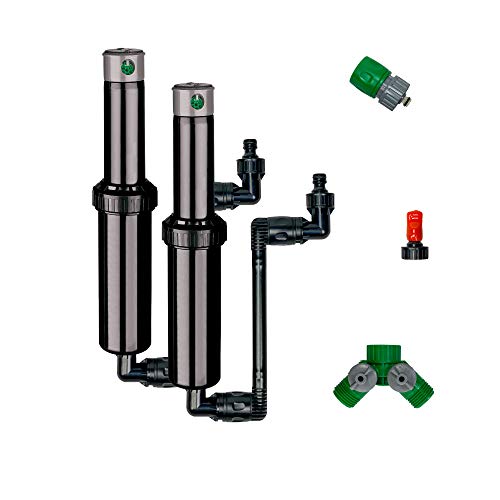
Quick-Snap QSK-742 In-Ground Pop-Up 2-Pack
A Closer Look At Each Pick
Pop-up spray heads like the Rain Bird 1804VAN sit flush with the lawn when idle and rise four inches once water pressure kicks in. That disappearing act matters for homeowners who mow regularly and don’t want a forest of stakes to dodge. The unit threads onto a standard half-inch riser, making it a common upgrade target when older systems start leaking or losing pressure at the nozzle.
The variable arc nozzle (a nozzle whose spray angle can be set anywhere between zero and full circle) means you can dial the coverage to match curved beds or narrow strips without swapping parts. For mixed lawns where a quarter-circle hits one corner and a full sweep handles the open middle, this single head earns its keep. Compared to the Orbit Pulse XL coming up next, this is a gentler spray suited to closer-in turf rather than long-distance throws.
Positive Takeaways
- Adjustable arc from zero to full 360 degrees lets you match coverage to curved or oddly shaped beds.
- Standard half-inch female threaded inlet fits most residential manifolds and replacement risers.
- Four-inch pop-up height clears most grass types and low ground cover without leaving dry spots close to the head.
- Variable arc nozzle is field-replaceable, so a clogged or damaged tip can be swapped without digging up the body.
Things To Consider
- Short throw distance means more heads per zone, which can raise trenching time during full-yard installs.
- Pop-up sprinklers with fixed spray patterns tend to mist more in heavy wind compared to rotor-style heads.
Key Specs
Built With In Mind
Homeowners with medium lawns mixing curved planting beds and open turf who want a serviceable, widely supported spray head.
A Better Fit Elsewhere
The Rain Bird 32SA Gear Drive Rotor suits larger open areas where one head can throw water further, reducing total head count.
Impact sprinklers work differently than spray heads. Instead of a fan of water, they use a weighted arm that slaps the stream repeatedly, breaking it into pulses that travel further. The Orbit 55201 Pulse XL hides inside a canister and rises when activated, so you get that long-distance throw without an above-ground tripod sprinkler cluttering the yard.
Where this head earns its reputation is on tough water supplies. If your irrigation runs on reclaimed, well, or mineral-heavy municipal water, the double-weighted impact arm keeps the mechanism cycling when a standard spray nozzle would clog after one season. Compared to the Rain Bird 1804VAN we just covered, this is a rotor built for dirty water and wide-open turf rather than tight beds.
The Practical Payoff
- Designed to keep cycling through mineral-laden, dirty, or reclaimed water where spray nozzles typically clog.
- Adjustable arc from 20 to 360 degrees lets you target irregular strips without sacrificing throw distance.
- Pop-up canister design hides the head flush with the lawn when the system is off.
- Impact mechanism handles higher pressures without significant misting or pattern breakup.
Worth Noting
- The clicking impact action is noticeably louder than gear-driven rotors, which may matter near bedroom windows.
- Heavier water hammer (pressure surge when the valve snaps shut) is common with impact heads, so a pressure regulator is worth considering.
Made For
Property owners with mineral-heavy or reclaimed water sources who need a clog-resistant rotor for wide-open lawn zones.
Consider Something Else When
The Rain Bird CP3504PC Rain Curtain Professional Rotor is a quieter, gear-driven option for exposed yards where wind drift and noise are concerns.
Gear-drive rotors use internal gears to rotate a single nozzle stream slowly across the lawn, producing large droplets that resist wind drift better than fine spray. The Rain Bird 32SA throws between 19 and 32 feet depending on nozzle choice, which makes it a strong middle-ground option for yards that are too big for spray heads but don’t need a 40-foot commercial-grade throw.
One of the quieter details in the spec sheet is the water-lubricated gear mechanism. Instead of relying on greased parts that can seize or wash out over time, the flowing water keeps the internals moving, which tends to extend service life in systems that run daily through summer. Compared to the impact-style Orbit above, the 32SA runs nearly silent, a meaningful difference if your zones run near outdoor living spaces.
Strengths Worth Knowing
- Water-lubricated gear drive avoids grease washout and tends to outlast lubricated alternatives in daily-use systems.
- Rain Curtain nozzle technology produces larger droplets that hold up better in light wind than fine mist.
- Pattern adjustment from the top with a flat-blade screwdriver, no digging required to fine-tune the arc.
- Throw range of 19 to 32 feet covers medium lawns with fewer heads than spray-only zones.
Room For Improvement
- Full-circle rotation only, so partial-arc zones need a different rotor or a separate part swap.
- Sediment in supply water can shorten gear life without a basic inline filter upstream.
Quick Facts
The Right Fit
Homeowners with mid-size rectangular lawns who want quiet, gear-driven rotation and straightforward arc adjustment.
Look Elsewhere When
The Orbit 58565N H2O-Six suits yards needing multiple spray patterns in a single head rather than a dedicated full-circle rotor.
The CP3504PC sits in a slightly different category from the 32SA above. It’s a professional-grade rotor with a wider throw band (15 to 35 feet) and a set of interchangeable nozzles that let you tune precipitation rate, the speed at which water lands on a given area, to match the rest of the zone. For mixed-vintage systems, that flexibility prevents the common problem of one head out-pacing another.
The standout engineering note is the Rain Curtain nozzle design, which intentionally produces large droplets close to the head and finer droplets further out. That staggered droplet profile fights wind drift better than rotors producing a single droplet size, which matters in exposed yards without windbreaks. If you’ve watched misting spray heads evaporate sideways on breezy afternoons, the difference shows up immediately.
Why It Works Well
- Six interchangeable nozzles let you match precipitation rate across mixed head types in the same zone.
- Large droplet design resists wind drift, keeping water on target in exposed yards.
- Close-in watering reduces dry rings around the head base where turf often struggles.
- Accepts non-potable water supplies, which broadens installation options where reclaimed water is available.
Trade Offs
- Full-circle only, so partial-arc zones require a different rotor or nozzle configuration.
- Premium tier pricing relative to entry-level rotors, even though the throw band overlaps the 32SA’s.
Best Suited To
Landscapers and serious DIYers managing exposed, breezy yards where wind drift and uneven precipitation have been ongoing problems.
Skip It When
The Rain Bird 32SA Gear Drive Rotor covers the same general use case at a lower tier for yards that don’t face serious wind exposure.
Most rotors lock you into a fixed pattern: a full circle, a half circle, a quarter circle. The Orbit 58565N H2O-Six sidesteps that limitation by offering six interchangeable spray patterns in a single head, switched by rotating the nozzle to a click-stop position. For a yard that mixes a wide lawn with a narrow side strip and a curved flowerbed, that flexibility removes the need to stock multiple rotor bodies.
Adjustment is tool-free on the spray side. The collar tabs slide to fine-tune the throw distance, and the pattern swaps by hand without unscrewing anything. That ease of use is genuinely valuable during seasonal tuning, when plants have grown and the original layout no longer matches the yard. Compared to the more specialized Rain Bird CP3504PC we covered earlier, this is a generalist pick favoring convenience over maximum throw refinement.
What Earns Its Place
- Six spray patterns in one head reduce the need to buy multiple rotor types for one yard.
- Tool-free pattern changes speed up seasonal adjustments when planting layouts shift.
- Gear-drive operation runs quieter than impact sprinklers, an underrated benefit near seating areas.
- Pattern clicks firmly into position, so vibration during operation doesn’t drift the setting.
A Few Limitations
- Versatility trades off against peak throw distance, so very large open areas may need a longer-throw dedicated rotor.
- Pattern changes are finger-adjusted, which means gritty water can make the dial stiffer over time without periodic rinsing.
Feature Snapshot
Perfect Match For
Homeowners with oddly shaped yards who want one head that adapts as plantings change across seasons.
Another Choice May Suit
The LIULO TOOL 2-Pack suits temporary or seasonal installs on spike bases where permanent trenching isn’t planned.
Most entries in this roundup are permanent in-ground heads tied to buried lateral lines. The LIULO TOOL 2-Pack breaks that mold by sitting on a spike base you push into the soil, with three-quarter-inch adapters for hooking up to a standard hose or a manifold feed. Two units in the box let you cover opposing corners or run sequential zones with a splitter.
The gear-drive internals spin through five distinct spray patterns, from a focused jet to a vertical fountain. That range is unusual at this price tier, where competing spike sprinklers usually offer one or two fixed patterns. The trade-off, of course, is that a spike base sits above ground rather than retracting into the lawn, so it isn’t a true “in-ground” install in the contractor sense.
A Few Strong Suits
- Spike-base install skips trenching entirely, so setup takes minutes rather than a weekend.
- Five spray patterns cover everything from a narrow jet to a full vertical column for garden beds.
- Two-pack format and three-quarter-inch adapters support multi-unit linking across larger yards.
- Gear-drive operation holds up better than impact-style spike sprinklers in the same budget tier.
Points To Note
- Above-ground spike base means tripping and mowing hazards that flush in-ground heads avoid.
- Nozzle adjustments are plastic-threaded, so over-tightening during pattern changes can strip the housing.
Whose Shelf It Belongs On
Renters and seasonal gardeners who can’t trench permanent lines but still want gear-driven spray patterns instead of a basic oscillating sprinkler.
Not Your Match When
The Quick-Snap QSK-742 suits permanent in-ground installs where flush mounting and a contractor-style look matter more than portability.
Sometimes the problem isn’t the sprinkler body but the nozzle on top. The HolyMaji 10-pack ships ten replacement variable arc nozzles, sized 12AN, that fit most pop-up spray heads with adjustable arcs. For a system that has uneven coverage because some nozzles have cracked, worn, or mineral-furred tips, replacing just the nozzles is faster and far cheaper than digging up entire bodies.
The textured top edge lets you rotate the spray pattern from zero to 360 degrees by hand. That’s useful when beds have expanded since the original install and the old fixed arc now overshoots onto a walkway. Compared to the Rain Bird 1804VAN covered earlier, this isn’t a complete head, it’s the consumable wear part, which makes the 10-pack format a practical maintenance buy for households with aging systems.
Noteworthy Benefits
- Ten-pack format covers a full yard’s worth of nozzles in one purchase, with spares for future replacements.
- Adjustable arc from zero to 360 degrees by rotating the textured top edge.
- 12AN sizing matches a wide range of common pop-up bodies, so compatibility surprises are less likely.
- Replacement-only install skips the trenching and thread-taping needed for full head swaps.
Honest Caveats
- Nozzles alone won’t fix bodies with damaged risers or cracked canisters, so a full head swap may still be needed in worst cases.
- Cheaper molded plastics can fade faster in full-sun exposures than OEM nozzles from major irrigation brands.
Right Fit For
Homeowners with existing pop-up systems whose coverage has degraded from worn nozzles rather than failed bodies.
Swap It Out When
The Rain Bird 1804VAN Pop-Up Sprinkler Head is the better starting point for full installs where bodies and nozzles both need replacing.
The Quick-Snap QSK-742 takes the in-ground concept and strips out the hard part: the plumbing. Each head connects to a standard garden hose via quick connectors, and the included splitter lets you run both heads from a single outdoor faucet. There’s no PVC to glue, no manifold to assemble, just a hose, a stake, and the lawn.
Coverage per head reaches up to roughly 5,000 square feet, and the heads retract when the water shuts off so you can mow straight over them. For someone who wants the flush look of an in-ground system without committing to a full irrigation build, this is a meaningful middle ground. Compared to the more permanent Rain Bird 32SA covered earlier, the QSK-742 trades professional-grade durability for weekend-install simplicity.
What Stands Out
- Quick hose connectors skip the PVC primer and cement step that intimidates first-time installers.
- Retracting design allows safe mowing across the head without trimming around it.
- Each head covers a large area, reducing total head count for typical suburban lawn sizes.
- Two-pack plus splitter means a complete starter kit arrives in one box.
Soft Spots
- Hose-fed design limits water pressure compared to a dedicated irrigation lateral, which can shorten throw in some yards.
- Plastic quick-connect fittings wear faster than threaded PVC under daily seasonal use.
Who Should Grab It
First-time installers who want the appearance of an in-ground system without the cost or complexity of a full PVC manifold build.
Where Another Pick Shines
The Rain Bird CP3504PC Professional Rotor is the right step up for homeowners ready to commit to a permanent, professional-grade system.
What Matters Most When Choosing In Ground Sprinkler Heads
Match The Head Type To The Zone
Spray heads, rotor heads, and impact heads behave very differently in the same yard. Spray heads throw short distances (under 15 feet) with a fine fan, which suits narrow strips, curved beds, and tight layouts. Rotor heads throw much further with a single rotating stream, ideal for open lawn rectangles where fewer heads can cover more ground. Impact heads, like the Orbit Pulse XL, sit between the two and excel in dirty-water conditions where spray nozzles would clog. Choosing by zone shape rather than by brand tends to deliver more even coverage.
Check Pressure And Water Quality First
Your supply water shapes which head types will actually last. A fine spray head on a high-mineral well will scale up and clog within a season, while a gear-drive rotor with water-lubricated internals handles that water much better. Low pressure (under 30 PSI) hurts rotor performance more than spray performance, so a pressure check before buying saves mid-summer frustration. A simple inline filter upstream of any pop-up zone extends the life of nozzles considerably.
Consider Adjustability Versus Simplicity
Fixed-arc heads are easier for beginners because there are fewer dials to set. Variable arc and pattern-adjustable heads cost more up front but pay off when plantings change, or when you discover a zone overlaps a walkway after the first run. For most homeowners with evolving landscapes, adjustable heads reduce the temptation to abandon irrigation altogether after a single frustrating season.
Key Considerations Across These Picks
Common Buying Traps
The most common slip-up is matching throw distance to the open space rather than to head spacing. A rotor throwing 30 feet covers a circle 60 feet across, but two heads spaced 30 feet apart will overlap heavily, wasting water and starving the middle of the lawn. Measure actual spacing in your yard first, then pick a head whose throw roughly matches head-to-head distance.
Another trap is buying spray heads for areas larger than 15 feet across, then discovering dry spots mid-zone. Rotor heads cost more per unit but reduce total head count and improve uniformity. Conversely, putting a long-throw rotor in a five-foot flowerbed produces overspray onto siding and walkways. Match the head’s natural throw band to the dimensions of the zone it covers.
What The Higher Tier Buys
Premium rotors like the Rain Bird CP3504PC earn their tier through nozzle engineering, not raw throw distance. Wind-resistant droplet profiles, interchangeable nozzles for precipitation matching, and closer-in watering all add up to measurable reductions in water waste and dry spots. For exposed yards or systems where runoff has been a chronic problem, the upgrade pays back through lower water bills and healthier turf within a couple of seasons.
Entry-level rotors cover the basics but tend to lock you into fixed patterns and smaller throw bands, leading to head-count bloat across larger yards. The honest read is that mid-tier and premium rotors suit permanent installs where you want to set the system once and tune it occasionally, while budget rotors suit temporary or smaller-scale projects.
Frequently Asked Questions
How deep should in ground sprinkler heads be installed?
Most pop-up heads sit with the canister top roughly at grade level, so the cap is flush with the soil. Trenching depth typically runs six to twelve inches depending on local frost line and pipe sizing. Setting the cap slightly below grade prevents the mower from catching it while still allowing the nozzle to rise fully.
Can I mix spray heads and rotor heads in the same zone?
Mixing them in the same zone creates uneven watering because spray heads and rotor heads deliver water at different rates. Sprays apply water faster than rotors, so areas near spray heads flood while rotor-only sections stay thirsty. The accepted practice is to run sprays and rotors on separate zones, or to use precipitation-matched nozzles that equalize the application rate.
How often should sprinkler nozzles be replaced?
Variable arc nozzles typically last several years before the arc adjustment loosens or the pattern distorts from mineral buildup. In areas with hard water, annual cleaning and replacement every two to three years is common. A nozzle that sprays unevenly or refuses to hold its arc setting is a clear signal it’s due for a swap.
What causes pop-up sprinkler heads to stop rising?
The most common cause is a cracked canister that leaks pressure, so the head never builds enough force to lift. Debris around the riser seal can also jam the pop-up mechanism, and a broken retraction spring will leave the head stuck in the up position. Diagnosing usually starts with digging up the head to inspect the body and seal before assuming a valve problem upstream.
Do impact sprinklers use more water than rotor sprinklers?
Impact sprinklers don’t inherently use more water than rotors, but their higher typical operating pressure can drive up consumption if the system pressure isn’t regulated. Modern rotors with matched nozzles can deliver equal precipitation at lower pressure. The right metric is gallons per square foot delivered, not gallons per minute at the head.
Bottom Line
A yard’s irrigation system is only as good as the heads sitting at the ends of its lateral lines. The right pick depends on zone shape, water quality, and how much tuning you want to do over the years. Start with the head type that matches your zone dimensions, verify your pressure and water supply, and let the rest of the decision follow from there. A well-matched set of heads turns watering from a chore into a quiet background task.
