

High branches shouldn’t mean dragging out a ladder. The right long reach pruner lets you trim overhead growth from solid ground, save your shoulders, and actually enjoy yard work on a Saturday morning. Whether you’re tidying a small orchard, picking apples, or clearing storm damage, this roundup focuses on real reach, real cutting power, and tools that feel balanced after an hour of use, not five minutes.
A Fast Comparison Of The Options

Corona TP 3206 SwivelCUT Long Reach Pruner

Corona TP 6870 RazorTOOTH 14-ft. Tree Pruner
LETYANGER 7.3-27FT Extendable Pole Saw
Mesoga 6FT Cut & Hold Pruner

GARTOL Telescopic Pole Pruner 6.23-10.5 FT

Corona BP 6250 MAXFORGED Bypass Pruner

GARTOL Telescopic Pole Pruner 3.67-5.45 FT
YRTSH Compound Action Loppers
The Details Behind The Selections
The Corona TP 3206 SwivelCUT earns its place as a practical starter for homeowners who mostly wrestle with branches around the eaves and mid-canopy, not the tops of mature oaks. Its rotating, tilting, and swiveling head is the standout feature, and it solves a problem most fixed-angle poles can’t: getting a clean cut when the branch doesn’t sit where you want it. In a typical suburban yard with mixed ornamental trees, that flexibility saves real time.
The handle includes an oval rubberized end-grip that adds a few extra inches of effective reach and stays comfortable during long sessions. At a stated 1¼ inch cutting capacity, it handles most green wood and thinner deadwood without straining. For anyone stepping up from a basic clipper, the tool feels like a meaningful upgrade without crossing into ladder-replacement territory.
Useful Strengths
- Swiveling head reaches awkward angles without repositioning the whole pole
- Oval rubberized end-grip adds usable reach and reduces hand fatigue
- 1¼ inch cutting capacity handles most home pruning tasks
- Lightweight build keeps the tool manageable overhead for extended sessions
Things To Consider
- Rope pull system can tangle over time, so periodic untangling is part of ownership
- Reach is modest for very tall trees, where the Corona TP 6870 RazorTOOTH stretches much higher
Quick Facts
Made For
Homeowners with mid-height ornamental trees and shrubs who want overhead cuts without leaving the ground.
Consider Something Else When
You need to reach well above a single-story roof, where the Letyanger 7.3-27FT Extendable Pole Saw offers dramatically more extension.
The Corona TP 6870 is the tool for serious overhead work where the smaller SwivelCUT model would force you to compromise. Its 14-foot reach, compound action cutting head, and a curved 13-inch razor tooth saw blade make this a hybrid pruner and pole saw, which is exactly what orchard owners and homeowners with mature trees need. Pulling the rope and sawing at full extension still demands a steady stance, but the long foam grip helps absorb vibration.
Where the first Corona leans into flexibility, this one leans into authority. Dual compound action multiplies hand force so cuts through thicker limbs feel less like a workout. In our view, this is the model that turns pruning from a chore into something closer to actual tree maintenance, and it tends to suit anyone managing more than a couple of mid-sized fruit or shade trees.
Well-Handled Touches
- 14-foot reach handles mature trees without ladder work
- Compound action multiplies hand force for cleaner cuts through thicker limbs
- Curved 13-inch razor tooth saw tackles branches too thick for bypass cutting
- 24-inch foam grip reduces vibration and hand strain during long sessions
Points To Keep In Mind
- Long pole requires more clearance and a wider working stance
- Two-piece setup (pruner head plus saw blade) adds weight compared with single-function pole tools
Who It Suits Best
Orchard keepers and homeowners with tall shade trees who need both a pruner and a saw in one reach.
Look Elsewhere When
Your trees are shorter and your main goal is harvesting apples, where the Mesoga 6FT Cut & Hold Pruner offers a lighter grab-and-cut approach.
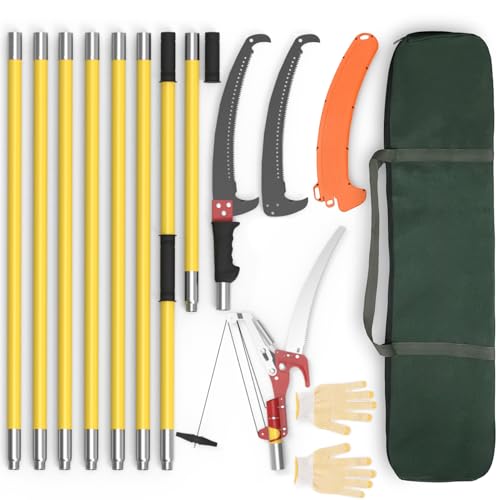
The Letyanger kit takes a different approach from the dedicated single-piece tools above. Seven connectable poles build out a reach of roughly 7.3 to 27 feet, which puts second-story and even taller canopy branches within striking distance from ground level. The set ships with a saw head, a pruner head, a spare saw with sheath, and a carry bag, so you get a complete system rather than a single tool.
The rods combine epoxy resin with aluminum alloy joints, and the saw blades use 65 Mn alloy steel, which is a common choice for aggressive wood-cutting edges. In real terms, that means the kit favors homeowners with varied jobs, from trimming tall ornamental grass clumps to clearing storm-damaged limbs. Reach is the headline feature, and it delivers, though fully extended length introduces flex that you feel on the heaviest cuts.
Features That Help
- Adjustable reach up to 27 feet tackles branches above a single-story roof
- Modular design collapses into a carry bag for storage in a shed or garage
- Includes both a bypass-style pruner head and a spare saw blade
- Alloy steel blades stay serviceable across many pruning seasons
Honest Caveats
- Maximum reach can feel flexible, which makes precision cuts at full extension harder to control
- Multi-piece connection points need occasional checks to stay tight
Best Suited To
Homeowners with very tall trees or two-story rooflines who want one kit that covers multiple job types.
A Better Fit Elsewhere
Compact urban gardens where the GARTOL 3.67-5.45 FT Telescopic Pruner handles the same tasks at a fraction of the storage footprint.
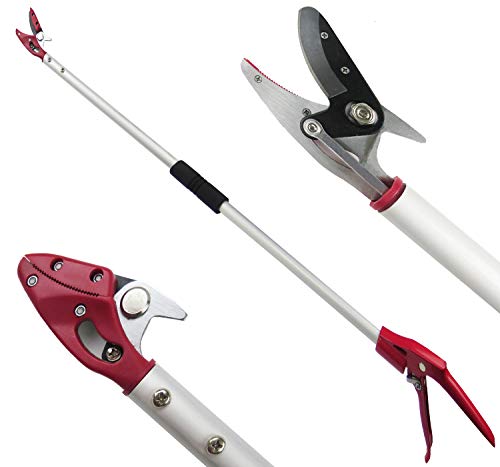
The Mesoga 6FT focuses on a different kind of reach: the kind that lets older gardeners and casual homeowners harvest fruit without climbing, bending, or dragging out equipment. The aluminum pole weighs roughly 1.43 pounds, which is light enough to swing one-handed overhead for a few minutes at a time. A 90-degree rotating head lines up cleanly with branches that don’t sit conveniently in front of you.
The real trick is the cut-and-hold grip. After the blade closes, the jaws clamp onto the severed stem so it doesn’t drop into the lawn or, worse, onto the roof. For anyone picking apples, pears, or plums, that single feature changes the workflow. It also trims without the rope-pull complexity of taller pole saws, which is a meaningful simplification for shorter sessions.
Points In Its Favor
- Cut-and-hold grip secures fruit and stems before they fall
- 1.43-pound aluminum pole reduces shoulder fatigue during overhead use
- 90-degree rotating head improves cut accuracy on awkward angles
- Simple manual operation requires no rope management
Worth Noting
- 6-foot total reach limits use to lower branches and small fruit trees
- High-carbon steel blade needs wiping and occasional sharpening to stay clean
Who Will Love This
Older gardeners, accessibility-focused users, and anyone harvesting from small backyard fruit trees.
Skip It When
You want to reach higher than one story, where the GARTOL Telescopic Pole Pruner 6.23-10.5 FT adds significantly more extension.
The GARTOL Telescopic Pole Pruner covers the awkward middle ground between the short Mesoga tool and the towering Letyanger system. Its 6.23 to 10.5-foot reach adjusts in stages, which is enough for most single-story rooflines and the tops of small fruit trees, yet still manageable for tighter gardens where a 27-foot extension would be overkill. The aluminum construction keeps the weight down even when fully extended.
A rotating blade head tackles awkward angles, and the cut-and-hold grip holds onto the severed stem so it doesn’t drop into a neighbor’s yard or onto a flowerbed. For homeowners managing mixed hedges, fruit trees, and ornamental shrubs, this is the kind of tool that ends up in the trunk of the car more often than it lives in the shed.
Strong Points
- Telescoping aluminum shaft adjusts from 6.23 to 10.5 feet
- Rotating blade head improves cut alignment on crooked branches
- 1-inch cutting capacity suits typical home garden branches
- Cut-and-hold grip secures fruit and twigs after each cut
Small Caveats
- 10.5-foot maximum reach won’t replace a ladder for very tall trees
- Locking collars at full extension should be checked before heavy overhead use
The Right Fit
Homeowners with mixed gardens who want one adjustable tool for hedges, fruit trees, and ornamental shrubs.
Not Your Match When
You’re working strictly below shoulder height, where the Corona BP 6250 Bypass Pruner offers better hand-control precision.
The Corona BP 6250 isn’t a long reach tool in the pole-and-rope sense. It’s a hand pruner, and it’s included because precision pruning is part of the same workflow that drives people toward pole tools in the first place. Once you’ve trimmed the overhead branches, the close-up work on rose canes, fruit tree suckers, and shrub interiors still demands a sharp, controlled hand tool. The MAXFORGED steel blade delivers scissor-like cuts on stems up to an inch thick.
Forged steel blades are tougher than stamped steel, which is why the BP 6250 holds an edge through dense seasonal use. The aluminum body drops weight without dropping strength, and the replaceable blade design extends the tool’s working life well past typical consumer pruners. In most gardens, this is the hand tool you’ll reach for before and after using any of the pole options above.
Benefits That Matter
- Forged steel blade holds an edge through repeated heavy use
- 1-inch cutting capacity handles woody stems and live growth
- Replaceable blade design extends the tool’s working lifespan
- Aluminum frame balances durability with light weight
Practical Considerations
- Hand pruner only, so it doesn’t extend your reach on its own
- Non-slip grip benefits from occasional cleaning to maintain tackiness
Quick Facts
Perfect Match For
Homeowners and serious gardeners who want a durable, sharp hand tool for close-up pruning alongside their pole equipment.
Another Choice May Suit
Your work is exclusively overhead, where the Mesoga 6FT Cut & Hold Pruner keeps you on the ground without sacrificing cut quality.
This shorter GARTOL model is the sibling to the 10.5-foot version above, sharing the same rotating blade head and aluminum telescoping shaft but reaching just 3.67 to 5.45 feet. That compact range suits gardeners who mostly manage berry bushes, hedge tops, and lower ornamental branches without needing to extend above head height. It also stores easily in a closet or car trunk, which matters for renters and small-yard owners.
The shorter pole improves control, since flex decreases as length drops. For tight spaces around raised beds or between established shrubs, this kind of maneuverability often matters more than raw reach. You won’t roof-prune a two-story house with it, but you also won’t overshoot the tool’s design the way some users do with full-size pole pruners.
Strengths Worth Knowing
- Short reach range improves control in tight garden spaces
- Telescoping aluminum shaft stores compactly
- Rotating blade head handles angled cuts around shrubs
- 1-inch cutting capacity matches typical shrub branch thickness
Where It Is Less Suited
- 5.45-foot maximum reach limits use to mid-level branches
- Not designed for tall tree work, so heavier orchard jobs fall outside its scope
Built With In Mind
Apartment gardeners, renters, and homeowners with low hedges and shrubs who want precision over height.
Reach For A Different Pick When
You need true overhead reach for taller trees, where the GARTOL 6.23-10.5 FT Telescopic Pruner offers the same controls with much more extension.
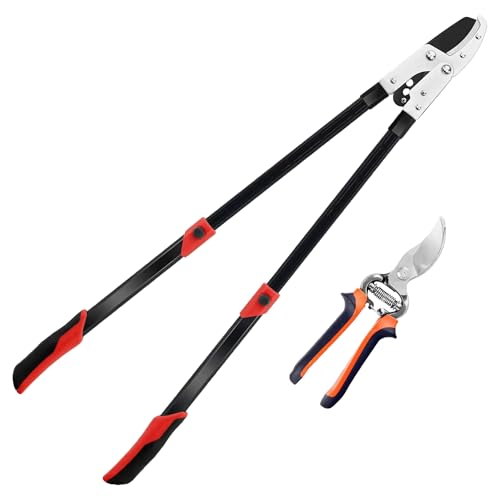
The YRTSH Loppers round out the list as a heavy-duty hand tool rather than another pole. Compound action is a mechanism that uses multiple pivot points to multiply the force your hands apply, so a branch that would crush a standard lopper cuts through with less effort. The Teflon-coated alloy steel blade reduces friction, which helps on thicker green wood and keeps sap from gumming up the cut.
For ground-level cleanup after using any of the reach tools above, this is the lopper that handles whatever falls or remains. It leans into raw cutting power rather than finesse, so it complements the precise Corona BP 6250 nicely. Where a bypass pruner makes surgical cuts, compound loppers chew through the thick stuff, and that distinction matters in real yards.
The Good Stuff
- Compound action multiplies hand force for easier thick cuts
- Teflon-coated blade reduces friction and resists sap buildup
- Alloy steel edge stays serviceable across tough jobs
- Suits older gardeners who want mechanical advantage over raw grip strength
Things To Weigh
- Hand tool only, so it pairs with rather than replaces a pole pruner
- Teflon coating can wear over years of heavy contact with woody stems
Whose Shelf It Belongs On
Homeowners clearing storm debris, maintaining mature shrubs, or pruning thicker branches that overwhelm bypass pruners.
Swap It Out When
Most of your cuts happen above shoulder height, where the Corona TP 6870 RazorTOOTH 14-ft. Tree Pruner keeps you on solid ground.
What Matters Most Before Choosing Long Reach Pruners
Reach vs. Control Trade-Offs
Longer poles mean wider access, but every extra foot adds flex and weight that reduces cut accuracy. For orchard work or two-story trees, the Letyanger 27-foot kit or the Corona TP 6870 RazorTOOTH earn their length. For tight garden beds and shrub shaping, the shorter GARTOL 5.45-foot model trades height for control.
Cutting Capacity and Blade Type
A pole pruner with a 1-inch cut handles most living branches, while 1¼ inch capacity adds room for thicker deadwood. Bypass blades (two curved blades that pass each other like scissors) make cleaner cuts on live wood, while saw blades tackle anything thicker than the bypass head can manage.
Weight and Ergonomics
A long aluminum pole can weigh noticeably less than steel, which matters during overhead work. The Mesoga at roughly 1.43 pounds shows how light a tool can be without sacrificing strength, and foam grips like those on the Corona TP 6870 reduce vibration on long sessions.
Cut-and-Hold vs. Drop Cuts
Cut-and-hold jaws grip the severed stem before it falls, which protects lawns, flower beds, and bystanders. For fruit harvesting in particular, this feature removes the most frustrating part of the job.
Key Considerations Across These Picks
Mistakes Worth Dodging
The most common slip in this category is buying the longest pole available when the yard only needs a 6-foot tool. Extra reach adds flex that hurts cut quality, and many shoppers end up with a tool that’s harder to control than the shorter alternative. Match the pole length to your tallest reachable branch, not the theoretical maximum.
Another frequent miss is choosing a pruner without confirming whether the blade cuts live wood, dry wood, or both. Bypass pruners excel at live growth, while saw blades handle thicker dry limbs that would jam a bypass head.
Where The Extra Money Goes
Higher-tier models in this category typically invest in forged or alloy steel blades, compound action mechanisms, and modular reach systems. The Corona TP 6870 RazorTOOTH, for example, adds a saw blade and dual compound action that simply don’t exist on entry-level pruners. You pay for cleaner cuts, less effort, and longer service life, which matters if your yard sees weekly pruning rather than seasonal touch-ups.
Frequently Asked Questions
How long should a long reach pruner be for a single-story home?
A 6 to 10-foot reach covers most single-story rooflines and standard backyard trees. Going beyond that adds flex and weight without much practical benefit for shorter homes.
Can long reach pruners handle thick branches?
It depends on the cutting capacity and blade type. Bypass pruners with 1-inch capacity handle typical live growth, while pole saws like the Corona TP 6870 RazorTOOTH tackle thicker dry wood with a separate saw blade.
Are telescoping poles as strong as fixed-length poles?
Telescoping poles use locking collars that hold firmly under normal use, but fixed-length poles have fewer joint points and slightly more rigidity. For routine pruning, modern telescoping designs hold up well.
How do I maintain a long reach pruner?
Wipe the blade clean after each session, occasionally sharpen the cutting edge, and check rope or collar connections for wear. A light oil coat on metal surfaces prevents rust during off-season storage.
Is cut-and-hold worth it for non-fruit trees?
It helps anywhere you’d rather not drop branches onto a lawn, flower bed, or roof. The feature shines during fruit harvest but remains useful for general cleanup work.
Wrap Up
The right long reach pruner depends on how high you actually need to go and how often you prune. Shorter telescoping tools reward tight gardens and routine shaping, while taller pole saws and orchard-grade pruners earn their place under mature canopies. Match the tool to your tallest task, and you’ll find the work feels lighter from the first cut.
