

Growing edible or medicinal mushrooms at home turns a spare closet, basement corner, or kitchen nook into a small production line. The right enclosure controls humidity, blocks stray light, and keeps contaminants out, all of which decide whether a flush (a wave of mushroom growth) thrives or stalls. This roundup walks through eight options built around the two main approaches: Martha-style grow tents (tall, lightproof grow chambers for fruiting blocks on shelving) for fruiting, and still air boxes (sealed clear plastic workspaces for sterile inoculation) plus monotubs (plastic tubs used as self-contained fruiting chambers) for inoculation work.
The Picks In Brief

Pure Garden 3-Tier Mini Greenhouse (27.5x19x50″)
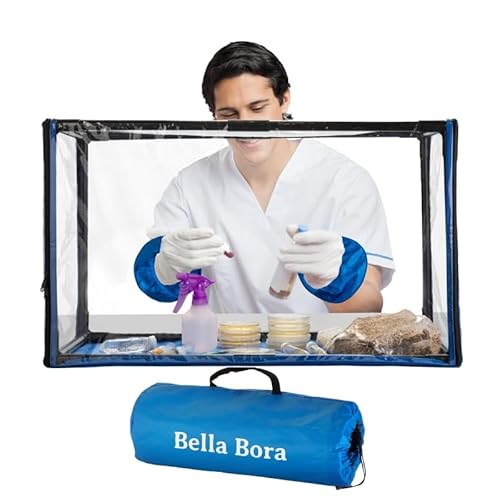
Bella Bora Still Air Box Mycology Mushroom Grow Box V2

VIVOSUN Small Grow Tent 20″x14″x21″ Mylar

Boomer Shroomer Inflatable Monotub Kit

MELONFARM 24″x16″x24″ Mylar Grow Tent

Lovely Ran Large Still Air Box Mushroom Grow Kit (31.5″)

Salcod Large Still Air Box Mushroom Grow Tent 38″

Myco Labs Mushroom Monotub 66Q Grow Kit
A Breakdown Of The Leading Choices
Most dedicated mushroom enclosures focus on a single stage, but this mini greenhouse from Pure Garden pulls double duty. Three wire shelves, each roughly 27.5 inches long and 18.5 inches wide, give you room to stack fruiting blocks (colonized substrate bags ready to produce mushrooms), trays, or small pots vertically instead of spreading out across a counter.
The PVC cover zips closed around the steel-tube frame to lock in humidity and keep dust and pests off developing pins (baby mushrooms just emerging from the substrate). Powder-coated iron tubing holds up to heavier containers without sagging. Apartment growers with a patio, deck, or bright sunroom get the most from this format, since it transplants easily between seasons.
What Helps Most
- Three tiers stack vertically, multiplying your footprint in tight rooms
- Powder-coated steel frame resists rust on covered porches
- Roll-up zippered door lets you check on pins without dismantling the cover
- Doubles as off-season storage for pots, soil bags, and tools
Points To Note
- PVC cover is clear, not light-blocking, so fruiting species that need darkness may not thrive
- Lighter tier weight capacity than dedicated grow tents, so heavy fruiting blocks need attention
Whose Shelf It Belongs On
Hobby gardeners and beginners who want a flexible, multi-season enclosure for sprouting seedlings and small mushroom experiments.
Skip It When
You want a lightproof fruiting environment for sensitive species, in which case the VIVOSUN Small Grow Tent or MELONFARM 24″x16″x24″ Mylar Grow Tent handles that need much better.
A still air box is a sealed clear-plastic workspace where still air replaces a laminar flow hood (a HEPA-filtered cabinet that blows sterile air toward your work), which is the standard lab tool that pushes filtered air across your work to keep contaminants out. Bella Bora’s V2 update leans into transparency. Crystal-clear panels let you watch every move of your scalpel and syringe, which matters when you’re handling small agar transfers (moving a tiny sample of mushroom mycelium from one dish to another) or grain spawn (sterilized grain used as a starter medium for mushroom growth) and need to see precisely where your hands land.
Compared to the Pure Garden greenhouse, this is purpose-built for sterile inoculation (introducing mushroom culture into a sterile growing medium), not for fruiting. Armholes flex enough for most adults to reach tools without bumping the walls, and the rigid plastic construction wipes down with alcohol between sessions. Home mycologists working from a desk or kitchen table benefit most from the compact footprint.
A Favorable Mix
- Clear panels improve visibility for fine inoculation work with scalpels and syringes
- Scratch- and water-resistant surface holds up to repeated alcohol wipe-downs
- Rigid build stays stable on a table, unlike inflatable or fabric alternatives
- Acts as a budget-friendly stand-in for a laminar flow hood for hobby-scale work
Some Limits To Know
- Smaller interior than the Lovely Ran or Salcod still air boxes, so bulk transfers take longer
- Plastic can fog during long sessions, requiring a wipe to maintain visibility
Key Product Details
Built With In Mind
Home mycologists running agar-to-grain or spore-to-grain transfers on a small scale who need clear sightlines and a wipeable surface.
Reach For A Different Pick When
You process a lot of jars or bags in one sitting, where the Salcod Large Still Air Box Mushroom Grow Tent offers a much taller and wider workspace.
VIVOSUN’s smallest tent targets the gap between a closet grow and a full-size fruiting chamber. At 20 by 14 by 21 inches, it fits on a countertop or a low shelf and pairs nicely with an Aerogarden or a small humidifier to maintain fruiting conditions. The 100% reflective diamond Mylar lining (a crinkled Mylar film that scatters light evenly to maximize lamp output) bounces every photon from your lamp back onto the canopy, so even a modest LED pulls more useful light out of each cycle.
The sealed bottom and a sturdy zipper block stray light from triggering premature pinning on the sides of your blocks. Where the Bella Bora still air box handles inoculation, this tent handles the next stage: pinning, fruiting, and harvesting. Apartment growers with limited space get the most mileage.
Noteworthy Benefits
- Lightproof zipper seal prevents side-pin issues on blocks (mushrooms fruiting from the sides of the bag instead of the top)
- Reflective Mylar lining boosts light efficiency for small LEDs
- Footprint slides onto a countertop or inside a closet
- Sets up in minutes without specialty tools
Honest Caveats
- Limited height restricts block size; tall species get crowded fast
- No viewing window means unzipping to check humidity and pin development
Best Suited To
Beginners fruiting one or two small blocks at a time in an apartment or dorm, especially anyone already running an Aerogarden.
Look Elsewhere When
You want to watch your mushrooms without breaking the seal, since the MELONFARM 24″x16″x24″ Mylar Grow Tent includes transparent viewing doors for exactly that.
Most monotubs (plastic tubs modified with air-exchange holes used as self-contained fruiting chambers) are rigid plastic totes that take up floor space whether you’re growing or not. Boomer Shroomer flips that with an inflatable body that inflates to roughly 19 by 11 by 11 inches and deflates flat between cycles. The patent-pending design includes a drain port, filter-ready plugs, and a removable liner.
That liner matters more than it sounds: cleaning up between flushes (successive rounds of mushroom growth from the same block) is the chore that pushes hobby growers away from monotubs. Pull out the liner, wipe it down, and you skip the soak-and-scrub routine. Apartment growers who rotate between projects, or anyone sharing space with non-growers, benefit most from the storage profile.
Where It Helps
- Deflates flat, freeing closet and shelf space between flushes
- Removable liner simplifies cleanup, the chore most growers skip
- Drain port handles misting runoff without lifting the whole tub
- Filter-ready plugs support passive gas exchange without drilling
Practical Considerations
- Inflatable walls are more vulnerable to punctures than a rigid tote
- Smaller fruiting footprint than a traditional 66-quart monotub
Key Specs
Made For
Urban growers with limited storage who want a monotub-style fruiting chamber that disappears between cycles.
A Better Fit Elsewhere
You want higher yields per flush from a single tub, where the Myco Labs Mushroom Monotub 66Q Grow Kit delivers a much larger fruiting volume.
Watching pins form without opening the tent is a quiet advantage when your humidity has finally dialed in. MELONFARM adds two transparent viewing doors to a 24 by 16 by 24 inch frame lined with 2100D diamond Mylar (a thick, crinkled reflective film rated for repeated light bounce). The thicker the denier (a unit of fabric thickness; higher numbers mean denser, more durable weave), the more the lining resists tearing when you reach past brackets and zippers repeatedly.
Compared to the smaller VIVOSUN, this tent adds headroom for taller fruiting blocks and a floor tray to catch any runoff from misting. Hobbyists who check on their mushrooms two or three times a day benefit from skipping the zipper cycle and the humidity dip that comes with it.
Where It Delivers
- Double transparent doors let you check pins without breaking the humidity seal
- 2100D Mylar lining is denser than standard tent fabric, resisting wear over time
- Included floor tray catches misting runoff and simplifies cleanup
- Extra height supports larger fruiting blocks
Where It May Fall Short
- Larger footprint than the VIVOSUN 20″ model, so it won’t fit on a narrow shelf
- Two doors mean more zippers to maintain for a true light seal
Who It Suits Best
Curious growers who want to observe pinning and side growth without unzipping the chamber every few hours.
Swap It Out When
You need a sterile workspace rather than a fruiting chamber, in which case the Bella Bora Still Air Box or Salcod Large Still Air Box serve inoculation tasks better.
The Lovely Ran kit frames itself as a propagation station, and the included accessories explain why. A clear tent roughly 31.5 by 20.5 by 20.5 inches ships with a mini digital hygrometer-thermometer and two 300 ml spray bottles, so you can monitor humidity and mist inside the workspace from day one.
Versus the Bella Bora’s compact build, this box gives you a much larger work surface for transferring multiple jars or bags at once. The trade-off shows up in assembly and storage: bigger panels mean more pieces to track when you disassemble. Family hobbyists setting up a dedicated mycology table get a sensible starting bundle.
Notable Upsides
- Generous interior accommodates several jars or bags per session
- Included hygrometer-thermometer tracks humidity without extra purchases
- Spray bottles in the kit match the typical still air box routine
- Clear panels support visibility for clean cuts and transfers
Less Ideal Details
- Larger footprint demands a dedicated table or counter spot
- More panels to assemble and disassemble than smaller still air boxes
Feature Snapshot
Right Fit For
Beginner family mycologists who want a turnkey kit rather than sourcing a thermometer and spray bottles separately.
Not Your Match When
You want a taller workspace for very large tubs or tall jars, in which case the Salcod Large Still Air Box Mushroom Grow Tent gives you extra height to spare.
Salcod’s take on the still air box stretches the workspace to roughly 38 by 20 by 25 inches, which is the tallest setup in this roundup. The transparent panels are scratch- and water-resistant, and the high-elasticity armholes accommodate larger frames better than tighter designs. Lab-leaning home cultivators running several grain spawn bags at once fit comfortably here.
Unlike the Lovely Ran kit, this box ships as a workspace without thermometers or sprayers, so you bring your own accessories. The upside is a roomier interior that handles bulky transfers without crowding your elbows into the walls. Expect to allocate a sturdy table to this size, since it does not store as easily as smaller boxes.
What It Does Well
- Tallest box in this roundup, supporting taller jars and larger bags
- Scratch-resistant panels hold up to repeated tool contact
- Stretchy armholes fit a wider range of body types during long sessions
- Generous width supports multi-jar layouts at once
A Few Limitations
- Larger footprint requires a permanent table or counter spot
- Ships without the hygrometer and sprayers that the Lovely Ran kit includes
Who Should Grab It
Mid-volume home mycologists processing multiple grain bags per session who want elbow room and don’t mind sourcing their own accessories.
Consider Something Else When
You want a beginner-friendly kit with accessories included, since the Lovely Ran Large Still Air Box Mushroom Grow Kit arrives with thermometer and sprayers ready to go.
Where most enclosures on this list cover one stage of the process, Myco Labs bundles the whole pipeline. The 66-quart monotub (a large plastic tub modified with air-exchange holes for mushroom fruiting) ships with two 2.25-pound sterilized grain spawn bags (bags of sterilized grain inoculated with mushroom mycelium), a 10-pound bag of bulk substrate (the nutrient-rich material mushrooms grow through after leaving the grain), vermiculite for the casing layer (a thin top layer that helps retain surface moisture), self-adhesive filters, and black hole plugs.
You bring your own spore syringe or liquid culture (a liquid suspension of mushroom spores or living mycelium used to start a grow) and inject the grain bags, then mix the colonized grain into the bulk substrate for a roughly 3-inch fruiting layer. Dung-loving species like many popular edible and medicinal strains benefit most from the manure-based substrate. Compared to the Boomer Shroomer inflatable tub, this rigid monotub holds a much larger fruiting volume and produces correspondingly heavier flushes.
The Good Stuff
- All components arrive in one box, removing the hunt for matched supplies
- 66-quart capacity supports heavy flushes from dung-loving species
- Pre-calculated spawn-to-bulk ratio removes the guesswork for new growers
- Built-in airflow and humidity controls skip the drill-and-filter modifications
Details To Watch
- Rigid tub takes up permanent floor space, unlike the collapsible Boomer Shroomer
- Casing layer is tuned for dung-loving species, so other gourmets may want a different substrate
Feature Card
Perfect Match For
Cultivators growing dung-loving species who want everything but the spores in one shipment and a high flush volume per cycle.
Where Another Pick Suits Better
You want a collapsible tub that deflates between grows, where the Boomer Shroomer Inflatable Monotub Kit handles storage constraints far better.
What To Weigh Before Choosing A Mushroom Grow Tent
Size And Footprint
Match the enclosure to your available space before anything else. Closet growers usually top out around 24 inches deep, so the VIVOSUN 20″ or MELONFARM 24″ tents slide in without crowding. Still air boxes are best sized to your work surface: the Bella Bora stays portable, while the Salcod claims a permanent table. Measure twice, since fruiting blocks and humidifiers add volume beyond the tent itself.
Sterile Work Versus Fruiting
These enclosures split into two camps. Still air boxes (Bella Bora, Lovely Ran, Salcod) reduce airborne contamination during inoculation by trapping still air around your hands. Grow tents and monotubs handle the fruiting stage where humidity, light, and fresh air exchange drive pinning. Many home growers eventually pick one of each, since the workflow moves from sterile inoculation into fruiting conditions.
Material And Light Control
Reflective Mylar lining (VIVOSUN, MELONFARM) bounces light back onto your canopy and supports a tight light seal for species that pin in darkness. Clear PVC (Pure Garden greenhouse) lets light through, which is fine for seedlings but less ideal for mushroom fruiting. The thickness of the Mylar (denier rating) and zipper quality determine how long the light seal holds up to repeated openings.
Cleanup And Reuse
Mushroom cultivation is messy, and the easiest cleanup wins long-term. Removable liners (Boomer Shroomer), wipeable plastic (still air boxes), and floor trays (MELONFARM) all reduce friction between flushes. Rigid totes and inflatable tubs each have their own scrubbing challenges, so plan for the wipe-down before you commit.
Key Considerations Across These Picks
Common Shopping Slip Ups
A frequent mistake is buying a fruiting tent before setting up a sterile inoculation workflow. Without a still air box or laminar flow hood, contamination rates climb and frustrate new growers. Another trap is underestimating humidity control: a tent alone does not hold humidity, so budget for a humidifier or fogger matched to the enclosure size. Picking an enclosure without checking the zipper and seam quality also tends to backfire, since light leaks through cheap stitching and trigger side pins.
Where The Extra Money Goes
Higher-tier still air boxes (Salcod, Bella Bora V2) cost more for rigid panels, scratch-resistant surfaces, and reinforced armholes that hold up to daily sessions. Premium grow tents (MELONFARM) justify the price with denser Mylar, double viewing doors, and floor trays. The upgrade pays off when you run multiple flushes a week, since cheaper materials wear out faster under repeated misting and zipper cycles. Hobby growers running one or two blocks per month often do not need the upgrade; weekly cultivators usually do.
Frequently Asked Questions
What size mushroom grow tent do I need for a small apartment?
A 20″x14″x21″ or 24″x16″x24″ tent fits on a closet shelf or countertop and supports one or two fruiting blocks. Larger monotubs (66 quarts) work if you have a dedicated floor spot, but they take up permanent space.
Do I need a still air box if I already have a grow tent?
Yes, the two serve different stages. A grow tent handles fruiting under controlled humidity and light, while a still air box keeps the air still during inoculation so contaminants don’t land on your grain or agar. Many growers eventually use both.
Can I use a regular mini greenhouse for mushrooms?
Partially. PVC-covered greenhouses work for species that tolerate light and humidity swings, but most edible and medicinal mushrooms prefer a darker fruiting environment. A reflective Mylar tent delivers tighter light control and humidity retention.
What’s the difference between a monotub and a grow tent?
A monotub is a plastic tub with filtered air-exchange holes, used for fruiting bulk substrate directly. A grow tent is a fabric or plastic enclosure that holds humidity and light around fruiting blocks or small pots. Monotubs produce higher flush volumes; tents offer more flexibility for block-style grows.
How often should I clean my mushroom grow tent or still air box?
Wipe down still air boxes with isopropyl alcohol before every inoculation session. Grow tents and monotubs benefit from a full clean between flushes, typically every four to eight weeks depending on your cycle. Removable liners and floor trays shorten the process considerably.
Closing Remarks
Your workflow decides which enclosure belongs on your shelf. New growers cultivating a single species benefit from a turnkey monotub kit, while tinkerers running multiple strains get more mileage from a still air box paired with a small fruiting tent. Measure your space, match the enclosure to the stage you are actually working on, and upgrade once your cycle stabilizes.
