

Light is the lever every houseplant responds to, and a winter window rarely delivers enough of it. Whether you’re nursing a fiddle leaf fig through January or running a small herb garden under a shelf, the right grow light can change how your plants actually grow. This roundup covers floor lights, pendant fixtures, clip-ons, and quantum boards, so you can match hardware to the corner of your home that needs it most.
The Leading Options At A Glance
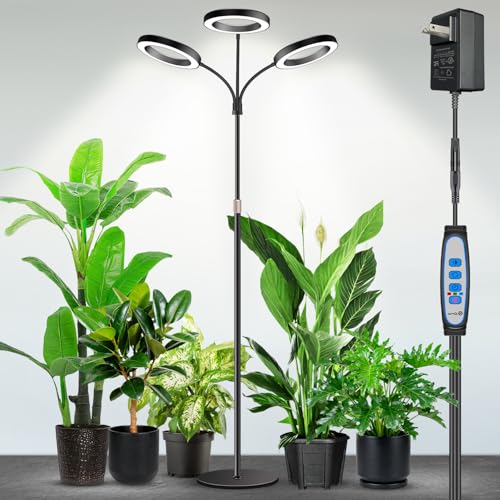
Garpsen Floor Grow Light, 3 Head Full Spectrum

HLG 600 Rspec FR 600W LED Quantum Board

GLOWRIUM Puck Grow Light G7

VIIVUU Clip-On Plant Light

Aspect Soltech Gen 2 Pendant Grow Light

Garpsen Grow Light with Stand, 80 LEDs

Garpsen Halo Dual-Head Floor Plant Light
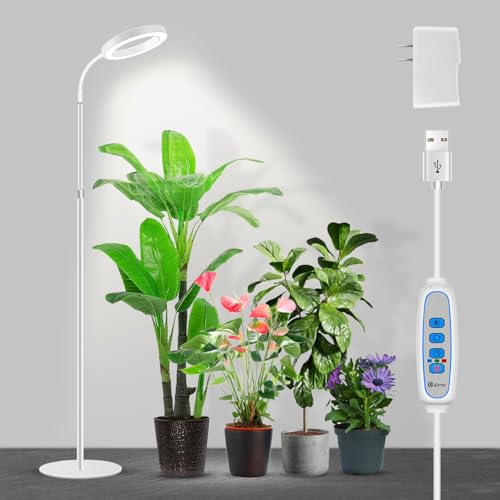
Garpsen Grow Light with Stand for Large Plants

Garpsen Dual-Head Plant Light, 168 LEDs

Garpsen Floor Plant Light, 3 Head
A Deeper Look At The Lineup
Tall floor plants like fiddle leaf figs and rubber trees struggle to find enough overhead light in most living rooms, and a clamp-style unit won’t reach them. The Garpsen Floor Grow Light solves that with a weighted metal base, a telescoping pole, and three ring-style heads you can aim at a canopy from above.
The gooseneck tubes hold their position once bent, so you can fine-tune coverage across a wide pot or split the heads between two plants. Compared to the pendant-style Soltech coming up later, this is clearly a tool-first piece of gear, not decor, which matters if your plant corner is more utility room than living room.
The Helpful Details
- Sturdy weighted base resists tipping around curious pets or vacuum bumps.
- Three semi-transparent ring shades throw light across a wide canopy at once.
- Telescoping pole adjusts so you can raise the heads as plants grow taller.
- Full-spectrum output supports leafy growth through darker months.
Things To Consider
- The industrial look can clash with minimalist interiors, so it works best tucked behind a plant.
- Cords and a weighted base take up noticeable floor space in tight rooms.
Who It Suits Best
Plant parents with one or two statement floor plants who want a hands-off overhead source without rewiring anything.
Consider Something Else When
If your living room is short on floor space, the VIIVUU Clip-On Plant Light offers a smaller footprint for a single tabletop plant.
Quantum boards (large, flat LED panels built from densely packed diodes) are the workhorses of serious indoor growers, and the HLG 600 Rspec FR sits at the heavy end of that category. It runs at 600W on a standard 120V outlet, dims smoothly, and is custom-tuned for a 4×4 foot grow tent.
This is not a living-room lamp. You’ll hang it from rope ratchets, manage its warmth, and likely pair it with a small fan. Where the Garpsen floor light we just covered is plug-and-play, this unit assumes you already think in terms of PAR (Photosynthetic Active Radiation, the wavelengths plants actually use for photosynthesis) and canopy penetration.
Real Benefits
- High-efficiency quantum board output supports dense flowering and fruiting stages.
- Dimmable driver lets you dial intensity back for seedlings and clones.
- Full-spectrum coverage reduces the need to swap bulbs between veg and flower cycles.
- Third-party tested efficiency gives hobbyists confidence in the output numbers.
Trade Offs
- Requires hanging hardware and a tent or dedicated grow space to perform properly.
- Generates meaningful heat, so you’ll want airflow in the room.
- No on-board timer, which is a common omission in this tier.
Quick Facts
Built With In Mind
Intermediate to advanced growers running a 4×4 tent who want high efficiency and don’t need a decor-friendly fixture.
Look Elsewhere When
If your setup is a windowsill herb garden, the GLOWRIUM Puck Grow Light G7 is far easier to drop into a small space.
Puck lights look more like a tech gadget than a grow lamp, and the GLOWRIUM Puck Grow Light G7 leans into that. The compact puck form factor slips under a shelf or onto a desktop, and the Bluetooth app lets you tweak brightness and timers without crawling behind furniture.
Full-spectrum LED chips cover the wavelengths most foliage and herbs need through their growing cycle. If you’ve been leaning toward the VIIVUU clip-on coming up next, but want app control and a wider light spread, this is the natural step up.
A Strong Showing
- Bluetooth app control means no manual buttons to press every morning.
- Auto timer helps keep photoperiods (the daily on/off light cycle plants rely on) consistent when you’re traveling.
- Puck form factor disappears into most shelf setups.
- Full-spectrum output covers both vegetative and flowering needs.
Small Caveats
- Coverage area is limited, so it suits one or two small plants rather than a row of pots.
- App-dependent features may frustrate anyone who prefers a simple on-cord switch.
Perfect Match For
Tech-comfortable plant owners who want scheduling and dimming control from a phone rather than a manual dial.
Skip It When
For raw coverage over a tall floor plant, the Garpsen Floor Grow Light, 3 Head Full Spectrum is the better tool.
A single pothos on a bookshelf or a kitchen herb trio rarely needs the firepower of a quantum board. The VIIVUU clip-on plant light handles those smaller jobs with a sturdy clamp and a hollow ring lamp head that keeps the weight down without sacrificing output.
A soil-insertion stake ships with the unit, so you can plant it directly in the pot when a shelf edge is too thick to clamp onto. That dual-mount approach gives it more flexibility than a basic desk lamp, and it sits well below the GLOWRIUM puck in price for casual users.
Useful Strengths
- Strong clamp grips pot rims and shelves securely without slipping.
- Soil-stake option opens up placement where a clamp can’t reach.
- Lightweight ring head is easy to reposition as the plant grows.
Areas To Watch
- Coverage is tight, so it suits one small plant rather than a grouping.
- Plastic clamp hardware may wear faster on thicker shelves over time.
Right Fit For
Apartment dwellers with a couple of small plants who want a tool that disappears when not in use.
Not Your Match When
For a styled living room where the fixture itself needs to look the part, the Aspect Soltech Gen 2 Pendant is the clear alternative.
Pendant lights belong in living rooms, not grow tents, and the Aspect Soltech Gen 2 leans all the way into that identity. It hangs like a designer pendant, casts a warm natural-white glow, and only reveals its plant-growing side when you look closely at the spectrum.
This is the model to pick when the light has to coexist with a styled space. Where the Garpsen floor light is a tool on display, this one reads as decor that happens to feed your plants.
Strengths Worth Knowing
- Pendant form blends into most interiors far better than clamp or floor units.
- Warm white output avoids the purple or harsh blue cast of typical grow fixtures.
- Dimmable so you can drop the level after sunset in a multi-use room.
Worth Noting
- Requires ceiling mounting, which adds installation steps compared to plug-and-play units.
- Coverage is narrower than a quantum board or triple-head floor light.
Spec Overview
Whose Shelf It Belongs On
Design-conscious plant owners who want a single statement pendant over a fiddle leaf fig or hanging pothos.
Reach For A Different Pick When
You’d rather avoid ceiling installation, in which case the Garpsen Halo Grow Lights floor model needs no mounting at all.
Tabletop gardens need a light that can sit on a small stand, reach a six-inch pot, and not dominate the room. The Garpsen Grow Light with Stand uses 80 LEDs in a translucent ring shade and an adjustable telescoping pole to deliver that simple job without overbuilding it.
An integrated 6/12/16-hour timer takes the daily on-and-off chore off your plate, which matters when a regular routine slips. This sits comfortably below the heavier 168-LED Garpsen units later in the lineup, and that’s the appeal: a small, capable piece of gear for a small, capable setup.
Benefits That Matter
- Built-in timer automates photoperiods for consistent growth.
- Telescoping pole fits under most shelves and on most tables.
- Compact footprint suits apartment and dorm setups.
Minor Gripes
- Single-head output covers one plant well, but struggles across a wider row.
- Timer increments are fixed, with no custom minute-level control.
Made For
First-time grow light owners who want an affordable, no-fuss stand for a single tabletop plant.
A Better Fit Elsewhere
For someone running a small herb shelf with multiple plants, the Garpsen Dual-Head Plant Light with 168 LEDs spreads coverage more evenly.
When a single ring head isn’t enough but a full quantum board is overkill, a dual-head floor unit fills the gap. The Garpsen Halo Grow Lights carries 168 LEDs split across two ring shades on flexible goosenecks, mounted on a telescoping pole that ranges from roughly 23 to 60 inches.
The metal base with cotton padding keeps the unit planted when you adjust the necks. That’s a real-world ownership win, since cheaper floor lights tend to wobble or tip the moment you push a head out of balance.
The Value In It
- Dual heads let you cover two plants or one wide canopy at once.
- Cotton-padded base grips hardwood and tile better than bare metal.
- Telescoping range covers anything from a small tabletop to a six-foot tree.
Worth Bearing In Mind
- Two heads on long goosenecks can drift back to center over weeks of use.
- No on-board timer, so you may want a smart plug to automate it.
Best Suited To
Plant households with multiple tall species who want one floor unit to handle the job.
Swap It Out When
For a single tall tree where one wide head suffices, the Garpsen Floor Plant Light, 3 Head spreads coverage even further.
Monsteras and large philodendrons grow fast enough that your light has to keep up with them, and this Garpsen stand extends high enough to handle a five-foot floor plant. The full-spectrum output runs from 380 to 800 nanometers, with extra blue and 660 nanometer red for vegetative and flowering stages.
The translucent ring shade increases light transmission, so the diodes work less hard for the same reach. Compared to the smaller 80-LED Garpsen stand earlier in the list, this one trades compactness for outright canopy coverage.
Points In Its Favor
- Tall stand accommodates floor plants other tabletop lights can’t reach.
- Full 380-800nm spectrum covers vegetative through flowering needs.
- Translucent ring shade brightens output without increasing wattage.
Honest Caveats
- Single ring concentrates light in one spot, so wider canopies may need multiple units.
- No dimming control, which limits flexibility for seedlings or shade-tolerant species.
Who Should Grab It
Owners of one large floor plant who want a single stand tall enough to follow it as it grows.
Another Choice May Suit
For variable intensity at different growth stages, the Garpsen Dual-Head Plant Light with 168 LEDs gives you more modes.
Different growth stages want different light, and this Garpsen unit acknowledges that with three lighting modes and five dimming levels. Two ring shades run from a single stand, splitting coverage between plants or aiming at the same canopy from two angles.
The full-spectrum output runs from 380 to 800 nanometers, with a 660 nanometer red boost for flowering responses. This sits in the middle of the Garpsen family: more capable than the 80-LED table stand, less sprawling than the 3-head floor unit.
Useful Touches
- Three lighting modes tailor output to seedlings, greens, or flowering plants.
- Five dimming levels give you finer intensity control than most stand models.
- Dual heads cover wider plants from multiple angles for even growth.
Points To Note
- More settings mean a slightly steeper learning curve for first-time users.
- Dual goosenecks can require occasional re-aiming as plants shift toward the light.
Who Will Love This
Plant parents juggling seedlings, leafy greens, and flowering houseplants under one fixture.
Where A Sibling Pick Shines
If your priority is reaching a tall floor plant, the Garpsen Grow Light with Stand for Large Plants extends higher on its pole.
Three ring heads on one weighted base give the Garpsen Floor Plant Light the widest spread in this lineup, useful when a corner of the room holds a small grove rather than a single statement plant. The semi-transparent shades lift light transmission, and a 6/12/16-hour timer handles daily photoperiods automatically.
This is the most capable of the Garpsen floor units in this roundup, with more heads than the dual-head Halo and a longer timer range than the 80-LED tabletop stand. It’s a strong closing pick for households juggling several plants at once.
What Makes Sense
- Triple heads cover a wider canopy or several smaller plants at once.
- Built-in timer with 6/12/16-hour options covers most photoperiods.
- Weighted base keeps the unit planted as you adjust multiple heads.
Practical Considerations
- Heavier footprint than smaller units, so it doesn’t suit cramped rooms.
- Timer increments are preset, with no custom schedule programming.
The Right Fit
Plant households with three or more floor plants who want one fixture to handle a whole corner.
Not Your Match When
If your space demands a fixture that looks like decor, the Aspect Soltech Gen 2 Pendant fits a styled room far better.
What Matters Most Before Choosing Plant Grow Lights
Match The Light To The Plant And The Room
Start by measuring the distance from where the light will hang or stand to the top of the plant. Floor units typically need a 12 to 36 inch drop, while pendant fixtures sit closer to the canopy. Plants with high light demands, like herbs and succulents, need higher output and closer placement than a pathos or philodendron.
Spectrum And Brightness Basics
Full-spectrum LED fixtures (lights that mimic natural sunlight across the visible range) support plants through both vegetative and flowering stages without swapping bulbs. Wattage tells you how much power the unit draws, but output quality matters more than raw wattage. For serious growers, look at PAR ratings (Photosynthetic Active Radiation, measured in micromoles per joule), which describe the light plants actually use. For casual use, full-spectrum output at a comfortable distance is usually enough.
Controls, Timers, And Daily Routine
A built-in timer removes the chore of remembering to turn lights on and off, which matters more than it sounds. Dimming and mode selection help when you raise seedlings or rotate between growth stages. App-controlled units like the GLOWRIUM Puck add scheduling without adding hardware, useful for travelers or anyone who already lives on their phone.
Mounting Style And Footprint
Clamp, pendant, and floor-stand styles each solve a different layout problem. Clamps disappear when not in use, pendants double as decor, and floor units reach tall canopies without rewiring. Choosing by mounting style often narrows the list faster than choosing by spec sheet.
Smart Choices Across The Grow Light Category
Pitfalls Shoppers Hit
The most common mistake is buying a small clip-on light for a tall floor plant and wondering why the lower leaves still lean toward the window. Match the form factor to the height of the plant, not just the number of LEDs. Another trap is chasing wattage without checking spectrum; a 100W grow light with poor spectrum underperforms a 60W unit tuned for the right wavelengths.
Where The Extra Money Goes
Higher-tier fixtures earn their cost through better diodes, more uniform spectrum, and sturdier housings that handle daily repositioning. The quantum board category, like the HLG 600 Rspec FR, costs more because efficiency and longevity translate directly into plant performance. For casual houseplant use, mid-tier floor units hit the balance, while premium pendants make sense when the fixture has to look the part in a finished room.
Frequently Asked Questions
How Many Hours Per Day Should I Run A Plant Grow Light?
Most foliage houseplants thrive on 12 to 16 hours of light per day, with a clear dark period to mimic natural cycles. Flowering plants often need shorter days to trigger blooms, while seedlings benefit from 14 to 18 hours while they establish. The 6/12/16-hour timers on several Garpsen models cover the most common ranges without guesswork.
Do Full-Spectrum LED Grow Lights Work For All Indoor Plants?
Full-spectrum lights support the majority of common houseplants, herbs, and leafy greens through both vegetative and flowering stages. High-light fruiting plants like tomatoes may still want a stronger quantum board in a tent setup. For foliage-only collections, full spectrum is more than enough.
How Far Should A Grow Light Sit From The Plant?
A general rule is 12 to 24 inches for most LED grow lights, depending on output strength and plant sensitivity. Seedlings and shade-tolerant species prefer the longer end of that range, while succulents and herbs tolerate closer placement. Adjustable stands and goosenecks make repositioning simple as plants grow.
Can I Leave A Grow Light On All Night?
Plants need a dark period to complete their respiration cycle, and constant light can stress most species. Run lights for a set photoperiod during the day and let the fixture turn off automatically. Built-in or smart-plug timers handle this without daily effort.
Are LED Grow Lights Better Than Fluorescent Options?
LED fixtures run cooler, last longer, and deliver more targeted spectrum per watt than fluorescent tubes. They cost more upfront, but the energy savings and durability make them a stronger long-term pick for most indoor gardens. Quantum board LEDs in particular outperform older fluorescent panels on efficiency.
The Takeaway
A grow light only earns its keep if it fits the plant, the space, and your daily routine. Tall floor plants reach for the Garpsen floor units, small shelves suit the VIIVUU clip-on, and styled rooms get the pendant treatment from Soltech. Match the form factor first, then layer in spectrum and timer features, and you’ll avoid the mismatches that leave plants stretching toward the window anyway.
