

Dead limbs above your head, a ladder that wobbles every time you climb, and a hedge that’s starting to take over the fence line. Pole pruners exist for exactly that kind of weekend. Whether you’re tending a small backyard orchard or clearing storm damage from a tall pine, the right tool turns a frustrating afternoon into a quick pass through the canopy. This roundup covers ten solid options spanning manual rope-pull saws, modular extendable systems, and cordless electric shears that pair with a telescoping shaft. Pick by reach, cut capacity, and how much muscle you actually want to put in.
How The Shortlist Stacks Up
Jameson FG-6PKG-7 FG-Series Manual Pole Saw with Two 6-Foot Fiberglass Poles

SEESII 2-in-1 Pole Electric Pruning Shears, 2.2″ Cut Cordless

SEESII Electric Pruning Shears 4 Modes, 2.2″ Cut Cordless

Fiskars 4-16 Ft XtendControl Extendable Pole Saw & Tree Pruner Modular Set

Fiskars 3-12 Ft XtendControl Extendable Modular Pole Saw & Tree Trimmer

Fiskars 3-14 Ft XtendControl Extendable Pole Saw & Tree Pruner Modular Set

TRUPER TR-82M-A Tree Pruner with Extendable Aluminum Pole
SEESII Electric Pruning Shears 4 Modes, 1.8″ Cut Cordless

Fiskars 7-13 Ft DualAction Extendable Pole Pruner, Telescoping
Jameson FG-6PKG-1 FG-Series Manual Pole Saw with Two 6-Foot Fiberglass Poles
The Strengths Of Each Pick
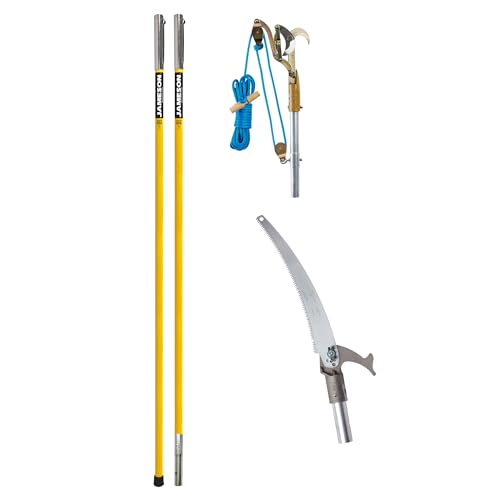
Working around overhead lines or storm-felled limbs calls for a pole that takes electrical safety seriously, and this Jameson kit is built with that in mind. The fiberglass shafts are batch-tested to OSHA standards, meaning the insulation rating holds up for utility work. You get two six-foot sections that stack into roughly twelve feet of reach, plus a 16-inch Barracuda tri-cut saw blade and a double-pulley bypass pruner head.
For homeowners with tall pines or dense canopies, the doubled pulley reduces the rope pull force required, which helps on longer sessions. The kit includes a 20-foot pruner rope and adapter hardware so you can swap the saw head and bypass cutter as needed.
The Helpful Details
- Fiberglass construction tested to 100 KV per foot for five minutes
- Double-pulley pruner head lowers rope-pull effort
- 16-inch Barracuda tri-cut saw blade for faster limb removal
- Two-section design reaches about 12 feet when combined
- Compatible with standard Jameson FG-Series accessories
Things To Consider
- Heavier than aluminum alternatives, so arm strength matters on long jobs
- Manual rope-pull operation requires practice to align cuts accurately
- Fiberglass can scuff or splinter over years of rough storage
Key Specs
Who It Suits Best
Utility crews, arborists, and homeowners dealing with frequent overhead branch work near power lines.
Consider Something Else When
For purely cosmetic pruning in a small yard, the Jameson FG-6PKG-1 is a lighter fiberglass alternative worth comparing.
Some days you need a pole pruner for overhead work, and other days you’re kneeling beside a shrub wrestling with thick stems. SEESII’s 2-in-1 design solves that by letting you detach the cutting head and use it as a handheld shear, so you can switch modes without grabbing a second tool.
The 2.2-inch cutting capacity handles branches that would defeat a basic bypass pruner, and the cordless setup means no gas, no pull cords, no extension cables to trip over. For most backyard tree and hedge work, that’s a real time saver.
Positive Points
- Detachable cutting head works handheld or pole-mounted
- 2.2-inch cutting diameter handles thicker branches
- Cordless operation removes extension-cable hassle
- Cuts down on hand fatigue during long sessions
Worth Noting
- Battery life depends on branch thickness and frequency of cuts
- Replacement batteries may cost extra if you want a spare
- Pole length is fixed, not telescoping
Made For
Homeowners who split time between high branches and dense shrubbery in the same yard session.
Look Elsewhere When
You need maximum reach above 12 feet, where the Fiskars XtendControl 4-16 Ft set stretches higher.
When the cutting goes beyond twigs and into wrist-straining branches, a wide blade opening makes the difference between finishing a job and abandoning it halfway. SEESII’s 2.2-inch cut paired with a 3.2-inch blade opening tackles growth that overwhelms standard shears, which is why orchard owners and serious landscapers reach for this category.
Four adjustable cutting modes let you match the blade speed and force to the branch at hand, conserving battery and reducing wear. For pruning a fruit tree or overgrown hedge, that flexibility keeps the cuts clean and your hands comfortable.
Real Benefits
- 2.2-inch cutting diameter handles thick orchard branches
- 3.2-inch blade opening accommodates larger limbs
- Four cutting modes adjust power and precision
- Cordless design removes fuel mixing and pull starts
Trade Offs
- Heavier than manual shears during extended overhead work
- Battery runtime shortens significantly in heavy limb mode
Key Specs
Best Suited To
Orchard keepers and homeowners with mature trees producing substantial branch growth.
Not Your Match When
You only need light hedge shaping, where the SEESII 1.8-inch model is easier on the wrist.
Most pole pruners force you to commit to one configuration before you climb the ladder. Fiskars flips that with a modular setup that swaps heads and adjusts length on the fly, giving you five different configurations from one compact kit. The reach stretches from four feet for low hedge work all the way to 16 feet for tall canopy branches.
What separates this from competitors is the weight balance. The pruner head sits closer to your hands rather than dangling at the tip, so you spend less energy fighting a top-heavy pole and more time making clean cuts. For most homeowners with a mix of pruning tasks, that’s a tangible upgrade.
Key Advantages
- Five configurations cover pruning, sawing, and trimming
- Reach extends from 4 to 16 feet for varied tasks
- Weight positioned closer to hands reduces fatigue
- Compact storage compared to fixed-length poles
- Compatible with other XtendControl attachments
Honest Caveats
- More parts to track when disassembling for the season
- Setup takes longer than single-piece pole saws
Perfect Match For
Homeowners juggling multiple pruning tasks across shrubs, mid-size trees, and tall canopy work.
A Better Fit Elsewhere
If your yard stays below 10 feet and you want simpler handling, the Fiskars 3-12 Ft set is easier to manage.
Smaller yards don’t need 16 feet of reach, and hauling a full-length kit around a tight suburban lot gets old fast. This shorter Fiskars setup stays manageable while still giving you the modular flexibility that defines the XtendControl line, with three interchangeable components for three common configurations.
The 15-inch X1 triple-ground saw blade cuts cleanly through branches up to a useful diameter, and the same weight-forward design from the larger kit carries over. For homeowners with low-hanging limbs and standard-size trees, this hits a sweet spot.
Useful Highlights
- Three configurations cover most yard tasks
- Compact length easier to maneuver in tight spaces
- X1 triple-ground blade stays sharp through repeated cuts
- Weight balanced closer to grip for control
Points To Note
- Max 12-foot reach limits tall canopy work
- Fewer included attachments than the 16-foot sibling
Feature Snapshot
Whose Shelf It Belongs On
Suburban homeowners with trees under 12 feet and limited storage space.
Reach For A Different Pick When
You regularly prune branches above 12 feet, where the Fiskars 4-16 Ft kit extends further.
Sitting between the compact 12-foot kit and the longer 16-foot set, this 14-foot Fiskars modular system offers a middle-ground reach plus more configuration options than the smaller sibling. Four interchangeable components combine into seven setups, so you’re rarely stuck without the right tool.
The X2 hook bill saw blade handles branches in a way that reduces binding, and the same weight-forward ergonomics carry through the line. For homeowners who want versatility without committing to maximum reach, this strikes a practical balance.
What Earns Its Place
- Seven configurations from four modular components
- 14-foot reach covers mid-to-tall residential trees
- X2 hook bill blade reduces binding during cuts
- Stores compactly compared to fixed-length alternatives
Potential Drawbacks
- Slightly heavier than the 12-foot kit
- More parts to keep organized than single-piece saws
Built With In Mind
Homeowners with varied pruning needs who want flexibility without maximum length.
Skip It When
Your yard contains very tall trees exceeding 14 feet, where the Fiskars 4-16 Ft set reaches higher.
Long overhead sessions punish your shoulders, and aluminum’s lighter weight makes a real difference compared to fiberglass or steel. TRUPER’s telescoping aluminum pole extends to about 2.4 meters, putting overhead branches within comfortable reach without exhausting you halfway through.
The SK5 steel blade (a high-carbon tool steel known for edge retention) with triple-edge teeth powers through cuts quickly, and the carbon steel step blade handles the sawing work. For homeowners who want quick overhead trimming without hauling a heavy kit, this is worth a look.
Where It Delivers
- Aluminum pole keeps overall weight manageable
- SK5 steel blade holds an edge through repeated cuts
- Triple-edge teeth speed through green wood
- 1.25-inch cutting capacity suits typical yard branches
Some Limits To Know
- Max reach of 2.4 meters limits very tall tree work
- Aluminum conducts electricity, so keep clear of power lines
Spec Overview
Who Should Grab It
Homeowners seeking quick overhead trimming without the bulk of fiberglass systems.
Where A Sibling Pick Shines
For work near power lines, the Jameson FG-6PKG-7 fiberglass kit is the safer choice.
Not every pruning session involves monster branches. For routine maintenance on shrubs, roses, and small-to-medium tree limbs, a 1.8-inch cutting capacity paired with four adjustable modes gives you plenty of headroom without overspending on heavier-duty models.
The 2.6-inch blade opening is generous for the size class, and switching modes lets you dial back power for delicate cuts or ramp up for thicker growth. Compared to the larger SEESII 2.2-inch shears, this model sits lighter in the hand and runs longer per charge, which matters on full-day yard projects.
The Practical Payoff
- Four settings match blade force to branch thickness
- 1.8-inch cut handles standard residential growth
- Lighter than the 2.2-inch SEESII sibling for extended use
- 2.6-inch blade opening adds versatility per cut
What To Weigh
- Lower cutting capacity than the 2.2-inch SEESII model
- Battery is built-in and not user-replaceable on some versions
Right Fit For
Homeowners handling routine pruning on shrubs, roses, and small tree limbs.
Swap It Out When
You regularly tackle thick orchard growth, where the SEESII 2.2″ model cuts faster.
Switching between thin whippy growth and thick overhead limbs usually means grabbing two different tools. Fiskars solves that with a dual-action pruner head that toggles between S mode for fast small-branch cutting and L mode for powering through larger limbs up to about 1.25 inches.
The telescoping pole extends from roughly seven feet to 13 feet, and the gear transmission inside the head lets you swap modes without changing tools. For homeowners pruning a mix of hedge branches and heavier limbs in the same session, that gear-switching feature earns its place.
The Value In It
- Dual-action head switches between speed and power modes
- Telescoping reach from 7 to 13 feet covers varied tasks
- Cuts limbs up to 1.25 inches in L mode
- Single-tool convenience reduces mid-job swaps
Less Ideal Details
- 13-foot max reach is shorter than longer Fiskars sets
- Mode-switch mechanism adds moving parts to maintain
Who Will Love This
Yard workers who prune both hedge growth and overhead limbs in the same afternoon.
Another Choice May Suit
For maximum reach on tall canopy work, the Fiskars 4-16 Ft XtendControl kit extends further.
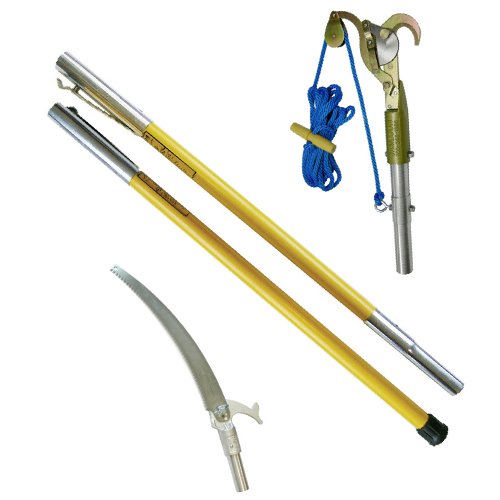
The original Jameson FG-Series kit offers the same fiberglass durability as the pro version, with hollow-core poles that keep weight manageable and aluminum ferrules (the threaded connectors joining pole sections) that make swapping sections straightforward. The 13-inch tri-cut saw blade and fixed-pulley bypass pruner handle typical residential tree work without fuss.
For homeowners who want a manual pole pruner that lasts years of seasonal use, the 0.125-inch wall thickness on the poles resists cracking and UV damage better than thinner alternatives. The kit includes base and extension poles, pruner, saw head, adapter, blade, and a 20-foot rope.
Real-World Strengths
- Hollow-core fiberglass resists cracking and weather
- Aluminum ferrules simplify pole section changes
- 13-inch tri-cut blade handles standard branches
- 1.25-inch side cut capacity covers most yard tasks
- Compatible with the broader Jameson FG-Series ecosystem
Room For Improvement
- Fixed-pulley pruner requires more pull force than double-pulley designs
- Manual rope operation has a learning curve for accurate cuts
Quick Facts
The Right Fit
Homeowners seeking a durable manual pole pruner for regular seasonal maintenance.
Not Your Match When
You want easier rope pulls, where the Jameson FG-6PKG-7 double-pulley version reduces effort.
Matching The Tool To Your Trees
Pole pruners fall into three broad categories, and matching yours to the right one saves frustration. Manual rope-pull systems like the Jameson FG-Series and TRUPER aluminum pole rely on your arm strength and a bit of technique, which rewards patient users with no batteries to charge and minimal maintenance. Cordless electric shears from SEESII trade that simplicity for faster cuts and reduced wrist strain, especially on repeated sessions. Modular extendable systems like the Fiskars XtendControl line sit in the middle, offering reach adjustments and swappable heads without the complexity of batteries.
Reach matters more than most shoppers expect. Measure the height of your typical pruning target, then add a few feet for overhead clearance. A 12-foot pole reaches branches about 10 to 11 feet high, depending on your arm length. Cutting capacity determines what you can remove in one snip, so check the maximum branch diameter before buying. Blade material affects longevity. SK5 steel and impulse-hardened teeth hold edges longer than basic carbon steel.
Weight balance and ergonomics matter on long sessions. Top-heavy poles wear out shoulders fast, so weight-forward designs reduce fatigue. Storage is practical, not glamorous, but a kit that breaks down to four feet stores in a garage much easier than a fixed 12-foot pole.
Key Considerations Across These Picks
Wrong Turns To Avoid
The biggest mistake is buying a pole pruner based on maximum reach without considering your typical pruning height. A 16-foot kit in a yard where nothing grows past 10 feet means you’re hauling extra weight and length for no benefit. Equally common is underestimating branch thickness. Shears rated for 1.5-inch cuts struggle at the upper end, and forcing through oversized limbs wears blades quickly and risks jamming the mechanism. Always buy for your thickest realistic branch, not your average one.
Where The Extra Money Goes
Higher-tier pole pruners earn their cost through better materials and smarter engineering. Fiberglass poles resist cracking and insulate against electrical hazards. SK5 steel blades hold an edge through heavy use instead of dulling after a few weekends. Modular systems add versatility through swappable heads, reducing the need to own multiple tools. For users pruning monthly rather than once a year, those upgrades translate to faster work, fewer replacements, and less frustration when tackling varied growth.
Frequently Asked Questions
How high can a typical pole pruner reach?
Most residential pole pruners max out between 12 and 16 feet of pole length, which translates to roughly 10 to 14 feet of overhead reach depending on your height and arm extension. Anything taller usually calls for a ladder or professional equipment.
What’s the difference between a bypass pruner and a saw blade?
A bypass pruner works like scissors with two curved blades that cross to make clean cuts on live wood up to about 1.25 inches. A saw blade handles thicker branches by removing material with toothed edges, which is why most pole pruners include both heads.
Are electric pruning shears worth it over manual?
Electric shears reduce hand fatigue significantly on long sessions and cut through thicker branches faster than manual models. The trade-off is battery runtime and upfront cost. For occasional light pruning, manual shears remain practical and dependable.
How do I maintain a fiberglass pole pruner?
Wipe down the pole after each use to remove sap and debris, store it indoors or under cover to prevent UV damage, and check the ferrules (pole connectors) periodically for tightness. Blade maintenance includes occasional sharpening and a light oil coat to prevent rust.
Can pole pruners handle tree limbs near power lines?
Only fiberglass poles rated for electrical work should be used near power lines, and even then with extreme caution. Aluminum conducts electricity and is dangerous near energized lines. For any work near utility wires, hiring a professional arborist is the safer choice.
Bottom Line
The right pole pruner turns a Saturday of wrestling with branches into a quick cleanup job. Manual systems like the Jameson FG-Series deliver durability without batteries, cordless electric shears like the SEESII models cut down on hand strain, and modular extendables like the Fiskars XtendControl line offer reach and versatility in one kit. Match the tool to your typical pruning height, branch thickness, and how often you work in the yard. Whichever you pick from this shortlist, you’re getting a tool built to last more than a few seasons.
