

Spending a Saturday pushing a mower under summer sun wears thin fast. Robotic mowers change that, quietly trimming in circles while you drink coffee or run errands. The six options below span replacement parts, boundary accessories, and full wire-free machines that handle anything from a townhouse lawn to a one-acre hillside.
How The Shortlist Stacks Up

Timbera 10m Low Voltage Charging Cable for Gardena SILENO

WORX WA0184 Boundary Wire for Landroid Robotic Lawnmower 50 m

YARDCARE AI Vision Robotic Lawn Mower 1600 Sq.Ft Dark Grey

Segway Navimow i110N Robot Lawn Mower Perimeter Wire Free 1/4 Acre
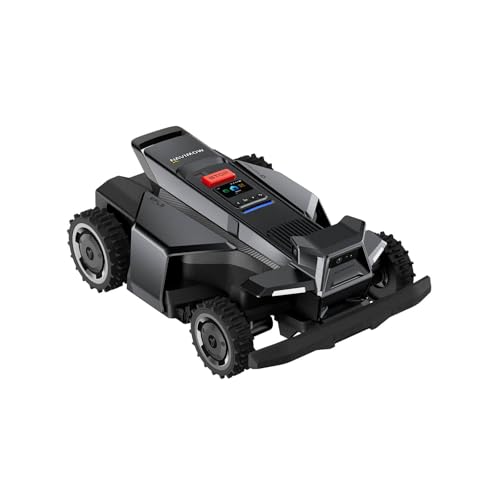
Segway Navimow X430 Robot Lawn Mower Wire Free up to 1 Acre

Segway Navimow i210 AWD Robot Lawn Mower Wire Free 0.25 Acre
More On The Choices That Made The List
If your Gardena base station sits on the far side of a tool shed or garage wall, the stock charging lead rarely reaches. The Timbera 10 m low voltage extension is built for exactly that frustration, threading power from a distant outlet to a docking point wherever you can route it. Compared to the rest of the list, it is the only accessory here, useful only when your mower happens to be a SILENO, City, Minimo, or R-series unit.
The 33-foot span covers most detached workshops and outbuildings without splicing. Anchoring the cable just under the sod with light hooks keeps it invisible after a few mowing cycles. For most setups, routing along an existing fence line or garden bed edge finishes the job cleanly.
Key Advantages
- Ten metres of reach covers detached garages and sheds that stock cables cannot bridge.
- Compatible across the SILENO Life, City, Minimo, and R-series Gardena ranges.
- Low voltage design stays safe to route along damp garden edges.
- Anchors below turf with light hooks, leaving a clean-looking yard after the grass fills in.
Things To Weigh Up
- Useless outside the named Gardena families, so check your model number before ordering.
- Requires manual burying or hooking, which adds a weekend of setup.
Who Should Grab It
Owners of a compatible Gardena mower whose charging station sits beyond the reach of the original lead.
A Better Fit Elsewhere
Anyone running a Landroid should pick the WORX WA0184 Boundary Wire instead, since it matches that ecosystem.
Boundary wires do the invisible work in any perimeter-based robotic mower, and they get cut, dug up, or stretched by curious pets. The WORX WA0184 gives Landroid owners a 50-metre replacement spool that matches the original gauge, so the signal stays clean. If you inherited a yard with the original loop half missing, this spool covers most small-to-medium lawn repairs.
Owners commonly report the sturdy jacket resists nicks from shovels and edging tools better than cheaper wire. Splice connectors are inexpensive to add if a single break splits your loop. Depending on your lawn shape, you may find a second spool helpful for island beds or a vegetable patch.
Where It Delivers
- 50 m length handles a full rewire of a small yard or two large repair patches.
- Sturdy outer jacket tends to shrug off accidental shovel strikes during bed work.
- Matches the Landroid signal frequency, so no calibration fuss at the base station.
Honest Caveats
- Works only with WORX Landroid units, so confirm your model before splicing.
- Laying or re-laying the wire still takes an afternoon of pegging.
Feature Snapshot
Made For
Landroid owners dealing with a damaged boundary loop or planning a yard expansion.
Skip It When
You would rather avoid boundary wire entirely, in which case the Segway Navimow i110N maps your lawn without one.
The YARDCARE entry is the approachable option for shoppers dipping a toe into robotic mowing. With AI vision obstacle sensing and a magnetic strip for marking off-limits patches, it skips the boundary wire step that frustrates many first-time owners. Its 1600 sq ft capacity suits a townhouse lawn or a tight backyard, the kind of space a push mower handles in fifteen minutes.
Setting no-go zones with the included magnetic strip keeps flowerbeds and play areas off limits without software maps. For most small backyards, the dark grey housing disappears against soil and shadow. If your lawn has narrow side passages, the vision system helps the mower thread them without wedging.
Standout Benefits
- AI vision reads the lawn in real time, dodging toys, pets, and hose tangles without a buried wire.
- Magnetic strip no-go zones let you protect beds in minutes rather than mapping them in an app.
- Compact 1600 sq ft rating matches small urban yards exactly.
- Dark grey finish hides scuffs from garden debris.
Small Caveats
- Best on flat, simple lawns; complex slopes belong to the i210 AWD or X430.
- Magnetic strip layout takes some trial and error on oddly shaped beds.
Quick Facts
Right Fit For
First-time robotic mower owners with a compact, mostly flat lawn who want a wire-free install.
Look Elsewhere When
Your yard spans a quarter acre or includes hills, in which case the Segway Navimow i110N handles the larger footprint with RTK precision.
The Navimow i110N steps up to real precision with RTK positioning (RTK, or Real-Time Kinematic, is a satellite navigation method that corrects GPS drift for centimetre-level accuracy) layered with vision sensors, so the mower knows exactly where it sits within a quarter acre. It walks the lawn without a buried loop, mapping zones and boundaries through the companion app. Compared to the YARDCARE option above, it is the natural next move once your yard grows past townhouse size.
Multi-zone management lets you split the front yard, side strip, and backyard into separate cutting schedules. At roughly 58 dB(A), it runs quieter than most window air units, so early evening sessions stay neighbourly. AI-assisted mapping also helps it navigate narrow passages and shaded spots that confuse basic bump-and-turn mowers.
The Helpful Details
- RTK plus vision navigation handles shaded patches and tight corridors where pure GPS drifts.
- App-based virtual boundaries mean no wire to bury, splice, or repair later.
- Multi-zone scheduling covers front, side, and back lawns on independent timers.
- 58 dB(A) operation stays quiet enough for evening runs in close-set neighbourhoods.
Points To Keep In Mind
- RTK accuracy depends on a clear sky view for the reference antenna, so heavily canopied yards may need an accessory antenna.
- App setup takes longer than a magnetic strip.
Best Suited To
Homeowners with a quarter-acre lot, multiple lawn zones, and enough open sky for satellite lock.
Another Choice May Suit
If your lawn slopes steeply, the Segway Navimow i210 AWD climbs where this one would hesitate.
The X430 is the heavyweight in this roundup, a wire-free unit built for acre-scale properties and punishing grades. Four-wheel drive and an ORV-tuned dual suspension system let it climb slopes up to 84 percent, which is steeper than most residential driveways. Where the i110N handles a polite suburban lawn, the X430 is engineered for orchards, pastures, and other rough ground that would stall a smaller robot.
Two 180 W motors feed the AWD system, and the zero-turn steering design pivots in place without skidding divots into the turf. The cutting height range spans 0.75 to 4 inches, covering short golf-green style lawns and taller field grass. Owners of large rural properties will appreciate not having to bury perimeter wire across a full acre.
What Works In Its Favor
- Handles slopes up to 84 percent (about 40 degrees), the steepest rating on this list.
- Wire-free virtual boundaries cover up to one acre without digging trenches.
- Zero-turn steering pivots without tearing up the lawn.
- Cutting height range from 0.75 to 4 inches suits both lawn and meadow grass.
Trade Offs
- Significant investment for properties under half an acre.
- Large chassis struggles at the bottom of narrow side-yard gates.
At A Glance
Whose Property It Belongs On
Owners of large, hilly properties who want a wire-free install and serious slope capability.
Reach For A Different Pick When
A modest quarter-acre lawn is enough, in which case the Navimow i110N covers the space at a friendlier size.
The i210 AWD slots between the i110N and the X430, pairing all-wheel drive traction with a quarter-acre footprint. Where the i110N sits best on flat terrain, this one tackles 45 percent slopes (about 24 degrees) using electronic stability control borrowed from the automotive world. It is the most sensible Navimow for hilly suburban lots where the i110N would hesitate but the X430 would be overkill.
The concentric third-wheel design delivers true zero turns, which protects the turf from skid marks during pivots. Wire-free mapping through the app removes the weekend spent pegging boundary cable. For most homeowners with a sloping yard, this lands in the practical sweet spot.
A Strong Showing
- AWD traction climbs 45 percent slopes with electronic stability control.
- Zero-turn third-wheel design pivots cleanly without lawn damage.
- Wire-free setup covers a quarter acre without trenching.
- Smaller chassis than the X430 fits through standard side-yard gates.
Possible Compromises
- Limited to 0.25 acre coverage, so larger properties will need the X430.
- AWD components add weight compared to the two-wheel-drive i110N.
Who Will Love This
Homeowners with hilly quarter-acre lawns who want wire-free mapping and serious slope capability.
Where A Sibling Pick Shines
Flat quarter-acre lawns are handled more economically by the Navimow i110N, which lacks AWD hardware you would not use.
Picking The Right Robotic Mower For Your Yard
Match The Mower To The Lawn Size
Coverage ratings are not interchangeable. A 1600 sq ft model handles a small townhouse lawn but bogs down on a quarter acre, while an acre-rated unit wastes battery on a postage-stamp yard. Measure your turf before browsing, then add a margin for oddly shaped borders and sloped sections that slow coverage.
Decide Between Wire And Wire-Free
Buried boundary wire is reliable and cheap to install, but a shovel or aerator can break the loop and force a half-day repair. Wire-free mapping uses GPS, RTK, or vision to set virtual boundaries through an app. Wire-free installs are cleaner for new yards, while repair-prone older lawns may still prefer the predictability of a physical loop.
Slope Capability Matters More Than You Think
Manufacturers publish slope ratings as a percentage, where 100 percent equals a 45-degree angle. Anything over 30 percent (about 17 degrees) starts to challenge two-wheel-drive units, so AWD and 4WD systems earn their keep on hilly lots. Slopes also affect battery life, since climbing drains cells faster than flat travel.
Consider Noise, Zones, And Maintenance
Quiet operation, around 58 dB(A) or lower, lets the mower run in the evening without neighbourhood friction. Multi-zone scheduling covers separate lawn areas on different timers, useful for side strips and backyards. Maintenance mostly involves blade swaps a few times per season and an occasional sensor wipe-down.
Key Considerations Across These Picks
Common Shopping Slip Ups
Many shoppers focus on coverage area and ignore slope rating, ending up with a mower that stalls on the first incline. Others underestimate boundary wire maintenance and resent the trenching required, which is exactly why the wire-free Navimow models gained traction. A third miss is forgetting to check model compatibility with existing accessories like the Timbera cable and WORX wire on this list.
Where The Extra Money Goes
Stepping up from a vision-only mower to an RTK plus vision model buys satellite-grade positioning that survives shaded patches and narrow corridors. AWD and 4WD systems add traction hardware, suspension, and beefier motors, which explains the price gap between the i110N and the X430. Premium tiers also tend to deliver cleaner zero-turn manoeuvres, protecting turf during pivots.
Frequently Asked Questions
How long do robotic mower batteries last per charge?
Most residential models run 60 to 120 minutes per charge, depending on grass thickness and slope, then return automatically to the dock.
Can a robotic mower handle wet grass?
Manufacturers generally recommend running in dry conditions, since wet clippings clump and clog the deck faster than dry ones.
Are robotic mowers safe around children and pets?
Vision and bump sensors stop the blades when the unit is lifted or meets an obstacle, though keeping pets and kids indoors during scheduled cuts is still wise.
How often do the blades need replacing?
Most blades last two to three months during peak season, so a small stash of replacements keeps the cut crisp without interruption.
Do robotic mowers work on uneven ground?
Slope ratings vary widely; units with AWD or 4WD handle uneven terrain far better than basic two-wheel-drive designs.
The Takeaway
Robotic mowers fit almost any yard once you match coverage, slope, and navigation style to the space. Small lawns get a friendly entry point with the YARDCARE, while the Navimow trio scales up from quarter-acre smart mapping to one-acre all-terrain work. Pick the profile that matches your lawn and let the mower do the weekend.
