

A patchy lawn in mid-July tells you everything about your watering setup. The right rotating sprinkler turns a chore into a set-it-and-forget-it routine, covering square footage evenly without soggy corners or bone-dry strips. This list sorts through six solid options, from in-ground rotors to smart controllers and a handheld wand for tighter jobs.
The Shortlist At A Glance

K Rain ProPlus 3/4″ Reclaimed Water Gear Drive Rotor Sprinkler 4-Pack

Hunter PGP-adj Rotor Sprinkler Heads 6-Pack
Eden 96213 Weighted Essential Oscillating Sprinkler

Eden 94110 Heavy-Duty Metal Oscillating Sprinkler
Eden 96618 Metal Thumb-Control 7-Pattern Watering Wand

Aiper IrriSense 2 Smart Lawn Sprinkler
The Details Behind The Selections
The K Rain ProPlus is built for homeowners who already have, or are planning, a reclaimed-water (sometimes called recycled or gray-water) irrigation setup. Purple tops typically signal non-potable water, so the reclaimed-water coloring on these rotors tells crews at a glance which lines carry which source.
The 4 1/2″ pop-up height keeps the head low to the ground until the system runs, which protects it from mower decks and foot traffic. The arc range from 40° to a full 360° lets you dial in tight corner coverage or wide open-field sweeps without swapping parts. Owners commonly appreciate that these bodies drop into standard Rain Bird 1800 cans, so retrofitting an older system is rarely a dig-up-the-yard project.
What Stands Out
- Gear drive internals tend to deliver a slower, more consistent rotation than impact-style heads, which translates to even precipitation across the throw distance.
- Pop-up height of 4 1/2″ clears most turf grass without leaving a stub when retracted, so the lawn looks clean between watering cycles.
- Adjustable arc lets you tune each head to its zone without buying extra nozzles.
- Compatibility with Rain Bird 1800 cans simplifies replacement projects in mixed-brand yards.
- The four-pack pricing makes a full-zone upgrade more cost-efficient than piecing heads together one at a time.
Points To Keep In Mind
- Reclaimed-water labeling assumes the rest of your system is also coded for non-potable use; mismatched parts across a yard can confuse future maintenance.
- Installation requires basic trenching or access to existing can fittings, so first-timers may want a hand for the initial layout.
Key Product Details
Whose Lawn It Belongs On
Homeowners with a reclaimed-water supply who want pro-grade pop-ups and don’t mind getting their hands dirty during install.
A Better Fit Elsewhere
The Hunter PGP-adj 6-Pack suits shoppers who want a quicker, tool-driven adjustment process and a six-head bundle rather than four.
The Hunter PGP is one of those names you hear from landscape crews almost reflexively. The “adj” suffix means the arc is adjustable, so a single head covers everything from a narrow side-yard strip to a full sweep across the backyard without needing a different model for each spot.
The included nozzle trees let you swap flow rates on the fly, which is useful when one zone demands a tighter throw than another. The adjustment tool in the box means you don’t need to hunt down a Hunter-specific key before your first walk-through. Compared to the K Rain ProPlus reviewed above, this set leans further toward flexible, contractor-friendly tweaking and ships with two extra heads to round out a six-zone layout.
A Favorable Mix
- Six heads in one box line up nicely with mid-size lawns that need multiple zones running off a single manifold.
- Adjustable arc on each head reduces the guesswork when corners and curves don’t match a neat rectangle.
- Nozzle trees give you several flow options in the same box, useful when pressure varies between zones.
- Adjustment tool included saves a trip to the hardware store before your first setup session.
Small Caveats
- Pop-up height isn’t listed in the supplied data, so confirm compatibility with your existing cans if you’re retrofitting an older system.
- With six heads to dial in, the initial setup takes longer than a single oscillating sprinkler you just plop on the lawn.
Right Fit For
DIYers replacing or building a multi-zone in-ground system who value brand familiarity and a six-head bundle.
Skip It When
You’d rather skip trenching altogether; the Eden 96213 oscillating sprinkler drops on top of the grass with no install at all.
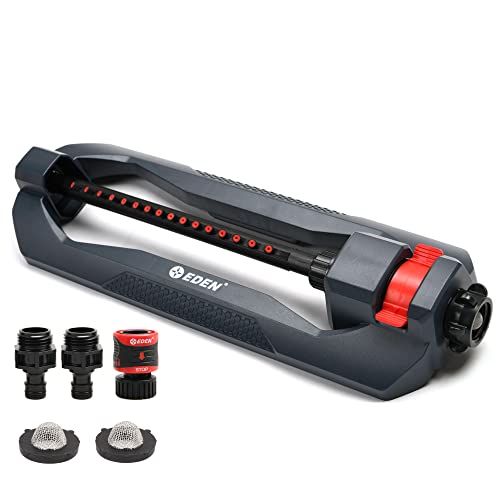
For shoppers who’d rather not dig trenches or wrestle with manifold plumbing, the Eden 96213 is a hose-end sprinkler that simply sits on the lawn. Its weighted base keeps it planted when the spray kicks up against a stiff breeze, and the 16-nozzle bar lays down a wide, rectangular pattern suited to typical suburban lots.
Coverage up to 3,600 sq ft is meaningful here. For a yard roughly 60′ by 60′, that’s a single placement covers most of the turf without dragging the hose. Adjustable range tabs let you shrink the throw for narrower side strips. The quick-connect bundle helps when you’re moving between front and back yards in the same afternoon. Unlike the in-ground rotors above, this one trades permanent installation for grab-and-go simplicity.
A Few Strong Suits
- The weighted base stays put on uneven turf, which matters when the throw is wide and the spray pressure is high.
- Sixteen nozzles spread water across a wide rectangle, reducing the striping you sometimes see with fewer-outlet bars.
- Sliding range tabs let you tune coverage without buying extra parts.
- Stainless steel filters help keep debris out of the nozzle bank over time.
Honest Caveats
- Maximum coverage assumes generous water pressure; on lower-pressure systems the throw shrinks noticeably.
- Storing the bar indoors during freezing weather extends the life of the seals and tubing, which is a real consideration for cold-winter regions.
Made For
Renters and homeowners who want simple, no-install coverage for a medium rectangular lawn.
Consider Something Else When
You have a reclaimed-water supply or a permanent in-ground layout in mind; the K Rain ProPlus fits that brief much better.
The 94110 is Eden’s heavier-duty answer to the 96213 reviewed above. Where the Essential model leans on a weighted base, this one steps up to a metal frame, which matters if your sprinkler tends to live outdoors through summer storms rather than getting tucked away after each run.
Eighteen nozzles cover up to 3,315 sq ft, slightly less square footage than the 96213 but with more outlets spread across the bar. The turbo drive motor keeps the oscillation smooth even at higher pressures. Quick-connect fittings make it easy to swap heads on the same hose run. Compared with the plastic-bodied models, the metal build here is the headline upgrade, especially for anyone tired of brittle tabs snapping after a season in the sun.
Positive Points
- Metal construction handles sun, hose yanks, and accidental kicks better than the all-plastic alternative.
- Eighteen precision nozzles break the throw into finer streams, which can reduce large-droplet runoff on sloped sections.
- Adjustable range controls let you shrink coverage for narrow garden strips when needed.
Trade-Offs To Consider
- Heavier body is less convenient to drag to the far corner of the yard each morning.
- Listed coverage is slightly smaller than the lighter 96213, so plan placement accordingly for very wide lawns.
Best Suited To
Gardeners who leave gear out for the season and want a sturdier body to handle repeated outdoor exposure.
Where Another Pick Suits Better
For something lighter to move around, the Eden 96213 covers similar square footage with a more portable footprint.
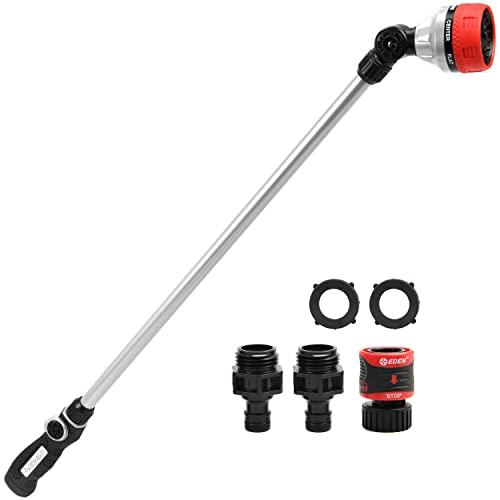
The 96618 is a watering wand, not a rotor, and it earns its spot here because every lawn routine eventually needs a tool for the spots a sprinkler misses. Hanging baskets, raised beds, foundation plantings, and freshly seeded patches all want targeted flow rather than a 30-foot throw.
The 33-inch length takes the bend out of overhead basket watering, and seven spray patterns cover everything from a gentle mist for seedlings to a jet for knocking debris off siding. The thumb-control valve on the grip means you can throttle flow without returning to the spigot. Quick-connect ends keep hose swaps fast when you’re rotating between wand and the oscillating sprinklers reviewed above.
Where It Delivers
- Reaching a high porch basket from the ground feels noticeably easier with the 33-inch shaft.
- Seven patterns cover misting, soaking, and rinsing without buying a separate nozzle.
- Thumb flow control lets you reduce pressure for delicate seedlings mid-watering without trips back to the spigot.
- Metal body holds up to repeated drops on concrete patios better than plastic-handled wands.
Worth Bearing In Mind
- A wand is a complement, not a substitute, for a wide-coverage sprinkler on open turf.
- Higher-end patterns like jet can waste water on tight indoor-outdoor transitions if left running.
Who Should Grab It
Anyone with hanging baskets, raised beds, or seedlings who needs a precise, reach-extending tool alongside a main sprinkler.
Another Choice May Suit
If open turf is your only concern, the Eden 94110 covers wider areas automatically without the handheld effort.
The IrriSense 2 takes a different angle from every other pick on this list. It’s a single integrated unit that combines a sprinkler, controller, valve, and nutrient feeder into one body, which simplifies yard setups where running multiple boxes and wires feels like overkill.
Smart scheduling paired with a built-in rain sensor means the unit can skip cycles after a downpour rather than watering an already-soaked lawn. Weather-adaptive logic adjusts runtime to recent conditions, which can meaningfully reduce waste through a hot July. Coverage targets lawns up to 4,800 sq ft, and the multi-zone, plant-specific watering approach gives you flexibility for mixed beds and turf. This is a step-change from the hose-end sprinklers reviewed above, and it carries a corresponding step up in setup complexity.
A Strong Showing
- Combining controller, valve, and sprinkler in one unit cuts down on wall-mounted boxes and low-voltage wire runs.
- Weather-adaptive scheduling and a rain sensor reduce the chance of watering during or right after a storm.
- Plant-specific watering lets you set different routines for turf versus ornamentals in the same yard.
- Coverage up to 4,800 sq ft handles larger suburban lots from a single placement.
Factors To Consider
- Setup involves app pairing and initial zone mapping, which is more involved than plopping an oscillating sprinkler on the grass.
- Smart features rely on a stable Wi-Fi signal at the sprinkler location, so placement near the router or a mesh node matters.
Feature Snapshot
Perfect Match For
Tech-comfortable homeowners who want app-driven, set-and-forget automation rather than manual hose-and-timer routines.
Reach For A Different Pick When
You’d rather skip app pairing and weather data entirely; the Eden 96213 plugs in, sets, and runs without a smartphone step.
What Matters Most Before Choosing Rotating Sprinklers
Start with the lawn shape. Rectangular turf rewards oscillating sprinklers like the Eden 96213 and 94110, while irregular zones with curves and corners usually need rotor heads such as the K Rain ProPlus or Hunter PGP-adj. Throw distance matters as much as square footage: a 50-foot radius head in a 30-foot yard wastes water on the driveway.
Pressure and water source come next. Reclaimed-water systems need labeled parts like the K Rain ProPlus. Smart units like the Aiper IrriSense 2 reward yards with stable Wi-Fi at the placement spot. For shoppers who mostly water baskets and beds, a wand like the Eden 96618 pairs with any of the broader-coverage picks rather than replacing them.
Installation willingness is the tie-breaker. Hose-end oscillating sprinklers and wands need no trenching. In-ground rotors require digging and a basic understanding of zone layout. Smart irrigation adds app setup on top of that. Match the system to your patience for the setup phase, and the right choice tends to surface quickly.
Key Considerations Across These Picks
Pitfalls Shoppers Hit
The most common miss is buying a rotor head with the wrong arc for the zone. A 360° head in a corner throws water into a fence. The fix is a quick measurement before ordering: if a zone is narrower than the head’s minimum throw, the spray will overshoot no matter how you adjust it.
A second mistake is assuming “coverage” numbers translate directly to any yard. The Eden 96213’s 3,600 sq ft spec assumes generous pressure. Real-world coverage often lands lower. Plan a buffer and you’ll avoid dry strips at the far end of the throw.
What Separates Premium From Basic
Premium picks like the Aiper IrriSense 2 add weather-adaptive scheduling and rain sensors. Mid-tier rotors such as the K Rain ProPlus and Hunter PGP-adj bring gear-drive internals and adjustable arcs. Basic oscillating models trade those features for grab-and-go simplicity. The upgrade is worth it when you want automation or precise arc control; for renters and casual users, the simpler picks often do the job just fine.
Frequently Asked Questions
How far should a rotating sprinkler throw?
Most residential rotors cover 20 to 50 feet. Match the throw to your lawn’s smallest dimension to avoid watering pavement.
Are metal oscillating sprinklers worth the extra weight?
Metal bodies resist sun damage and accidental drops better than plastic. If the sprinkler lives outdoors all season, the upgrade tends to pay back in longevity.
Do smart sprinklers actually save water?
Units with weather-adaptive scheduling and rain sensors can skip unnecessary cycles after storms. Savings depend on local weather and how often you forget to turn a hose off manually.
Can I mix rotor and oscillating sprinklers on one yard?
Yes, plenty of homes run rotors on open turf and an oscillating or wand for beds. Just make sure each zone gets appropriate runtime for the head type.
How long should I run a sprinkler per zone?
Most established lawns do well with roughly 20 to 30 minutes per zone, two or three times a week, rather than short daily blasts. Soil type and sun exposure change the answer.
The Takeaway
Rotating sprinklers come in three flavors worth knowing: in-ground rotors for permanent zones, hose-end oscillators for grab-and-go coverage, and smart units for hands-off automation. Match the format to your lawn shape, water source, and tolerance for setup, and any of these six will keep the grass green through the hot months.
