

A thick, spongy layer of thatch locks out water, fertilizer, and air before they ever reach the roots of your grass. The right rake solves that without shredding the green growth you want to keep, and the wrong one wastes a Saturday afternoon. This shortlist covers hand tools for tight beds, stand-up rakes for big lawns, and a few clever hybrids for anyone juggling leaves, moss, and leveling in the same weekend.
How The Shortlist Stacks Up

Garden Guru Hand Rake Soil Tiller Tool with Ergonomic Handle

4-Tine Garden Hand Tiller Cultivator, 55″ Adjustable Long Handle

THE GROUNDSKEEPER II Rake 55-inch Lightweight Fiberglass Handle, 21-inch Head

Hand Rake Garden Tool, Heavy Duty Hand Cultivators for Gardening

Lawn Leveling Rake 30×10 inch, Professional-Grade Lawn Leveler Tool
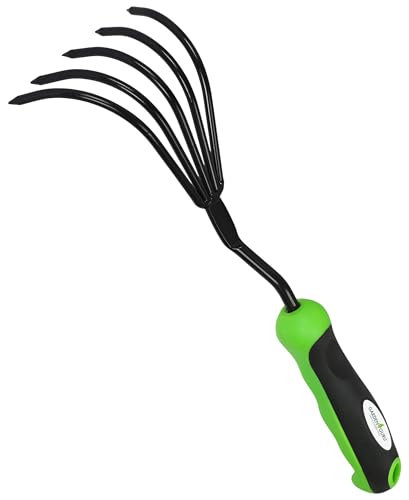
Garden Guru Hand Rake Cultivator Claw Soil Tiller with Ergonomic Handle

Walensee Heavy Duty Dual-Sided Bow Rake, 63″ Stainless Steel Handle

BARAYSTUS 16″ Wide Bow Rake, Adjustable Garden Rake for Lawn

GARDEASE Leaf Scoops, Ergonomic Large Hand Held Rakes for Yard

BARAYSTUS Thatch Rake, 15-Inch Wide Dual-Side Dethatching Rake
Meet The Standout Selections
Small beds, vegetable patches, and tight corners between perennials don’t need a stand-up rake. They need a hand tool that can reach in, scratch up the soil, and pull out a season’s worth of matted debris without chopping green growth. The Garden Guru Hand Rake is built around that exact job, with a five-tine head shaped to navigate around stems instead of bulldozing through them.
An ergonomic handle keeps wrist strain down during long weeding sessions, and the carbon steel construction holds up to the kind of gritty work that eats cheap metal. For most backyard gardeners tending flower beds, this one earns a permanent spot by the potting bench. Compared to the stand-up picks later on this list, it trades reach for precision, which is exactly the trade-off that matters at ground level.
The Case For It
- Five curved tines dig into compacted soil without slicing through shallow roots.
- Carbon steel resists warping under heavy clay and stays rigid through rough use.
- Ergonomic handle reduces wrist fatigue during extended weeding and cultivating.
- Compact head reaches into tight spots where bigger rakes simply do not fit.
- Rust-resistant finish holds up across a wet spring cleanup season.
Things To Consider
- Hand-held design means bending and kneeling for the full duration of the job.
- Five-tine width covers ground slowly on anything bigger than a modest flower bed.
Key Specs
Built With In Mind
Backyard gardeners tending modest flower beds and vegetable plots who want a hand tool that lasts more than one season.
A Better Fit Elsewhere
Anyone with a half-acre lawn should look at THE GROUNDSKEEPER II instead, since its stand-up design covers far more ground per minute.
Long-handled cultivators earn their place when you have soil to turn but knees that would rather not. The BARAYSTUS 4-Tine tiller stretches your reach up to 55 inches while still letting the four sharp tines dig in and break up packed earth. It’s a middle-ground tool between the small hand rakes earlier in this list and the wide leveling rakes coming up next.
The adjustable handle matters more than it sounds, since taller gardeners can lengthen it while shorter ones dial it back for better leverage. Carbon steel and stainless steel components resist the corrosion that finishes off cheaper tools after one wet winter. For someone prepping rows for planting without dragging out a full-size rototiller, this hits a useful sweet spot.
Bright Spots
- Adjustable 55-inch handle fits a wide range of gardener heights and reduces back strain.
- Four sharp tines break up compacted soil faster than wider leaf rakes ever could.
- Mixed carbon and stainless steel construction holds up to damp soil conditions.
- Long reach lets you cultivate established beds without stepping on the plants.
Worth Noting
- Four-tine width covers ground slower than a bow rake on big open plots.
- Long handle can feel unwieldy in tight raised beds or densely planted corners.
- Not designed for thatch removal, so it pairs with another tool for spring lawn work.
Whose Shelf It Belongs On
Vegetable gardeners preparing spring rows who want to stand upright while loosening soil around existing plants.
Reach For A Different Pick When
Your main goal is pulling thatch out of a lawn, where the BARAYSTUS Thatch Rake with its 19 curved tines per side is the more focused tool.
Most rakes demand either you push down hard or accept a mediocre pass. THE GROUNDSKEEPER II flips that expectation with spring-loaded, round, hardened steel tines that dig in on their own, so you stand upright and pull rather than hunching and shoving. Across a long Saturday of leaf pickup or spring dethatching, that ergonomic difference adds up fast.
The 21-inch head covers ground quickly without feeling unwieldy, and the fiberglass handle keeps weight down without sacrificing rigidity. Replaceable torsion spring tines are a quietly thoughtful detail, since the parts that wear out first can be swapped without junking the whole rake. Where the Garden Guru hand rake reaches into beds, this one sweeps across entire lawns.
Noteworthy Benefits
- Spring-loaded tines cut their own path, removing the need to lean hard on every stroke.
- Lightweight fiberglass handle reduces arm fatigue over multi-hour cleanup sessions.
- Versatile across leaves, pine straw, gravel, sticks, acorns, and thatch.
- Replaceable tines extend the working life of the tool past a single season.
Honest Caveats
- Spring mechanism can collect debris, so periodic cleaning keeps it working smoothly.
- More aggressive than a standard leaf rake, which may pull up loose new sod.
Quick Facts
Who It Suits Best
Homeowners with mid-size lawns who want one rake that handles leaves, pine straw, and light thatch without swapping tools.
Swap It Out When
You have heavy thatch buildup that needs real cutting action, where the BARAYSTUS Thatch Rake delivers more aggressive tine work.
Raised beds, herb planters, and container gardens ask a different question of a rake: can you work in tight soil without wrecking the box? The MECHEER three-claw cultivator answers yes with curved aluminum alloy tines shaped to dig deep and aerate without the bulk of a five-tine head. For apartment patios and balcony gardens, this kind of compact tool simply works better.
The thickened alloy body resists bending when you meet a stubborn root or a hidden rock, and the ergonomic handle keeps blisters off during long weeding passes. Compared to the Garden Guru hand rake earlier, this one trades one extra tine for a thicker, more rigid build aimed at compacted container soil. For gardeners who mostly kneel and reach, the trade-off is the right one.
A Strong Showing
- Curved three-claw design penetrates hard container soil effectively.
- Aluminum alloy body resists bending under rocky or root-heavy conditions.
- Compact head fits raised beds, planters, and tight herb garden layouts.
- Ergonomic handle reduces strain during focused, hands-on weeding.
Points To Keep In Mind
- Three-tine footprint is slow going on any open ground beyond a small bed.
- Not suited to thatch removal since the curve is built for soil penetration.
Perfect Match For
Container and raised bed gardeners who need a rigid, focused hand tool for weekly weeding in tight soil.
Look Elsewhere When
You want to clear thatch from a full lawn, where the Dremmt Lawn Leveling Rake gives far more reach and surface coverage.
Bumpy lawns are a mower’s worst enemy, since uneven ground scalps high spots and leaves low pockets scalped bare. The Dremmt Lawn Leveling Rake solves that problem with a flat 30-inch by 10-inch plate that drags across the surface, pushing soil mix into hollows while knocking down mounds. That kind of plate-based leveling reads almost like a trowel on a long handle, and the effect on rough ground is dramatic.
Available in multiple size combinations to match yard scale, the stainless steel handle resists the rust that ruins cheaper leveling tools after one season. Whether you’re filling in dog spots, prepping for sod, or smoothing a patch before reseeding, this rake does what flexible leaf rakes cannot. Where THE GROUNDSKEEPER II sweeps debris, this one shapes the ground itself.
A Few Highlights
- Flat leveling plate fills low spots and knocks down soil clumps simultaneously.
- Multiple head and handle size combinations to fit yard scale.
- Stainless steel handle construction resists corrosion across seasons.
- Works well for prepping new sod or repairing damaged lawn patches.
Trade Offs
- Not a thatch removal tool, so it complements rather than replaces a dethatching rake.
- Wide plate is harder to maneuver around curved bed edges and tight corners.
- Best results require loose top dressing material on hand to spread.
Best Suited To
Homeowners repairing uneven patches or prepping for sod who want a smooth, professional-looking lawn surface.
Consider Something Else When
Your lawn’s main problem is thick thatch rather than bumpy ground, since the Walensee Dual-Sided Bow Rake handles both jobs in one tool.
Clay-heavy or rocky soil eats garden tools for breakfast, bending thin tines and snapping cheap welds. The Garden Guru Ninja Claw steps into that fight with military-grade steel construction across all five tines, designed for the kind of conditions where lighter cultivators give up. If your soil fights back when you dig, this is the hand tool built for it.
The large five-tine layout moves more material per stroke than the MECHEER three-claw design, while the ergonomic handle keeps the extra force from translating into wrist pain. Think of it as the bigger sibling to the Garden Guru hand rake earlier in this list, sharing the brand DNA but aimed at tougher soil profiles and longer cultivation sessions.
Where It Delivers
- Military-grade steel tines resist bending in heavy clay and rocky ground.
- Five large tines move more soil per stroke than compact three-claw designs.
- Ergonomic handle absorbs torque during high-resistance cultivation work.
- Rust-resistant finish holds up through repeated damp-soil use.
- Maneuvers around existing plants without uprooting shallow stems.
A Few Limitations
- Heavier than typical hand cultivators, which can tire wrists over very long sessions.
- Overkill for soft, sandy, or already-loose garden soil.
Feature Snapshot
Who Should Grab It
Gardeners working compacted clay, rocky beds, or neglected soil that needs real force to break up.
Skip It When
You’re tending a small herb planter, where the MECHEER three-claw cultivator offers lighter, more precise work.
A bow rake with one job is useful, but a bow rake with two jobs earns its storage space. The Walensee dual-sided head puts 17 steel tines on one side for breaking up soil and pulling thatch, while the opposite side lays flat for leveling mulch, gravel, and garden beds. That kind of built-in versatility means one tool instead of two leaning against the shed wall.
Heat-treated manganese steel gives the head the kind of toughness that survives years of ground contact, and triple-welded connections keep the head from working loose under heavy use. The 63-inch stainless steel handle adds reach for taller gardeners and stands up to weather without the splintering that finishes off wooden handles. For someone rebuilding beds and lawns over a full season, the dual-sided design is the quiet win.
What Makes Sense
- Dual-sided head handles thatch removal and bed leveling in one tool.
- Heat-treated manganese steel resists wear across heavy seasonal use.
- Triple-welded head connection prevents wobble during tough pulls.
- 63-inch stainless handle resists weather damage over years of storage.
- Long handle suits taller gardeners without forcing awkward bending.
Worth Bearing In Mind
- Heavier than single-purpose tools, so longer sessions can tire shoulders.
- Wide bow rake head is harder to use in narrow raised beds or tight paths.
Made For
Year-round yard workers who want one well-built rake for soil work, thatch removal, and bed leveling.
Not Your Match When
Your priority is fast spring dethatching on a large lawn, where the BARAYSTUS Thatch Rake’s 19 curved tines per side move thatch more aggressively.
The 16-tooth design on this BARAYSTUS bow rake earns its keep by giving each stroke more cutting edges than typical bow rakes, which means faster penetration through crusted soil and stubborn weeds. For prepping beds in spring or breaking up dead root mats, that density matters more than the raw width of the head. You feel the difference on the second or third pass.
Stainless steel and carbon steel construction paired with an anti-rust coating helps the rake survive damp storage, and the triple-welded head connection prevents the wobble that frustrates gardeners with cheaper tools. Where the Walensee bow rake offers a second leveling edge, this one stays single-purpose but does that job with extra sharpness and lighter handling.
Useful Touches
- Sixteen sharp teeth deliver more cutting action per stroke than wider, sparser rakes.
- Anti-rust coating extends service life through wet storage seasons.
- Triple-welded head keeps the connection tight through heavy pulling.
- 3mm-thick head resists bending under rocky or root-heavy conditions.
- Adjustable handle fits different gardener heights comfortably.
Some Limits To Know
- Single-purpose design means pairing with another tool for leveling tasks.
- Sharp teeth can catch on hidden irrigation lines in shallow beds.
Who Will Love This
Gardeners preparing vegetable beds or breaking up weed-heavy soil who want a focused, sharp-toothed bow rake at a sensible weight.
Where Another Pick Suits Better
Anyone rebuilding lawn surfaces should consider the Dremmt Lawn Leveling Rake, which spreads and smooths in a single pass.
Sometimes the right “rake” is really a pair of oversized claws that let your hands act like a bucket. GARDEASE Leaf Scoops fit that description exactly, turning loose leaves, grass clippings, and yard debris into something you can scoop, lift, and drop without bending into a pile by hand. For anyone who finds traditional rakes punishing on the back, this is a kinder way to clean up.
The closed-claw design keeps debris contained instead of letting it slide off mid-lift, and the plastic barrier protects your hands from thorns, nettles, and rough bark during the work. They nest together for storage, which matters more than it sounds when shed space runs out. Compared to the stand-up rakes on this list, these belong to a different cleanup method entirely.
Well-Handled Touches
- Oversized claw shape scoops leaves and debris without constant bending.
- Hand barrier protects against thorns, nettles, and rough material.
- Works on wet or dry yard waste without clogging.
- Nesting design keeps storage footprint small in tight sheds.
- Doubles as a fruit-picking aid for low branches during fall cleanup.
Less Ideal Details
- Not designed for thatch removal, so it complements rather than replaces a dethatching rake.
- Slow going on large open lawns where a wide rake covers ground faster.
Right Fit For
Gardeners with back or knee issues who want to clean up leaves and clippings without bending or dragging a heavy rake.
Another Choice May Suit
Homeowners with a wide lawn should pair these with THE GROUNDSKEEPER II for faster initial sweeping before scooping details.
Serious thatch buildup calls for a purpose-built tool, not a leaf rake with crossed fingers. The BARAYSTUS Thatch Rake answers with 19 curved carbon steel tines on each side of a 15-inch head, designed specifically to slice into matted dead grass and drag it up to the surface. After a few passes, the difference between this and a generic rake becomes obvious in the pile it pulls out.
The adjustable head angle on both sides adapts to your working posture, taking pressure off the wrists during long dethatching sessions. The extended stainless steel handle keeps your back upright, which matters when you’re clearing a full lawn rather than a small patch. Think of it as the focused specialist compared to the versatile Walensee bow rake earlier in this roundup.
Everyday Advantages
- Nineteen curved tines per side cut through matted thatch efficiently.
- Adjustable head angle reduces wrist strain during long raking sessions.
- Dual-side design handles both thatch removal and soil loosening.
- Extended stainless handle suits tall gardeners without forcing bending.
- Heavy-duty head stands up to serious spring dethatching workloads.
Practical Considerations
- More aggressive than leaf rakes, so avoid using on newly seeded or fragile grass.
- Dethatching creates large debris piles that need bagging or composting afterward.
At A Glance
Who Will Love This
Homeowners with thick thatch buildup who want a purpose-built rake that pulls up matted debris in a single focused pass.
Consider Something Else When
You also need a versatile year-round rake, since the Walensee Dual-Sided Bow Rake handles lighter thatch and offers more general yard utility.
Choosing The Right Thatch Rake For Your Lawn
Match The Tool To The Job
Thatch is the layer of dead roots, stems, and runners that builds up between grass blades and soil, and a light coating under half an inch actually protects the lawn. Anything thicker than that blocks water and nutrients, which is where dethatching pays off. Match the rake to the depth of the problem: a flexible leaf rake skims the surface, while a stiff-tined thatch rake actually cuts into the mat.
For small lawns and detail work, hand tools and short-handle rakes give you control without wearing out your shoulders. Mid-size yards benefit from stand-up rakes with 15 to 21 inch heads, since you can finish the job in under an hour. Large properties or heavy thatch call for a wide bow rake with curved tines, since each stroke pulls up far more material.
Know Your Tine Types
Curved tines slice into thatch from multiple angles, while flat flexible tines tend to skate over the surface. Round, hardened steel tines last longer under repeated flexing, and replaceable tines extend the life of the tool beyond a single season. For rocky or root-heavy lawns, look for manganese or military-grade steel that resists bending when the tines meet unexpected resistance.
Carbon steel offers rigidity at the cost of slightly more weight, while aluminum alloy keeps hand tools light but trades some strength. Stainless steel components resist rust through damp storage but can cost more. The honest read is that for occasional homeowners, mid-grade steel with a rust-resistant coating delivers the best balance of price and longevity.
Handle Length And Ergonomics
Handle length matters more than most people expect. A 55-inch handle suits gardeners of average height, while 63-inch models fit taller users and reduce bending. Adjustable handles let multiple household members share the same tool, which is a quiet bonus for families. Ergonomic grips and cushioned ends reduce blisters during long sessions, so it’s worth prioritizing them on any hand tool.
Fiberglass handles keep weight down without splintering, while solid wood looks traditional but needs occasional care to prevent cracking. Stainless steel handles outlast both but add weight at the head end of the rake.
Smart Spending And Common Mistakes
Pitfalls Shoppers Hit
Choosing a flexible leaf rake for thatch work is the most common misstep, since those tines skim over the mat instead of cutting into it. Another mistake is buying the widest head available without considering storage space, since 30-inch leveling rakes don’t fit neatly into most sheds. Skipping rust protection also shortens tool life; even stainless steel benefits from a dry storage spot between seasons.
Where The Extra Money Goes
Premium rakes earn their higher cost through better steel, replaceable tines, and welded connections that don’t loosen after a season. Heat-treated manganese heads resist bending far better than basic stamped steel, and fiberglass handles outlast wooden ones without the maintenance. For gardeners who dethatch every spring, the upgrade pays back in years of reliable use instead of annual replacement.
