

Spreading manure, compost, or top dressing by hand is brutal on the back and uneven on the ground. The right spreader turns a long afternoon of pitchforking into a smooth tow behind your lawn tractor or ATV, and it changes how evenly nutrients reach your soil. Home growers managing a few acres, smallholders feeding pastures through winter, and gardeners refreshing raised beds all benefit from gear that matches the scale of the job. This list pairs tow-behind units, roller-style compost tools, ATV-mounted broadcasters, and a handheld option for tight spots, with notes on who each one actually serves.
The Main Contenders

CHAPIN 8622B TurfPro Tow-Behind Turf Spreader
Brinly Tow Behind Combination Aerator Spreader

Buyers Products UTVS16 UTV ATV Broadcast Spreader

Boss Buck ATV Seeder Spreader Wireless Control

Garden Tailor 30-Inch Compost Spreader
Thunderbay 24-Inch Compost Spreader Roller
Garden Tailor 24-Inch Compost Spreader

CHAPIN 84700A TurfPro Handheld Bag Spreader
Taking A Closer Look At The Options
For sub-acre lawn care, the CHAPIN 8622B hits a comfortable middle ground between a budget drop spreader and a professional turf unit. The 2.2 cubic foot poly hopper hooks to most riding mowers and small garden tractors, which suits weekend users who already own a mower but lack a dedicated ATV rig. The dual impeller system, where two rotating disks fling material outward, spreads seed or fertilizer in a wide arc and the auto-stop feature halts flow the moment you stop rolling.
Compared with the larger Buyers Products UTVS16 covered later, this CHAPIN is lighter, easier to store in a garage, and far less work to hitch up for a quick overseeding pass. For most homeowners with a quarter to half acre of lawn, it strikes a useful balance of capacity and control.
Real-World Strengths
- Auto-stop flow control cuts waste when you pause or back up at the end of a row.
- Dual impeller lays down a wide, even fan pattern for faster coverage.
- Poly hopper resists rust and rinses clean with a hose after granular fertilizer use.
- Compact footprint fits through standard yard gates and stores upright in most sheds.
Things To Consider
- Hopper capacity limits you to lighter materials; pelletized manure may need frequent refills on larger lawns.
- Not designed for wet, chunky compost, which is better served by the roller spreaders below.
- Wide spread pattern can throw material into flower beds if you cut too close.
Key Specs
Who It Suits Best
Homeowners with a riding mower and a lawn up to half an acre who want reliable, even coverage without stepping up to a larger tow unit.
Where Another Pick Suits Better
For thicker, wetter compost top dressing, the Garden Tailor 30-Inch Compost Spreader handles material this CHAPIN was not built for.
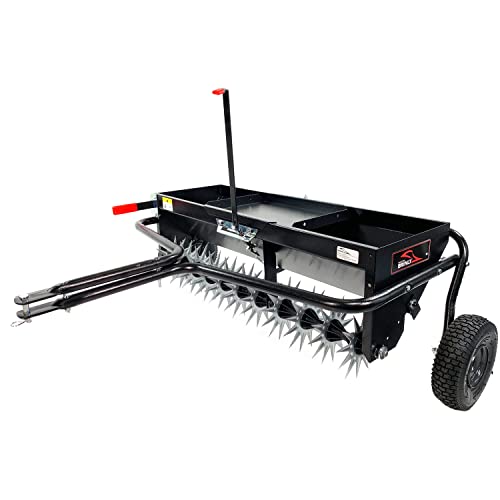
Where most entries on this list spread material across the surface, the Brinly AS2-40BH-P pulls double duty by perforating the soil while it drops seed, lime, or fertilizer. The 40-inch working width covers a meaningful swath in a single pass, and the integrated weight tray lets you add concrete blocks or sandbags to drive the steel tines deeper into compacted ground. For anyone fighting thick thatch or hard-packed clay, that two-step pass matters.
Compared with the CHAPIN 8622B reviewed above, this Brinly is heavier, slower to hitch up, and rewards patience. If your lawn responds to aeration and you already top-dress annually, the time savings stack up fast.
Well-Handled Touches
- Two-in-one design cuts a separate aeration pass, saving a full afternoon on larger yards.
- Steel tine construction handles compacted soil that lighter tools skip across.
- Weight tray accepts standard blocks, so depth settings stay customizable without specialty parts.
- Flat black powder finish resists scuffs during transport and storage.
Worth Noting
- Without added weight, tine penetration stays shallow on hard, dry ground.
- Bulkier turning radius than the CHAPIN 8622B, which complicates tight lawn edges.
- More moving parts mean seasonal inspection of tines, bolts, and the drop gate is wise.
Made For
Homeowners with compacted or clay-heavy lawns who want to aerate and overseed in the same pass.
Consider Something Else When
If your priority is broadcasting dry fertilizer over an open pasture, the Buyers Products UTVS16 is a better fit than this combo tool.
The UTVS16 sits in a different weight class than the CHAPIN and Brinly entries. With a 150 pound poly hopper and a standard 2-inch receiver mount, it bolts onto the back of an ATV or side-by-side and handles salt, fertilizer, grass seed, and animal feed across real acreage. The hopper shape, where the rounded interior feeds material toward the spinner, helps wet or clumpy product move without jamming.
For property owners managing long driveways in winter or food plots in spring, this unit covers ground the smaller tow-behinds simply cannot. Storage is straightforward, since most users leave it mounted year-round.
Where It Helps
- Receiver-mount design drops onto a standard ATV hitch in minutes.
- All-season versatility covers salt, seed, fertilizer, and feed in one unit.
- Poly hopper shrugs off rust, a real plus for users who store gear outdoors.
- Wide broadcast pattern cuts passes on open fields and long lanes.
Honest Caveats
- Requires an ATV or UTV, which raises the real cost of entry for casual users.
- Without a gate control upgrade, manual shutoff means climbing off to stop flow.
- Material prone to clumping, like damp feed, benefits from pre-screening.
Quick Facts
Best Suited To
Property owners with an ATV or UTV who need year-round material handling across acreage, driveways, or food plots.
Skip It When
For garden-scale compost work, the Garden Tailor 30-Inch Compost Spreader is a calmer and cleaner match than a 150 lb broadcast rig.
The Boss Buck takes the ATV-spreader concept and adds a wireless remote, which sounds like a small upgrade until you are halfway down a food plot and want to throttle the flow without climbing off the seat. The 80 pound hopper sits between the CHAPIN 8622B’s compact scale and the UTVS16’s full-sized capacity, making it a sensible pick for hunters and smallholders running a midsize ATV.
The adjustable nozzle helps the same machine switch between coarse grain and fine seed, so you do not need separate units for corn versus clover. Compared with the Buyers Products unit, the trade-off is a smaller hopper in exchange for the wireless convenience.
Benefits That Matter
- Wireless remote keeps you on the ATV while adjusting gate and on-off flow.
- Adjustable nozzle handles large grains and small seeds in one hopper.
- Mid-size capacity suits plots that are too big for a push spreader but too small for a 150 lb rig.
- Directional spread path keeps seed where you want it on windier days.
Points To Note
- Wireless remote needs battery checks before each use, a small but real habit.
- Hopper sits lower than the UTVS16, so ground clearance on rough trails can be tight.
- Not intended for road salt duty, where a steel-construction unit lasts longer.
Perfect Match For
Hunters and rural landowners establishing or maintaining food plots, who benefit from the wireless flow control during long, steady passes.
A Better Fit Elsewhere
If winter salt and ice management is a priority, the Buyers Products UTVS16 is built for that workload instead.
Roller-style spreaders work differently than the broadcast units above. Instead of flinging material with a spinning disk, the Garden Tailor 30-Inch rolls across the bed, releasing compost through slits in the drum as it turns. For gardeners spreading aged manure or peat moss across vegetable plots, that mechanism delivers a thicker, more even layer without the airborne dust you get from a broadcaster.
Setup is the easiest part of the deal. The proprietary support system is designed for quick assembly, and the side latches let you open the drum for cleaning without dragging out a toolbox.
Advantages To Know
- Drum-slit release pattern lays down a uniform layer of compost or peat moss.
- Designed for setup in roughly fifteen minutes, which lowers the barrier for first-time users.
- Side latches simplify cleanout between manure and peat moss loads.
- Push or tow versatility suits gardeners without a lawn tractor.
Trade Offs
- Drum slits can clog with overly wet or fibrous material, slowing the pass.
- Best on level ground; steep slopes interrupt consistent drum rotation.
- Not a substitute for a broadcast spreader when applying grass seed over a lawn.
Feature Snapshot
Who Should Grab It
Home gardeners refreshing vegetable beds and ornamental borders each season who want compost applied evenly without airborne dust.
Look Elsewhere When
For very wet or chunky manure, the Thunderbay 24-Inch Compost Spreader handles moisture this Garden Tailor may struggle with.
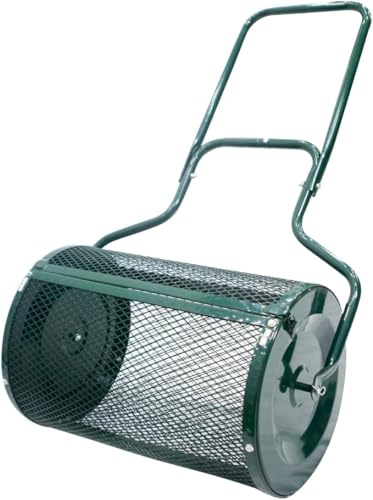
The Thunderbay differs from the Garden Tailor roller above in three ways that matter to heavy users. The drum is stainless steel, the slits are diamond-shaped for smoother release, and the side latches are upgraded for repeated open-close cycles. For gardeners who top-dress monthly rather than once a season, that build quality earns its keep.
The rust-resistant powder-coated finish is a quiet detail that pays off when the unit sits through wet winters. Compare that to the Garden Tailor 30-Inch, which favors width and fast assembly over material toughness.
Useful Strengths
- Stainless drum and powder-coated frame resist corrosion through repeated wet seasons.
- Diamond-shaped slits release material smoothly without clumping.
- Upgraded side latches hold up to repeated opening for cleanout.
- Push or tow-behind operation works across lawn tractors and walk-behind use.
Practical Considerations
- Narrower 24-inch width means more passes than the Garden Tailor 30-Inch on wide beds.
- Heavier drum takes more push effort on flat ground without a tractor.
- Stainless build raises the price relative to basic steel rollers in the category.
Built With In Mind
Frequent compost users who want a corrosion-resistant drum that survives repeated wet-season loads and cleanouts.
Reach For A Different Pick When
If you want wider coverage with faster setup, the Garden Tailor 30-Inch Compost Spreader prioritizes width and ease of assembly instead.
Smaller gardens do not need a 30-inch roller. The Garden Tailor 24-Inch keeps the same drum-slit release pattern as its wider sibling, but trims the width so it pivots easily between raised beds and tight pathways. For gardeners with limited storage space, the narrower drum also fits on a garage shelf where a wider unit would not.
Compared with the Thunderbay 24-Inch reviewed just above, the trade-off is construction rather than dimensions. Both share a 24-inch footprint, so the choice comes down to how much weather exposure the drum will see.
A Strong Showing
- Narrower drum pivots easily between raised beds and narrow garden paths.
- Same drum-slit release pattern as the wider 30-inch sibling.
- Side latches support quick cleanout between material types.
- Compact storage profile suits small sheds and garage corners.
Some Limits To Know
- Fewer inches per pass means more trips on larger plots.
- Coating is not stainless, so long-term outdoor storage can shorten lifespan.
- Lighter drum can struggle with very dense, wet manure.
The Right Fit
Gardeners with smaller plots, narrow pathways, or limited storage who still want a roller-style top dressing tool.
Swap It Out When
For wet, heavy loads across a larger property, the Thunderbay 24-Inch Compost Spreader is built tougher for that workload.
The 84700A closes out the list with a tool for the smallest jobs. With a 25 pound capacity and a handheld bag design, it works for patch repairs, overseeding thin spots, or applying fertilizer along edges where a tow spreader would overshoot into the flower bed. Crank-driven and manual, it asks for nothing more than a comfortable grip and a steady walking pace.
For anyone owning only one of the entries here, this CHAPIN is a complement rather than a replacement for a tow unit. Think of it as the patch kit you grab after a tow spreader pass reveals a few bare corners.
A Few Highlights
- Handheld size reaches spots a tow-behind cannot, like narrow side yards and slopes.
- Adjustable gate controls flow for grass seed, fertilizer, and ice melt granules.
- Light enough to carry with one hand during longer seeding sessions.
- Stores on a shelf or hook without taking floor space in a crowded garage.
Worth Bearing In Mind
- Manual cranking gets tiring across large patches compared with motorized units.
- 25 lb capacity means frequent refills on bigger repair jobs.
- Not suited for compost or manure, which clump and clog the gate mechanism.
Whose Shelf It Belongs On
Homeowners who already own a tow spreader but need a lightweight tool for spot seeding, edge work, and small repairs.
Where A Sibling Pick Shines
For full-yard top dressing, the CHAPIN 8622B TurfPro Tow-Behind Turf Spreader is the same brand’s larger-capacity answer.
Matching Spreaders To The Job You Actually Do
The first fork in the road is material type. Dry granular fertilizer, seed, and salt flow through broadcast units with a spinning disk or impeller, where a calibrated gate controls how much product drops onto the spinner. Compost, peat moss, and aged manure behave differently, so roller spreaders with slits or perforations along the drum release material as the unit rolls. Pick the wrong family and you will fight jams and uneven layers no matter how nice the build.
Capacity comes next, and it scales with the equipment you already own. A 25 lb handheld like the CHAPIN 84700A serves a backyard gardener with patch-level needs. A 2.2 cubic foot tow unit suits riding-mower owners with half-acre lawns. ATV and UTV owners managing multiple acres step up to 80 lb or 150 lb hoppers, where refill frequency drops sharply. Match capacity to your typical pass length, since refilling mid-row wastes time and disrupts pattern consistency.
Hitch style matters more than people expect. Lawn tractor hitches work for small spreaders, but UTV and ATV receivers require a 2-inch mount, and roller spreaders often run as push or tow units without a powered vehicle. Verify hitch compatibility before adding to cart, since adapters add cost and complicate storage.
Build material affects lifespan in ways that show up after a season or two. Poly hoppers resist rust from fertilizer and salt but can fade in direct sun. Stainless steel drums cost more upfront yet shrug off wet compost and manure without corroding. Powder-coated steel frames strike a balance, working well for most users who store gear under cover.
Finally, think about flow control. Manual gates work, but wireless or auto-stop systems cut waste during pauses, turns, and back-ups. For occasional users on small lawns, manual is plenty. For larger properties, those controls pay back in saved material and reduced overapplication.
Key Considerations Across These Picks
Mistakes Worth Dodging
The most common error is choosing a broadcast spreader for compost. Granular fertilizer flows freely through a gate, while damp manure clumps and stalls the spinner. Roller spreaders exist for that reason. Another slip is ignoring hitch style. A UTV-mounted unit with a 2-inch receiver will not bolt to a lawn tractor without an adapter, and that detail often surfaces only at delivery time.
Overbuying capacity is the third trap. A 150 lb hopper sounds productive, yet it adds weight your small lawn tractor may struggle to pull on slopes or wet grass. Matching capacity to your towing vehicle keeps the work safe and steady.
What The Higher Tier Buys
Premium roller spreaders trade up to stainless steel drums and upgraded latches, which hold up through repeated wet-season loads. Higher-tier broadcast units add wireless flow control, poly hoppers that resist corrosion, and auto-stop systems that save material during pauses. The upgrade makes sense for frequent users, while occasional gardeners get plenty from entry-level builds.
Frequently Asked Questions
What is the difference between a broadcast spreader and a roller spreader?
A broadcast spreader flings material outward from a spinning disk or impeller, which suits dry granular fertilizer, seed, and salt. A roller spreader releases material through slits in a drum as the unit rolls across the ground, which suits compost, peat moss, and aged manure. Pick based on material type, since each design handles its target well and the other poorly.
Can manure spreaders handle wet or clumpy material?
Roller spreaders with stainless drums and upgraded latches, like the Thunderbay 24-Inch, handle wet material better than entry-level units. Broadcast spreaders generally struggle with anything damp, so pre-screening or drying helps avoid jams. For very wet loads, a roller is the safer family.
How do I pick the right hitch style?
Match the spreader hitch to the towing vehicle. Lawn tractors use small hitch pins, while ATVs and UTVs use 2-inch receivers. Roller spreaders often run as push or tow units without a powered vehicle. Confirm compatibility before checkout to avoid adapter purchases.
Is a wireless remote worth the upgrade?
For ATV and UTV users running long passes over food plots or large yards, wireless control saves repeated stops and reduces overspray during turns. For small lawn work, manual gates work fine and cost less. The upgrade pays back when passes stretch past a few hundred feet.
How should I clean and store a manure spreader?
Rinse the hopper and drum after each use, paying attention to gates and slits where residue builds up. Dry the unit before storage to slow corrosion, especially on coated steel frames. Indoor storage extends lifespan, though poly hoppers tolerate outdoor placement better than steel components.
Bottom Line
The right manure spreader comes down to material, acreage, and towing setup. Roller units like the Garden Tailor and Thunderbay entries serve gardeners refreshing beds with compost and aged manure. Broadcast units like the CHAPIN 8622B, Brinly, Buyers Products, and Boss Buck cover dry fertilizer, seed, and salt across lawns, driveways, and food plots. Match the family to the material, match the capacity to your towing vehicle, and the work stops feeling like work.
