

If you’ve ever watched a tomato plant sulk through a heat wave or scrambled to find someone to water the porch pots before a long trip, an olla can feel like a small act of gardening magic. The premise is old: a porous clay vessel, buried in soil, slowly releases water through its walls wherever roots grow close. The picks below span simple spike-style inserts, multi-pack sets for raised beds, and one grid-based drip alternative that solves a related pain.
The Shortlist At A Glance
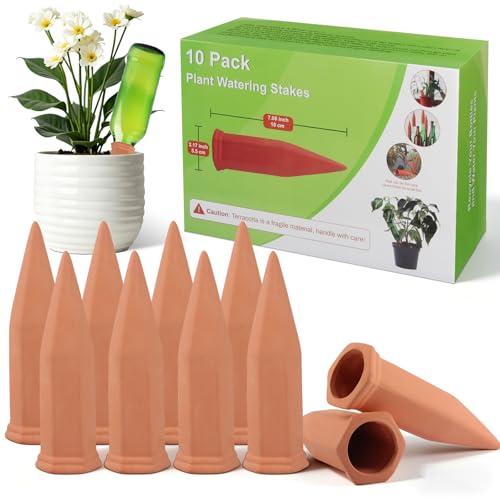
Tcamp 10 Pack Terracotta Watering Spikes

BioGreen Hydro MAX S Self-Watering Olla
SMARTILIVING Ollas Set of 4 (12oz)

Garden In Minutes Garden Grid 3×6

SMARTILIVING Ollas Set of 4 (12oz)

GARDENBRO 4 Pcs Terracotta Ollas (14 oz)

Generic 4PCS Terracotta Watering Spikes

Lovely Ran 8pcs Terracotta Watering Spikes
A Deeper Look At The Lineup
Ten spikes in a single box puts the Tcamp set ahead of almost every other option here for sheer volume. Each spike is plain fired terracotta, shaped to take an inverted bottle on top so a standard plastic water reservoir feeds the soil from above.
The “olla” label is loosely applied: these are really clay stakes you pair with a bottle, not buried vessel reservoirs. For someone with a long porch rail of mixed pots, that trade-off tends to be worth it. Compared to the BioGreen Hydro MAX S below, this is a budget-first approach rather than a single deep-buried reservoir.
What It Does Well
- Ten units let you kit out a whole patio without thinking about per-unit cost
- Porous clay walls release water only as surrounding soil dries, so moisture matches demand
- Works with common plastic bottles you already recycle at home
- No electricity, timers, or hoses required
Things To Consider
- Each spike holds far less water than a buried olla, so bottles need refilling in summer heat
- Uneven bottle threading can cause minor leaking at the spike joint, widely reported
- Top-heavy bottles tip in shallow pots without a stake deep enough
Who It Suits Best
Patio gardeners running a long row of mid-size pots who want one box to cover the whole setup and don’t mind recycling bottles into the watering routine.
Consider Something Else When
Shoppers managing one large raised bed should look at the BioGreen Hydro MAX S, whose single large vessel covers a wider radius per refill.
The BioGreen Hydro MAX S is the closest thing in this roundup to a true traditional olla. You bury the fired-clay pot up to its neck, fill it, cap it, and walk away. The 0.3-gallon capacity is meaningfully larger than the spike-style inserts earlier in this list.
The roughly 23.6-inch irrigation radius is the headline number, since it defines how many plants one vessel can serve. For a vegetable patch or a long raised bed, one MAX S can replace several smaller spikes. The set ships as a four-pack for a wider area or distributed placement.
Strengths Worth Knowing
- 0.3-gallon reservoir means fewer refills than spike-style inserts
- Wide irrigation footprint suits clusters of vegetables in a bed
- Fired clay weathers outdoor use across full growing seasons
Honest Caveats
- Larger size demands more soil to bury and steady ground to sit in
- Refilling requires pulling the cap and pouring, so a watering can is part of the routine
Made For
Vegetable gardeners and raised-bed owners who want fewer refill trips and don’t mind the modest installation effort of burying a clay pot.
A Better Fit Elsewhere
Houseplant owners tending small individual pots will get more mileage from the SMARTILIVING Ollas Set of 4 reviewed below, since those smaller vessels tuck into standard planters.
SMARTILIVING’s four-piece set sits in the comfortable middle of the olla category. Each globe holds 12 ounces of water, which is enough for a small to medium planter to coast through a long weekend. The top-fill design is the practical selling point: no digging, no flipping, just pour and walk away.
Terracotta is unfussy to clean and stores easily between seasons. Unlike the larger BioGreen Hydro MAX S, these globes slip into standard indoor and outdoor pots without disturbing root systems. For someone planning a trip and wanting a worry-free gap-filler, the format fits naturally.
A Strong Showing
- Top-refill neck keeps refilling simple, even with houseplants indoors
- 12-ounce reservoir stretches watering intervals over several days
- Four-pack spreads coverage across multiple planters at once
- Subtle terracotta color blends into most pot finishes
Points To Keep In Mind
- Smaller footprint than raised-bed systems, so one globe per plant is the realistic setup
- Glazed or very dense potting mixes wick water more slowly, which owners commonly report
Best Suited To
Indoor plant collectors and balcony gardeners who travel occasionally and want a low-maintenance bridge between waterings.
Look Elsewhere When
Anyone outfitting a full raised bed with many seedlings in a grid should reach for the Garden In Minutes Garden Grid 3×6 instead, which delivers even coverage across a whole bed.
The Garden Grid 3×6 breaks from the buried-clay-olla format entirely. It is a pre-built drip irrigation grid designed to sit on top of a raised bed soil surface, fed by a standard garden hose. Eighteen planting squares each deliver sixteen streams, so coverage is genuinely even.
Setup is the headline: place the grid, connect the hose, and you’re watering. That makes it appealing for gardeners who like the olla idea but don’t want to bury vessels across an entire bed. The catch is that this is a hose-fed system, so it leans closer to drip irrigation than to true passive clay watering.
Real-World Strengths
- Pre-assembled grid removes the guesswork of laying drip line and emitters
- Sixteen streams per square keep soil moisture consistent at root level
- 3×6 footprint matches common raised bed dimensions
- Hose-fed design suits gardeners already running a spigot nearby
Trade-Offs To Consider
- Requires a hose connection and water pressure, unlike passive clay ollas
- Grid size is fixed at 3×6, so custom bed shapes need trimming or combining
Feature Snapshot
Right Fit For
Raised-bed vegetable gardeners who want predictable, even coverage across a whole bed and already have a hose nearby.
Swap It Out When
Travelers or renters without hose access should pick the BioGreen Hydro MAX S, which works fully passive in a bed without plumbing.
This second SMARTILIVING listing is, on paper, the same 12-ounce terracotta globe four-pack reviewed earlier. The reason it appears separately is that it has been listed longer, which generally means a longer trail of user feedback and packaging iterations to learn from.
If you compare this set against the BioGreen Hydro MAX S above, the difference is capacity versus age. Each globe is small, but the four-pack covers a tidy row of standard planters with predictable behavior. For long-time SMARTILIVING fans restocking, this is the familiar format.
What Makes Sense
- Established listing often indicates refined packaging and clearer user guidance
- Top-fill neck avoids digging and root disturbance
- Terracotta porosity self-regulates flow as soil dries
- Four-pack matches a typical small-garden planter count
Small Caveats
- Same 12-ounce size as the newer SMARTILIVING set, so reservoir capacity is modest
Who Will Love This
Repeat SMARTILIVING shoppers who prefer a longer-tenured listing over the newer SKU and want a proven four-pack format.
Reach For A Different Pick When
You’d rather have larger reservoirs that handle wide beds; the BioGreen Hydro MAX S is the better match there.
GARDENBRO’s four-piece set pushes the per-vessel capacity up to 14 ounces, edging past the 12-ounce SMARTILIVING sets above. The stated moisture reach extends roughly two feet in diameter per pot, which makes these globes a sensible choice for larger planters over 15 inches wide.
The target use case leans toward outdoor beds and oversized patio pots where one globe can serve a cluster of plants. Refilling is positioned as a one-to-two-times-per-week task, which is realistic in moderate climates. In peak summer, depending on your soil, you may find that cadence tightens.
Useful Strengths
- 14-ounce reservoir stretches refill intervals compared to 12-ounce sets
- Two-foot moisture reach covers large planters and small beds
- Suitable for pots over 15 inches in diameter, a common pain point
- Multicolor finish blends into varied planter palettes
Worth Noting
- Larger size requires deeper planters or beds for full burial
- Hot, dry climates may shorten refill intervals below the weekly claim
Built With In Mind
Garden owners with oversized outdoor planters and raised beds who want fewer refill trips per week.
Skip It When
Small indoor houseplant owners should pick the SMARTILIVING Ollas Set of 4, since those smaller vessels fit standard pots more easily.
This Generic four-pack is the budget entry in the roundup. The format follows the classic terracotta spike, paired with a bottle reservoir on top. Porous clay walls slowly release water to nearby roots, matching the same wicking principle the bigger sets use.
The honest read is that, like the Tcamp ten-pack earlier, this is a stake-plus-bottle system rather than a buried olla globe. For someone curious about the category and willing to test the format on a few pots, a four-pack keeps the experiment small.
Useful Touches
- Four-spike count keeps initial outlay modest for first-time users
- Standard terracotta spike shape pairs with common plastic bottles
- Wicking principle is the same as larger, more expensive sets
Points To Note
- Generic branding means packaging and tolerances vary more than named brands
- Spikes need steady burial in soil to stand upright under a filled bottle
- Reservoir capacity is limited by whatever bottle you supply
Whose Shelf It Belongs On
Curious beginners testing whether self-watering spikes work for their setup before committing to a larger set.
Where A Sibling Pick Shines
The Tcamp ten-pack gives you more spikes per shipment for similar per-unit cost, so larger collections benefit from that scaling.
Lovely Ran’s eight-piece set lands at the high-volume end of the spike-style options. The brand recommends soaking each spike in water for eight hours before first use, which both pre-saturates the clay and helps control the flow rate once planted.
Eight units makes this set a natural fit for a long windowsill of houseplants or a row of medium patio pots. The pour-into-the-ball setup is straightforward, and lids keep evaporation down between refills. For indoor use, owners commonly report that the lower water volume suits typical room-temperature conditions.
Noteworthy Benefits
- Eight-spike count suits a full cluster of houseplants at once
- Pre-soak conditioning slows initial flow, which improves clay durability
- Lidded design reduces water loss between refills
- Pour-and-bury format works indoors without spillage
Things To Weigh
- Spikes need a long pre-soak before first use, which delays setup
- Same stake-plus-bottle format, so reservoir size depends on the bottle you use
Who Should Grab It
Houseplant enthusiasts with multiple pots who want a bulk kit and don’t mind the pre-soak step on day one.
Not Your Match When
Outdoor raised-bed gardeners get more value from the BioGreen Hydro MAX S, whose larger vessel suits open-soil layouts better than individual spikes.
What To Weigh Before Choosing Olla Watering Systems
Vessel Type And Coverage
The first real fork in the road is whether you want buried clay globes or stake-style inserts. Traditional ollas are porous pots you bury up to the neck; refilling means pouring water through the open top, and the surrounding soil pulls moisture from the walls as it dries. Stake-style inserts rely on an inverted bottle reservoir, which is simpler but holds much less water per unit. Pick based on whether you prefer fewer, deeper refills (globes) or many small reservoirs you swap more often (stakes).
Reservoir Capacity And Refill Cadence
Capacity dictates how often you walk back out with a watering can. Twelve to fourteen ounces covers a small planter for several days in mild weather, while a 0.3-gallon vessel can stretch to a week or more. Hotter climates and fast-draining soil shorten every interval, so for full-sun beds, larger reservoirs tend to be worth the extra effort.
Planter Size And Soil Type
Each vessel wicks moisture into a roughly fixed radius. Mismatched sizing is the most common frustration, since a small globe in a wide planter leaves dry zones at the edges. Dense, peat-heavy mixes wick more slowly than sandy or loamy soils, which influences how often the clay releases water. Matching vessel radius to pot diameter keeps the whole root zone evenly moist.
Placement, Cleanup, And Season Storage
Terracotta wants to stay drained in winter to avoid freeze cracking. Most sets benefit from a quick rinse and dry before being tucked away at season’s end. Burying depth also matters: too shallow and the vessel tips; too deep and refilling becomes awkward.
Key Considerations Across These Picks
Common Shopping Slip Ups
The most frequent mistake is choosing stakes for a large raised bed, or a single large olla for a wide patio of small pots. Mismatched scale means either dry spots or constant refilling. Another pitfall is forgetting that terracotta clay must be soaked before first use to control flow rate. Skipping that step can flood the soil on day one. Always confirm your planter diameter before sizing up.
Where The Extra Money Goes
Higher-tier sets tend to offer more clay per vessel, more uniform firing, and packaging that survives shipping without cracks. For casual use, a budget four-pack is often plenty. The upgrade pays off when you want larger reservoirs, wider coverage radii, or the reassurance of a longer-tenured listing for restocking across seasons.
Frequently Asked Questions
How long does an olla watering system actually last between refills?
In mild weather, a 12-ounce globe typically waters a medium planter for several days, while a 0.3-gallon vessel in a raised bed can stretch toward a week. Heat and fast-draining soil shorten every refill interval.
Can I leave ollas outdoors through winter?
Most terracotta ollas tolerate cold, but waterlogged clay can crack in hard freezes. The common move is to empty, rinse, and store them indoors until spring.
Do olla watering systems work with all soil types?
They work best in loamy or sandy soils that wick moisture freely. Heavy peat or dense mixes slow water movement, so you may see slower release and need to monitor soil moisture by feel.
How many ollas do I need per bed?
A rough rule is one standard olla per two to three feet of bed width. Larger vessels with wider reach, like the BioGreen Hydro MAX S, can space out further than smaller globes.
Are bottle-based spikes the same as traditional ollas?
They use the same porous-clay principle but rely on an inverted bottle rather than a buried reservoir. The watering behavior is similar, but refill intervals and capacity are quite different.
Closing Remarks
The right olla watering system comes down to how many pots you tend, how much sun they get, and whether you’d rather refill less often or bury fewer vessels. Match capacity and radius to your actual setup, and the rest of the season tends to take care of itself.
