

Bug season has a way of creeping up before the lawn even thinks about greening up, and the right granule in the spreader saves a whole summer of hand-spraying. Containered plants on the patio, a sprawling half-acre lawn, and a tiny herb patch along the back fence all need different approaches. This roundup sorts through eight granule options that cover ornamentals, turf, and crawl spaces without forcing a single one-size solution. The picks run from systemic plant treatments to cedar-based repellents, so there’s a fit whether you want chemistry, biology, or scent doing the work.
The Leading Options At A Glance

Hi-Yield 31228 Systemic Insect Granules
BioAdvanced Complete Insect Killer Granules

Talstar PL Granules Insecticide
Sevin Lawn Insect Granules

RobiGuard Diatomaceous Earth with Peppermint
GranuCide Cedar Granules 8 lbs

Bayer Merit 0.5 Granular Insect Control

Maxforce Complete Granular Bait
More Details On Our Top Picks
A small 1-pound shaker bottle treats containered roses on the patio or a short row of foundation shrubs without dragging out a spreader. Systemic insecticides (those absorbed by the roots and carried through the plant’s vascular system) make sense when sap-sucking insects keep returning despite foliar sprays, because the chemistry lives inside the leaves rather than sitting on the surface. Hi-Yield’s formulation lists aphids, whiteflies, leafminers, and lace bugs among its targets, which covers the usual suspects on roses, hibiscus, and similar ornamentals. The granular format also makes measuring straightforward: a scoop, a sprinkle, a watering-in.
Unlike the larger turf-focused bags from BioAdvanced and Sevin later in this roundup, this one is sized for a homeowner with a dozen pots rather than a half-acre lawn. Gardeners working a balcony or courtyard get the right scale without paying for chemistry they’ll never use.
Positive Takeaways
- Root-absorbed formula keeps working through new growth, so fresh leaves get protected automatically.
- Small 1-pound package fits a single application across a modest collection of ornamentals.
- Targets the soft-bodied pests that hit roses and flowering shrubs hardest during peak summer.
- Granule format avoids the drift and inhalation concerns of spray concentrates near open blooms.
Things To Consider
- Coverage window runs roughly two months, so repeat applications are needed across a long growing season.
- Containered plants respond best with measured dosing, since the active ingredient concentrates in a smaller root zone.
Key Product Details
Made For
Patio gardeners and rose growers fighting recurring aphid and whitefly pressure on containered ornamentals.
Look Elsewhere When
You’re managing lawn-wide grub or mole cricket damage, where the BioAdvanced Complete Insect Killer Granules cover the soil-surface pest list more directly.
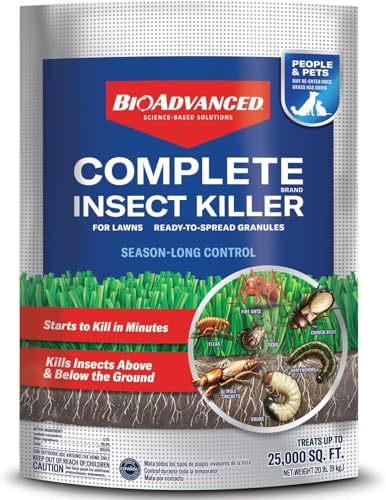
A 20-pound bag covers a meaningful slice of suburban lawn without forcing a midseason refill, which matters when pests show up at the same time the grass needs every watering cycle you can give it. BioAdvanced markets this formula for both surface and subsurface insects, including ants, fleas, ticks, chinch bugs, mole crickets, and grubs. That dual-action positioning makes it a sensible pick for homeowners who don’t want to buy one product for ticks and another for grubs. The ready-to-spread granule format also skips the mixing step, so the spreader comes out and the job moves quickly.
Compared with the smaller Hi-Yield systemic bottle reviewed above, this is a turf-scale treatment aimed at square footage rather than individual plants.
Notable Upsides
- Targets ants, fleas, ticks, chinch bugs, mole crickets, and grubs in a single application pass.
- Ready-to-spread granules drop straight into a broadcast spreader with no pre-mixing.
- Useful around ant mounds as a perimeter treatment beyond the lawn itself.
Trade Offs
- The broad pest list covers listed insects specifically, so non-listed species may still thrive.
- Coverage claims assume uniform spreader calibration; missed strips leave untreated pockets where pests rebound.
- Bags of this size need dry storage to prevent clumping between applications.
Whose Shelf It Belongs On
Suburban homeowners managing a quarter-acre or larger lawn with mixed surface and subsurface pest pressure.
Swap It Out When
You’re only treating a few foundation plantings and don’t need the volume; Hi-Yield 31228 Systemic Insect Granules fits a smaller scale more economically.
Talstar’s sand-core granule is built to push through mulch and turf thatch without demanding immediate irrigation, which removes a step that often gets skipped in real life. The product claims a two-to-four-month residual, which lines up with the longer intervals between treatments that landscape contractors typically prefer. Outdoor ant and flea pressure around patios, fence lines, and foundation plantings tends to respond well to broadcast application of this material. The formulation is widely used in commercial pest management, which signals a level of consistency that translates to homeowner results when applied at label rates.
This one sits between homeowner-friendly BioAdvanced and professional-grade Bayer Merit on the scale of coverage ambition.
Well-Handled Touches
- Sand-core granule structure penetrates mulch and grass without watering-in.
- Two-to-four-month residual window reduces repeat-application trips across the season.
- Performs against outdoor ants and fleas along property perimeters and foundation lines.
Points To Note
- Residual length depends on rainfall and soil contact, so dry climates may see shorter effective windows.
- Not labeled for every landscape pest, so supplemental treatments might still be required.
Right Fit For
Homeowners with established landscapes who want fewer application rounds and broadcast coverage along fence lines and foundation beds.
Reach For A Different Pick When
You’re battling a wide variety of listed lawn pests beyond ants and fleas, where Sevin Lawn Insect Granules covers a broader pest list.
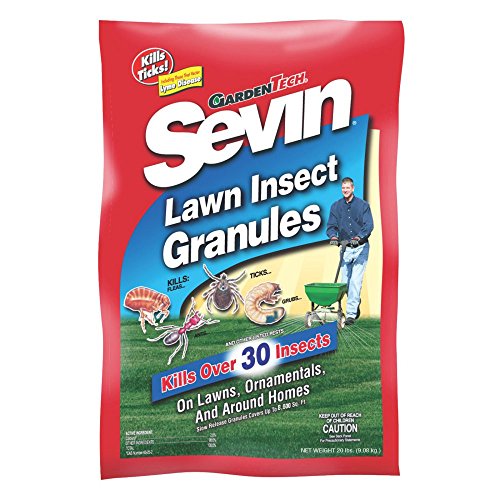
Sevin’s 20-pound bag reads like a broad-spectrum answer for homeowners who don’t want to play pest detective every weekend. The label covers more than thirty listed pests, including ticks, fleas, ants, and various worm species that turn a green lawn into a brown mess by August. Loaded into a broadcast spreader, the granules cover thousands of square feet in a single pass, which suits larger suburban lots or rural properties. The brand also supports perimeter use around homes and applications in flower beds and ornamentals, adding flexibility beyond pure turf treatment.
Versus Bayer Merit reviewed further down, Sevin leans toward surface and perimeter pests rather than systemic turf protection.
The Value In It
- Targets over thirty listed pests, which simplifies product selection for mixed infestations.
- Works on lawns, ornamentals, and around home foundations from the same bag.
- Large 20-pound format covers extensive square footage in one spreader pass.
- Suitable perimeter treatment for tick and flea pressure in tall grass.
Honest Caveats
- Requires thorough watering after spreading to release the active ingredient, which adds a step on application day.
- Some vegetable garden uses are restricted, so always check the label before treating edible beds.
- Heavy bags need a dry storage spot to prevent clumping between seasons.
Feature Snapshot
Best Suited To
Owners of larger properties who want one bag to handle perimeter ticks, lawn grubs, and ant trails without juggling products.
Skip It When
You’re only treating indoor or pet-area pests; RobiGuard Diatomaceous Earth with Peppermint fits that smaller, contained footprint better.
RobiGuard’s pitch is straightforward: a food-grade diatomaceous earth (a fine powder made from fossilized algae that damages insect exoskeletons through abrasion and dehydration) blended with peppermint oil, packaged for households that want pest control without synthetic chemistry in living spaces. The product targets crawling insects like ants, roaches, fleas, silverfish, and bed bugs along baseboards, under sinks, and in pantry corners. Peppermint adds a sensory dimension that many homeowners appreciate, and the powder format works where sprays would stain fabrics or settle unevenly. A 1-pound bag handles a modest home or apartment without overcommitting budget.
This option sits apart from the lawn-scale products in this roundup and complements them by handling interior and enclosed-space pest issues.
Useful Touches
- Food-grade formula suits homes with curious pets and small children who investigate corners.
- Targets crawling insects across kitchens, bathrooms, and basements without aerosol drift.
- Peppermint oil adds a pleasant scent during application, unlike many synthetic dusts.
A Few Limitations
- Wet conditions reduce effectiveness, so outdoor garden beds need reapplication after rain.
- Coverage depends on getting the powder into cracks and voids, which takes patience along baseboards.
- Works through physical action rather than fast knockdown, so heavy infestations need repeated applications.
Technical Highlights
Who It Suits Best
Pet owners, parents of toddlers, and renters who need crawl-space defense without synthetic residues indoors.
A Better Fit Elsewhere
You’re spreading across open lawn square footage; BioAdvanced Complete Insect Killer Granules handles turf-scale coverage with broader pest reach.
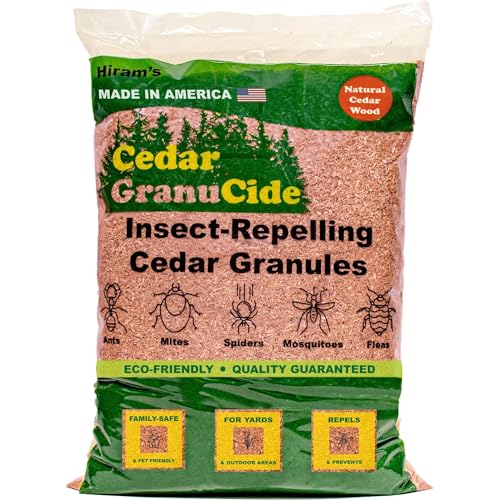
Cedar-based repellents lean on aroma rather than chemistry, and GranuCide packages that approach in an 8-pound bag sized for garden borders and patio perimeters. The cedar scent acts as a deterrent against ants, aphids, spiders, mosquitoes, and similar pests that homeowners would rather keep at a distance. The product markets itself as safe around people and animals, which suits households where synthetic insecticides feel like overkill. Sprinkled around vegetable beds, along fence lines, or in flower borders, the granules create a scented buffer that doubles as light mulch.
Where Talstar and Sevin rely on insecticidal action, GranuCide keeps pests away through scent, making it a complementary pick rather than a direct replacement.
What It Does Well
- Untreated cedar makes the product safe around kids, pets, and edible garden beds.
- Repels a broad pest list including mosquitoes, ants, spiders, and aphids through scent rather than contact kill.
- Doubles as light mulch that holds moisture around the base of ornamentals.
Worth Bearing In Mind
- Aroma fades after a few weeks, so reapplication keeps the deterrent effect active through the season.
- Heavy rain washes granules into the soil, reducing the surface buffer until fresh material is spread.
Quick Facts
Who Should Grab It
Edible garden growers and pet households who want a scented buffer around play areas and vegetable beds.
Consider Something Else When
You need fast knockdown of an established ant trail or flea infestation; Talstar PL Granules Insecticide offers contact activity with a longer residual.
Bayer’s Merit formulation has a long track record in professional lawn care, and the 30-pound bag reflects that heritage with coverage aimed at serious acreage. The active ingredient, imidacloprid, moves systemically through turfgrass, trees, shrubs, and ornamentals after watering in, providing protection against insects that feed on plant tissue. Label use covers turfgrasses, trees, shrubs, evergreens, flowers, foliage plants, and ground covers, which makes it versatile across mixed landscapes. Application rates are capped at 80 pounds per acre per year, a detail that matters for anyone calibrating a spreader for a full property.
Among the granular options here, this is the one that scales furthest for estates or acreage while still being homeowner-applicable.
Everyday Wins
- Systemic action protects turf and ornamentals from insects that feed on treated plant material.
- 30-pound bag supports large properties and multi-zone landscape treatment.
- Label covers a wide plant range from turfgrass to shrubs and ground covers.
Factors To Consider
- Annual application caps require careful record-keeping across repeat treatments on the same acreage.
- Heavy bag demands a dry storage area and a spreader that handles larger hopper loads.
- Professional-grade chemistry may exceed the needs of a small residential lawn.
Core Details
Perfect Match For
Owners of larger properties, estate managers, and serious DIY lawn-care enthusiasts comfortable calibrating professional-grade spreaders.
Not Your Match When
You’re managing a quarter-acre suburban lot and don’t need acreage-scale coverage; Sevin Lawn Insect Granules offers a more measured fit.
Maxforce Complete takes a different route from the repellent and contact-kill granules earlier in this list: it works as a bait, drawing insects to a food-based matrix laced with hydramethylnon. The granule combines proteins, simple sugars, fats, and complex carbohydrates, which gives it broad appeal across species with different dietary preferences. Ants, silverfish, and roaches carry the bait back to colonies, where the active ingredient spreads through the population. An 8-ounce package handles targeted placements along ant trails, behind appliances, and in basement corners rather than broadcast lawn application.
This is the right tool for homeowners facing persistent indoor ant trails or roach sightings rather than outdoor lawn pressure.
Strengths Worth Knowing
- Food-based matrix attracts ants, silverfish, and roaches that ignore contact treatments.
- Colony-level delivery reduces the chance of surface survivors repopulating the infestation.
- Small 8-ounce package fits targeted placements in kitchens, basements, and utility rooms.
Some Limits To Know
- Placement requires identifying trails or harborages, which means a little reconnaissance before application.
- Wet areas reduce palatability, so moisture-prone spots need dry placement or refresh.
- Pet access to baited areas should be managed to prevent curious noses from reaching the granules.
Built With In Mind
Apartment dwellers and homeowners dealing with persistent indoor ant or roach colonies that other treatments haven’t resolved.
Where Another Pick Suits Better
You’re focused on lawn and landscape defense; GranuCide Cedar Granules offers garden-border coverage without indoor-bait chemistry.
What Matters Most When Choosing Insect Granules
Match The Granule To The Pest, Not The Other Way Around
The first filter is always the pest you’re actually fighting. Sap-sucking insects on roses and ornamentals respond to systemic granules that move through plant tissue, like Hi-Yield’s offering, while lawn-scale grubs and surface insects call for broadcast products with broader pest lists. Indoor crawl-space issues typically need bait-based or powder-based approaches. Picking the right category first saves money and reduces the frustration of applying the wrong chemistry for the job.
Consider Where The Granule Goes
Yard, patio, garden bed, kitchen, and basement each demand a different formulation. Outdoor turf benefits from ready-to-spread broadcast granules, while containered plants need measured doses for smaller root zones. Indoor spaces call for food-grade or scent-based options that fit household safety expectations. The format should match the location, and the location usually dictates whether a shaker bottle, a 20-pound bag, or a bait tin makes sense.
Think About Application Effort And Frequency
Some granules require watering-in to activate, while others work dry. Residuals run anywhere from a couple of months to a full season depending on the chemistry and weather conditions. Homeowners with limited time for repeat applications tend to favor longer-residual options, while gardeners who enjoy regular garden rounds may prefer shorter-window products that fit a routine.
Storage And Handling Realities
Granular products last longer when stored dry, and heavy bags need a shed or garage spot where moisture won’t reach them. Pet and child households may want to skip broadcast applications in play areas, leaning instead on targeted placement or scent-based alternatives. Planning storage ahead of purchase prevents half-used bags from clumping in a corner of the garage.
Key Considerations Across These Picks
Where Shoppers Go Wrong
A common misstep is picking a broad-spectrum lawn granule for a small container garden and overapplying because the bag suggests acreage-scale coverage. Another is treating outdoor perimeter pests with an indoor bait and wondering why nothing changes. Always read the label’s target pest list and the use-site language before assuming any granule is interchangeable. Treating the right pest in the right place is half the battle.
What The Higher Tier Buys
Larger bags and professional-grade formulations typically bring longer residuals, broader pest coverage, and lower per-application cost over a full season. The Bayer Merit and Sevin bags priced at the higher tier deliver coverage that homeowner-grade products can’t match on acreage. Spending up makes sense when a single treatment needs to cover thousands of square feet, while smaller-scale gardens get more value from compact systemic or natural options that match the footprint without waste.
