

A patchy lawn rarely comes down to bad grass. More often it’s the irrigation pattern, the throw distance, or the spray type that decides whether water reaches every corner evenly. Whether you’re retrofitting an older system, starting a brand-new layout, or just swapping a few tired nozzles, the right irrigation sprinkler heads change how your yard actually drinks. This roundup walks through eight solid options across pop-up sprays, gear-drive rotors, drip emitters, micro-bubblers, and impact heads, with notes on who each one really serves.
A Side-By-Side Look

Rain Bird 1804VAN 4-Inch Pop-Up Sprinkler Head

Rain Bird 32SA Gear Drive Rotor 19-32 Ft

Eden 98063 Flex Design Above-Ground Sprinkler Set

Romanend 60-Pack Adjustable Drip Emitters

Rain Bird MBF4PKS Micro-Bubbler 4-Pack

HolyMaji 10-Pack 12AN Variable Arc Nozzles
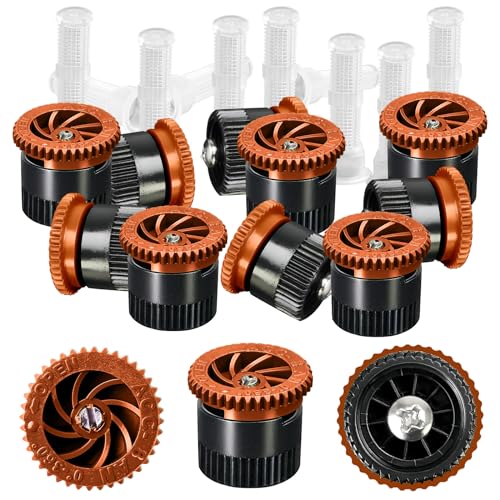
HolyMaji 10-Pack 8AN Variable Arc Nozzles

Ferraycle 1/2-Inch Brass Impact Sprinkler Head
The Strengths Of Each Pick
The Rain Bird 1804VAN is the kind of spray head that quietly anchors a lot of residential systems, and for good reason. Its 4-inch pop-up clears most lawn grasses without constant clipping, and the variable arc nozzle lets you dial a tight 90-degree wedge in a side yard or open it up to a wide sweep across a broad lawn. The half-inch female threaded inlet drops onto standard swing-pipe risers without odd adapters, which makes new installs and repairs less painful.
It sits inside the wider 1800 Series platform, which means replacement nozzles and parts are widely available. For most mid-sized lawns with mixed planting beds nearby, this one tends to be the easy default. Compared with the long-throw rotor you’ll see further down this list, the 1804VAN trades distance for a softer, closer spray that suits tight corners and odd shapes.
Real-World Strengths
- Variable arc from 0 to 360 degrees lets you water a curved bed edge or a square lawn corner with the same head.
- 4-inch pop-up riser clears St. Augustine, Bermuda, and similar taller turf, so the spray stays above the grass blades.
- Standard 1/2-inch threaded inlet fits mainstream swing assemblies and cut-off risers.
- Sits in a long-running platform, so spare nozzles and internal assemblies stay easy to source.
- Fixed spray pattern behaves well at lower pressure, which suits older homes with modest supply.
Trade Offs
- Fixed-spray heads throw shorter distances than rotors, so larger lawns end up needing many more of them.
- Internal filters need occasional rinsing in areas with hard water or sandy sediment.
- Best matched with spray nozzles; pairing it with rotors on the same zone creates uneven precipitation.
Key Specs
Best Suited To
Homeowners planning a new spray zone in a yard under about 4,000 square feet with mixed bed edges.
Look Elsewhere When
Open turf larger than a quarter acre pushes you toward the Rain Bird 32SA Gear Drive Rotor for fewer heads and longer throw.
Where the pop-up spray head focuses on tight shapes and short throws, the Rain Bird 32SA picks up the pace. It’s a gear-driven rotor, which is a fancy way of saying a small gear train inside the body rotates the nozzle slowly through its arc, delivering heavier droplets across 19 to 32 feet. That range handles the middle of a big lawn with far fewer heads than a spray layout would need.
The body is water-lubricated, meaning the same flow that drives the spray also cools the gear assembly, which is a tidy bit of engineering. Top-of-body pattern adjustment means you don’t need to dig up the head to set the arc, and a fast-forward feature lets you check the rotation without running a full cycle. For folks who manage larger lawns and want fewer heads per zone, this is a step up from the 1804VAN without crossing into commercial territory.
Where It Helps
- 19 to 32 foot throw cuts head count on open lawn areas, simplifying zone design.
- Water-lubricated gear drive keeps the internal assembly cooler during long cycles.
- Top-access pattern adjustment means a flat-blade screwdriver and a few minutes is all you need for setup.
- Larger droplet size resists wind drift better than fine mist sprays.
Honest Caveats
- Full-circle model only, so narrow strips and bed edges still call for a different head type.
- Rotor zones run longer than spray zones, which lengthens watering time per cycle.
- Pressure-sensitive: undersized supply lines can leave the rotation sluggish.
Made For
Homeowners or light-commercial properties with open turf areas of roughly 1,500 square feet or more per zone.
Skip It When
Your yard is mostly irregular beds; the Rain Bird 1804VAN pop-up handles those shapes more naturally.
Not every irrigation need calls for a buried system. The Eden Flex Design set is a no-dig option: snap together the hose, place the heads where you want them, and adjust the spray angle by hand. Four sprinklers, four extensions, and the connecting hose ship together, so the install is essentially plug-and-water. That makes it a thoughtful fit for renters, odd-shaped gardens, or anyone who simply isn’t ready to trench a yard.
The flex extensions lift the spray above taller plantings, which is the kind of detail that matters once you’ve watched a tomato canopy swallow a low-set sprinkler. Because the system sits above ground, you can rearrange it mid-season as beds shift. Compared with the in-ground picks above, Eden trades permanence for portability, and for many casual gardeners that’s the right trade.
Useful Touches
- Modular hose layout bends around corners and obstacles that a rigid pipe run wouldn’t allow.
- Adjustable spray angle and flow per head handles mixed plant heights in one pass.
- Extension risers lift the spray above taller annuals and vegetable canopies.
- Whole setup packs away for winter storage in apartments or short-term rentals.
Small Caveats
- Above-ground hose is a trip hazard in play areas and busy pathways.
- Sun-exposed tubing tends to wear faster than buried PVC.
- Not a match for a fully automated timer-based schedule out of the box.
Feature Snapshot
Right Fit For
Garden owners who need a flexible, re-arrangeable watering layout more than a permanent in-ground network.
Consider Something Else When
You want a hidden system that runs on a timer; the Romanend drip emitters and Rain Bird pop-ups handle automation more cleanly.
Drip irrigation works on a different principle than spray heads: it pushes a slow, measured trickle of water right at the root zone, which is where plants actually drink. The Romanend 60-pack gives you enough emitters to wire up a long bed, a hedge row, or a sprawl of container plants without running out halfway through. Each emitter accepts 1/4-inch tubing, which is the standard drip-line size used across most DIY kits.
The adjustment knob on top of each emitter lets you tune flow per plant, so a thirsty tomato gets more than a drought-tolerant herb in the same bed. Plastic construction keeps cost down while still holding up to UV exposure for typical seasons. If you’ve been running a Rain Bird spray head over a bed and watching the water evaporate off the leaves, this is the workmanlike upgrade that quietly solves that problem.
Where It Excels
- 60-piece count supports a large garden expansion without ordering more pieces mid-project.
- Adjustable flow per emitter handles tomatoes, peppers, and shrubs side by side.
- Wide water passages reduce clogging in hard-water areas compared with cheaper pinpoint emitters.
- Snaps into 1/4-inch tubing without specialized tools.
Points To Keep In Mind
- Filters need cleaning on a schedule in mineral-heavy water.
- Not a substitute for sprinklers on open turf; drip shines in beds and containers.
- Tube layout requires planning, since emitters spaced too far apart leave dry zones between plants.
Spec Overview
Who It Suits Best
Garden owners watering mixed beds, vegetable rows, or containers where overhead spray wastes water.
Not Your Match When
You need broad lawn coverage; the Rain Bird MBF4PKS Micro-Bubbler handles individual plants more precisely, and rotors handle turf.
The MBF4PKS sits between a drip emitter and a small spray head, which makes it the right tool when you want gentle, low-volume coverage around a shrub or tree base. It pushes out up to eight streams in a 360-degree pattern, and the twist cap adjusts the throw from 0 to about 3 feet. Staked on a barbed fitting, it pushes directly into 1/4-inch tubing, so adding one to an existing drip run takes about ten seconds. For a new shrub or a thirsty foundation planting, that’s a satisfyingly tidy install.
The shut-off option on the cap is a small but meaningful touch: during rainy stretches you can close individual emitters without ripping up tubing. The flow also stays low enough to avoid blasting delicate foliage, which is the kind of detail that matters around young plants.
Points In Its Favor
- Eight-stream pattern covers a wider footprint than a single-point emitter.
- Twist cap adjusts throw from 0 to roughly 3 feet, matching plant size.
- Built-in shut-off option lets you close individual emitters without cutting tubing.
- Barbed inlet attaches to standard 1/4-inch drip tubing with no extra fittings.
Some Limits To Know
- Four-pack may leave larger projects short; pair with the 60-pack emitters above for bigger beds.
- Not suited to lawns, where the spray pattern is too small and gentle.
- Mineral-heavy water can leave scale on the cap threads over time.
Perfect Match For
Garden owners watering newly planted shrubs, rose beds, or small trees with targeted root-zone moisture.
Reach For A Different Pick When
You want a high-volume spray across a lawn; that’s the territory of the Rain Bird 32SA Gear Drive Rotor.
If your existing pop-up bodies are still healthy but the spray heads have grown tired, cracked, or clogged past saving, the HolyMaji 12AN nozzles step in as a cost-effective refresh. Ten nozzles come in the pack, enough to overhaul an entire small-to-mid zone and keep a few spares in the garage. The 12AN designation points to a roughly 12-foot spray distance, which is the middle of the residential spray range.
The textured top edge turns easily with wet fingers, which sounds trivial but matters when you’re dialing the arc on every head. Like the Rain Bird 1804VAN earlier in this list, the 0-to-360-degree range handles narrow side strips and wide lawn sections from the same nozzle. For shoppers replacing worn heads rather than building a new system, this is a tidy bulk option.
What Helps Most
- Ten-piece pack supports a full zone refresh plus bench spares.
- Textured top edge adjusts easily even with wet hands.
- 12-foot throw matches common residential layout dimensions.
- Variable arc covers side strips, corners, and wide sweeps in one nozzle type.
Factors To Consider
- Designed as replacement nozzles, so they need a compatible pop-up body.
- Plastic threads can cross-thread during install; hand-tightening with care prevents that.
Whose Shelf It Belongs On
Anyone rebuilding a worn spray zone with existing Rain Bird or compatible pop-up bodies still in good shape.
Where Another Pick Suits Better
If the body itself is shot, the Rain Bird 1804VAN pop-up head arrives as a complete assembly rather than a nozzle-only swap.
Where the 12AN nozzles above throw roughly 12 feet, the 8AN trims that down to about 8 feet, which suits narrow lawn strips, oddly shaped courtyards, or planting beds bordered by hardscape. The brown color blends a bit better with mulch than bright plastic, which is the kind of small visual detail that matters once you’re staring at a dozen heads across a tidy bed edge.
Functionally it shares the same 0-to-360-degree arc range as its sibling, so the install and adjustment process feels familiar if you’ve used the 12AN version before. For a project that mixes narrow strips and tighter zones, pairing this pack with the 12AN can give you a complete refresh without overspraying onto paths and driveways.
Bright Spots
- 8-foot throw fits narrow lawn strips and tight courtyards without wasted overspray.
- Brown tone blends with mulch and soil better than brighter plastics.
- Variable arc from 0 to 360 degrees covers the same shape range as the 12AN.
- Ten-piece pack matches the 12AN for parallel zone refreshes.
Where It Is Less Suited
- Shorter throw means more heads per zone on larger lawn areas.
- Like the 12AN, needs a compatible pop-up body to install.
Who Should Grab It
Shops refreshing pop-up bodies in tight courtyards, side-yard strips, or bed-edge zones.
A Better Fit Elsewhere
For wide-open lawn areas, stepping up to the HolyMaji 12AN pack reduces head count on the same project.
Impact sprinklers are the older, click-click-click style you remember from parks and big backyards. The Ferraycle brings that tradition into a brass-bodied head that shrugs off the kind of sun exposure and rough handling that cracks plastic. Two heads arrive in the box, which lets you alternate use and extend the working life of each. The 1/2-inch inlet threads onto a standard garden hose fitting or a rigid riser, depending on how permanent you want the install to be.
The 0-to-360-degree adjustment and heavy-duty build suit farms, orchards, and very large yards more than a tidy residential lawn. The pattern is coarser than a spray nozzle, which actually helps in wind. For shoppers who want a forgiving, repairable head that doesn’t mind getting knocked around, this is a refreshing change from delicate pop-up bodies.
Real Benefits
- Brass body resists UV damage, mineral buildup, and rough handling far better than plastic.
- Two-head pack supports rotation between units to extend working life.
- Coarse droplet pattern holds up better in windy open spaces than fine mist sprays.
- Standard 1/2-inch inlet threads onto common hose fittings and risers.
Honest Caveats
- Above-ground body is more visible and easier to damage than a pop-up head.
- Higher flow demands may not suit homes with restricted supply pressure.
- Coarser droplets can damage very delicate flower petals if aimed too close.
Who Will Love This
Property owners managing large yards, food gardens, or small-acreage pastures who want a rugged, repairable head.
Swap It Out When
Your project is a residential lawn with mixed beds; the Rain Bird 1804VAN and 32SA split that work more elegantly.
What Matters Most Before Choosing Irrigation Sprinkler Heads
Match The Head Type To The Area You’re Watering
Pop-up sprays, rotors, drip emitters, micro-bubblers, and impact heads each solve a different problem. Pop-up sprays and short-throw nozzles like the HolyMaji 8AN and 12AN handle small-to-mid lawns and bed edges cleanly. Rotors such as the Rain Bird 32SA cover wider turf with fewer heads. Drip emitters and bubblers focus on root zones in beds and around shrubs, where overhead spray wastes water. The right mix usually means more than one head type in the same yard.
Pay Attention To Pressure And Precipitation Rate
Heads on the same zone should deliver water at roughly the same rate. Mixing a rotor with a spray nozzle on a single zone leaves dry patches on one side and puddles on the other. Check your home’s static water pressure before choosing long-throw rotors, since they need stronger flow than mist-style sprays to rotate properly. Drip systems run on much lower pressure and typically need a pressure regulator at the tap.
Think About Maintenance And Seasonal Storage
Pop-up bodies sit below the lawn most of the year but still need occasional nozzle cleaning and riser inspection. Above-ground systems like the Eden Flex Design set can be drained and stored for winter in regions with hard freezes. Drip emitters need filter cleaning on a regular schedule, especially in hard-water areas. Brass impact heads last longer with occasional wipe-downs, but their exposed bodies take more cosmetic abuse than buried heads.
Plan For Future Expansion
Buying in bulk packs like the Romanend 60-emitter set or the HolyMaji 10-nozzle packs leaves spares on the shelf for inevitable repairs. For larger projects, sticking within one platform (Rain Bird 1800 Series bodies plus Rain Bird nozzles, for example) keeps the parts inventory simple. Mismatched threads and odd inlet sizes are the kind of friction that turns a Saturday project into a Tuesday project.
Smart Choices That Pay Off Later
Wrong Turns To Avoid
A common slip is choosing heads purely on throw distance. A rotor that throws 30 feet onto a 10-foot-wide lawn wastes enormous amounts of water onto sidewalks and fences. Another is mixing precipitation rates on the same zone, which leaves grass looking like a patchwork quilt. Skipping a filter on a drip system is the third classic mistake: emitters clog fast without one, and the problem is invisible until plants start wilting.
When Paying More Pays Off
Spending more on rotors and brass impact heads usually buys durability and longer service life rather than better spray. Premium spray bodies often include pressure regulation and sealed nozzles that hold up better in dirty water. For drip systems, the extra cost tends to buy clog-resistant labyrinth passages and UV-stabilized plastic. The honest read is that upgrades pay off most in yards with tough water, large open turf, or simply a long ownership horizon where replacement costs add up.
Frequently Asked Questions
What Is The Difference Between A Spray Head And A Rotor?
A spray head pops up and delivers a fixed fan-shaped mist over a short distance, typically 4 to 15 feet. A rotor rotates one or more streams across a longer arc, often 15 to 35 feet. Sprays suit small and oddly shaped areas, while rotors cover wide-open turf more efficiently.
How Far Apart Should Sprinkler Heads Be Placed?
Spacing depends on the head type and manufacturer pattern, but a common rule is head-to-head coverage, meaning each head throws water all the way to the next head. For most residential sprays, that translates to roughly 8 to 15 feet between heads. Rotors usually space at 18 to 30 feet apart.
Can Drip Emitters Replace Sprinklers For A Lawn?
Drip emitters are designed for plant-by-plant watering in beds, not for turf. A lawn needs broad, even coverage that drip lines cannot deliver economically. Stick with sprays or rotors for grass and use drip for shrubs, vegetables, and containers.
Do Brass Sprinkler Heads Last Longer Than Plastic?
Brass generally outlasts plastic in UV-heavy and rough-handling conditions. Plastic pop-up bodies can last many seasons too, but they tend to become brittle with age. For above-ground impact use or tough climates, brass is the more durable choice.
How Often Should Sprinkler Heads Be Replaced?
Most residential spray and rotor bodies last 5 to 10 years before seals and nozzles show real wear. Nozzles alone often wear out sooner, which is why replacement packs like the HolyMaji sets are useful. Drip emitters may need replacement every few seasons in hard-water areas.
Wrap Up
The right irrigation sprinkler heads quietly change how a yard looks by midsummer. For mixed residential lawns, starting with the Rain Bird 1804VAN pop-up and adding a Rain Bird 32SA rotor on the open stretches is a sensible foundation. Garden-heavy layouts benefit from Romanend drip emitters and Rain Bird micro-bubblers for targeted root-zone moisture. Above-ground flexibility comes from the Eden Flex Design set, and tough, large-area watering belongs to the Ferraycle brass impact head. Match the head to the area, plan for maintenance, and the rest is just dialing in the arcs.
