

Dead lawns, thirsty tomatoes, and that nagging feeling you forgot to shut the spigot again. A hose-end timer takes that mental load off your shoulders by automating when and how long water flows. The picks below cover single-zone basics, multi-zone workhorses, and rugged brass-bodied units for harsher climates, so you can match a timer to the size and complexity of your yard.
Your Options, Compared

TiFFCOFiO Sprinkler Timer Outdoor with Rain Delay

RAINPOINT Sprinkler Timer with Brass Inlet & Outlet
BN LINK Outdoor Water Timer for Garden Hose
XinFuture Water Timer for Outdoor Garden Hose

DEWENWILS Sprinkler Timer 4 Zone

Rain Bird 1ZEHTMRP Professional Irrigation Controller

TiFFCOFiO Sprinkler Timer with 2 Outlets

Orbit 62067 1-Outlet Hose Watering Timer (2-Pack)

Insoma Sprinkler Timer with Brass Inlet and Outlet

RAINPOINT Sprinkler Timer 2 Outlet
A Closer Look At Each Pick
This single-outlet unit sits between your outdoor spigot and hose, letting you program start times, watering duration, and how often the cycle repeats. The rain-delay setting pauses the schedule for 24, 48, or 72 hours after a downpour, which prevents the soggy-overwatering problem many homeowners hit in shoulder seasons.
The interface leans on a turning dial plus a few buttons, so you can program it in a couple of minutes without a phone app. For a small yard with one or two drip lines, it’s an easy entry point, and the manual override is handy when you want to fill a watering can without resetting the program.
Advantages To Know
- Three rain-delay options protect plants from accidental overwatering after storms
- Manual mode runs the hose on demand without disturbing saved programs
- Single-outlet design keeps the dial layout simple for first-time users
- Compact body fits tight spigot areas where bulkier controllers won’t
Things To Consider
- Plastics only at the connections, so very high-pressure municipal lines may warrant a brass-bodied alternative
- One outlet means you need a splitter or a second timer to cover more than one line
- Battery compartment owners commonly report benefits from a quick check each spring for corrosion
Who It Suits Best
First-time buyers with a single small garden zone and straightforward watering needs.
Where Another Pick Suits Better
Anyone running two lines from one faucet will find the TiFFCOFiO 2-Outlet Sprinkler Timer (later in this list) saves the cost of a splitter.
Where the first pick keeps things simple, this RAINPOINT model leans into durability. Pure brass threading at both the inlet and outlet adds serious strength at the two points most timers fail: the hose connection and the faucet joint. The body uses weatherproof, UV-resistant materials, so it stays outside year-round without the housing turning brittle.
A built-in metal filter gasket keeps sediment out of the valve, which matters for anyone on well water or older municipal lines. Compared with the TiFFCOFiO above, you trade a touch of weight for fittings that can take years of repeated attach-and-detach cycles.
Everyday Perks
- Brass connections rated for higher pressures than plastic-threaded timers
- Sediment filter helps protect drip emitters from clogging
- Programmable duration runs from 1 minute up to nearly 4 hours
- Frequency settings span hourly through weekly, giving flexibility for different plant types
Honest Caveats
- Single outlet limits you to one zone unless you add a splitter
- Slightly heavier than plastic-only timers, so a loose hose reel mount can be an issue
Key Product Details
Made For
Gardeners with hard water, well water, or simply higher water pressure who want metal fittings where it counts.
Consider Something Else When
Hose-fed vegetable beds that need more than one schedule running at once will benefit more from the RAINPOINT 2-Outlet Sprinkler Timer further down the list.
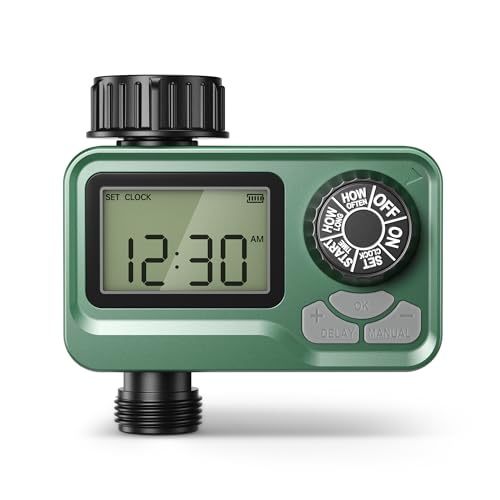
BN-LINK’s offering focuses on a clean setup that doesn’t punish you for missing a step. You set a start time, a duration between 1 minute and roughly 4 hours, and a frequency spanning hourly through weekly, which covers most residential needs in one screen.
The rain-delay and manual mode pair keeps the controls familiar even if you’ve never programmed a timer before. In our view, it works best for newer gardeners who want more scheduling depth than the TiFFCOFiO at the top, without moving up to multi-zone territory.
Where It Excels
- Wide frequency range suits both daily veggie beds and weekly lawn soakings
- Manual mode keeps the program intact when you want extra watering
- Single-screen design lowers the learning curve for new users
Some Limits To Know
- Plastic threaded connections, so high-torque installs can stress the joint
- Single zone only, meaning two beds means two timers or a splitter
Best Suited To
Homeowners stepping into automated watering for the first time, especially with one consistent zone to manage.
Look Elsewhere When
You want metal-threaded connections for tougher water conditions; in that case the RAINPOINT model with brass fittings above is the stronger match.
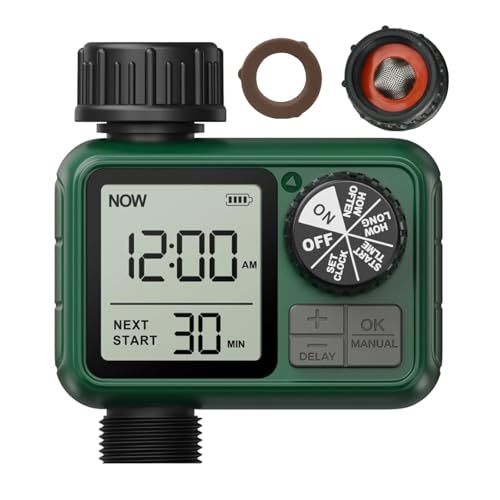
XinFuture’s design pairs a brass outlet with three working modes (auto, manual, and rain delay), which is enough flexibility for most soaker-hose and drip-irrigation layouts. You program it for the exact run pattern your bed needs, then let the cycle repeat.
Versus the BN-LINK model above, the main upgrade here is the brass outlet, which gives a more secure mating point to a soaker hose or manifold. For most backyards using a gravity-assisted or standard-pressure drip system, that’s a worthwhile trade.
The Good Stuff
- Brass outlet reduces wear at the most-stressed connection point
- Three modes cover nearly every residential watering pattern
- Programming steps stay short enough for a quick seasonal reset
Points To Keep In Mind
- Single brass outlet with a plastic inlet, so the faucet-side connection still needs a careful hand-tightening
- One zone only, so larger setups call for either a splitter or another timer
Perfect Match For
Drip and soaker hose users who want a sturdier outlet and don’t need multiple zones.
Skip It When
You need fully brass-threaded connections on both sides; the Insoma model covered later is built for that scenario.
DEWENWILS jumps from single-zone territory into a four-zone controller, which transforms a multi-bed yard from a juggling act into a single screen. A 3.4-inch LCD lays out current time, run time, and frequency for each zone, so you see the whole system at a glance instead of squinting at tiny digits.
Five physical buttons and a flashing cursor drive all the programming, which feels closer to a small appliance than a hose attachment. For homeowners with a mix of lawn, flower bed, veggie patch, and containers, four independent schedules solve a problem no single-outlet timer can.
What Pays Off
- Four zones let you run lawn, beds, and containers on independent schedules
- Larger LCD with explanatory on-screen text reduces programming guesswork
- Rain delay and manual override cover the two most common schedule interruptions
Worth Noting
- Bulkier housing than single-outlet timers, so crowded spigot areas may need a longer hose to fit it in
- More settings to learn, which may be overkill for a single raised bed
Feature Snapshot
Who Will Love This
Anyone with a medium-to-large yard running different plant types that don’t share the same watering rhythm.
Not Your Match When
You only need one zone and a small body, in which case the TiFFCOFiO single-outlet model at the top is simpler to live with.
Rain Bird has long been a name in professional irrigation, and this hose-end controller brings that heritage to the residential end of a garden hose. The 1ZEHTMRP connects to drip tubing, soaker lines, or hose-end sprinklers, making it a flexible hub for varied watering hardware.
A large program dial and an easy-read LCD screen walk you through the setup, and Rain Bird typically designs for repeated seasonal use, so the housing and seals tend to hold up across years of weather. It’s the choice for shoppers who care about the brand as much as the spec sheet.
Real Benefits
- Brand heritage in irrigation gives confidence in long-term valve reliability
- Large dial and LCD simplify the initial setup, even for detail-heavy programs
- Works with drip, soaker, and standard sprinkler attachments
Trade Offs
- Single zone limits multi-bed yards without additional timers
- Generally a higher price band than the basic plastic units above
Right Fit For
Detail-oriented users who want a trusted pro-grade brand and one carefully scheduled zone.
Reach For A Different Pick When
You need four zones from one controller; the DEWENWILS model covered above handles that more efficiently.
Same brand and dial-driven setup as the single-outlet TiFFCOFiO at the top, but with two outlets on one body, which is a smart way to water a front yard and a back bed from the same faucet. The knob-and-button interface is identical, so the learning curve from the single-outlet version carries straight over.
For shoppers comparing the two, the real question is whether you want two independent schedules on one body or simpler programming on one shared line. Depending on how different your plant zones are, the second outlet can save a splitter and a second timer.
What Makes Sense
- Two outlets from one faucet means fewer splitters and hose adapters
- Same familiar dial programming as the single-outlet TiFFCOFiO
- Weatherproof housing matches the brand’s standard outdoor build
A Few Limitations
- Plastic fittings at the connection points, so high-torque hose installs can stress them
- Two outlets run on one shared schedule, so truly different frequencies still need separate timers
Whose Shelf It Belongs On
Households with two nearby zones that share a similar watering rhythm and want one body instead of two.
A Better Fit Elsewhere
You need genuinely independent schedules per zone; the RAINPOINT 2-Outlet Sprinkler Timer at the end of this list programs each line separately.
Orbit is a familiar name in residential irrigation, and this listing ships two of the 62067 timers in one box. For homes with a front faucet and a backyard spigot, that’s the cleanest way to get both running on automated schedules without buying two separate listings.
Each timer turns a single hose faucet into a programmable sprinkler line, and the digital interface handles start time, duration, and frequency. It’s the practical choice for two-tap properties where the second tap is too far away to share one body.
Notable Upsides
- Two timers in one purchase simplifies outfitting a two-tap home
- Orbit’s broader irrigation ecosystem offers easier replacement parts down the line
- Digital interface supports standard start-time, duration, and frequency settings
Factors To Consider
- Each unit is single-outlet only, so larger zone counts still need more timers
- Two separate schedules means programming each unit independently
Built With In Mind
Two-tap households that want matching timers on each spigot without sourcing them separately.
Swap It Out When
Both taps are close enough to share one body, in which case the TiFFCOFiO 2-Outlet model gives you both lines on one schedule.
Insoma matches the RAINPOINT brass-threaded approach with its own take: a brass inlet and outlet rated to handle up to 116 psi of working pressure, paired with a built-in metal filter that blocks sediment from clogging downstream drip emitters. If your water source carries grit, that filter earns its keep quickly.
Compared with the RAINPOINT brass model covered earlier, the build philosophy is similar, so the decision often comes down to which interface and warranty you prefer. For drip systems in particular, the dual brass connections and metal filter are the headline features.
The Helpful Details
- Dual brass connections hold up to repeated attach-and-detach cycles
- Metal filter reduces clogging in drip lines fed from well or hard water
- Standard auto, manual, and rain-delay modes cover seasonal shifts
Possible Compromises
- Single outlet only, so multi-zone yards still need extra hardware
- Slightly heavier than all-plastic units, so wall mounting deserves a secure bracket
Quick Facts
Who Should Grab It
Drip irrigation users on gritty or hard water sources who want metal-threaded reliability and a built-in filter.
Another Choice May Suit
You want two independent zones on one body, which is exactly what the RAINPOINT 2-Outlet model below is designed for.
Closing the list with the most feature-dense option, this RAINPOINT unit treats each of its two outlets as its own independent zone. Zone 1 and Zone 2 each get their own start time, duration, frequency, and end time, so the schedules can be as different as the plants they feed.
It also offers up to 38 distinct watering frequency combinations, which is far more than most homeowners ever need, but useful for anyone juggling seed-starting, established beds, and a lawn on the same faucet. Relative to the single-outlet RAINPOINT earlier, this is the upgrade path when one zone simply isn’t enough.
A Few Highlights
- Two independently programmed zones on a single body
- Wide frequency range suits everything from germinating seeds to mature shrubs
- Rain delay and manual mode round out the standard control set
Things To Weigh
- More settings to learn, so casual users may not tap its full potential
- Plastic fittings at the connection points, which can wear under heavy use
Right Fit For
Two-zone households with genuinely different watering needs, like a thirsty lawn paired with low-water shrubs.
Where A Sibling Pick Shines
One zone is all you need, in which case the RAINPOINT brass single-outlet model further up the list keeps the build simpler and the cost down.
What To Weigh Before Buying A Garden Timer
Start with zone count. A small raised bed, a single hanging basket line, and a modest lawn all run fine on one outlet, but the moment you add a second bed with a different rhythm, you either add a splitter, buy a second timer, or step up to a multi-zone controller. The DEWENWILS four-zone unit and the two-outlet RAINPOINT cover that growth path most cleanly.
Connection material matters more than most people expect. Brass-threaded fittings cost a little more up front, but they resist the cracking and stripping that all-plastic threads can develop after a couple of seasons of attach-and-detach. For well water or hard municipal supply, a built-in metal filter (found on the RAINPOINT and Insoma brass models) keeps drip emitters from clogging.
Match the controls to your comfort level. Turn-dial programming suits people who like a tactile, screen-free setup, while LCD-based interfaces with on-screen prompts help anyone who wants a bit more visual guidance. Rain delay and manual override are standard on every pick in this list, and both pay for themselves the first time a storm rolls through on a scheduled watering day.
Picking Well Without Overpaying
Where Shoppers Go Wrong
The most common slip is buying a single-outlet timer when the yard actually has two distinct watering rhythms, then running a splitter that throttles pressure to both lines. The cheaper initial cost ends up replaced within a season. Counting your real zones first, including hanging baskets and containers, prevents that cycle.
Another trap is overlooking the connection material. Plastic threads at both the inlet and outlet can work fine on a covered porch spigot, but an exposed south-facing faucet in summer heat asks a lot of the plastic. Brass at the high-stress joints is a worthwhile upgrade in those conditions.
When Paying More Pays Off
Higher-tier models like the brass-bodied RAINPOINT and Insoma units, plus the four-zone DEWENWILS, earn their cost through longer service life and broader scheduling. For a yard with high water pressure, sediment, or multiple plant types, the upgrade buys fewer replacements and finer control. For a single small bed on a sheltered spigot, a basic model is the honest fit.
Frequently Asked Questions
How long do garden hose timers usually last?
Most residential garden timers last several seasons when mounted out of direct sun and brought in before freezing winters. Brass-threaded models tend to outlast all-plastic units, and owners commonly report that a quick spring battery check extends service life.
Can a single timer run two hoses at once?
A dual-outlet timer can run two lines from one faucet, but a single-outlet timer cannot. Some shoppers add a Y-splitter, though that reduces pressure to both lines, so a true two-zone unit like the RAINPOINT 2-Outlet is the cleaner solution for genuinely independent schedules.
Do garden timers need a power source?
Most hose-end timers run on AA or AAA batteries, not a wall outlet, which keeps installation simple. Higher-end multi-zone controllers use the same battery approach, so no outdoor receptacle is required.
Are rain delay features worth it?
Rain delay is one of the most practical features on any garden timer because it pauses the schedule after a storm and resumes automatically. For anyone in a region with frequent summer rain, the 24, 48, and 72-hour options prevent accidental overwatering.
Can I use a timer with drip irrigation and sprinklers?
Yes, most timers on this list work with drip tubing, soaker hoses, and standard hose-end sprinklers. Brass-threaded units with built-in filters, like the RAINPOINT and Insoma brass models, are especially well-suited to drip systems where sediment can clog emitters.
The Takeaway
A garden timer is one of the few upgrades that pays you back in time saved and plants kept alive through busy weeks. The right match depends on zone count, water pressure, and how much scheduling depth you want. Once the right unit is on the spigot, the watering routine tends to run itself, and that is exactly the point.
