

A reliable garden water timer turns a faucet into a set-and-forget irrigation system, freeing you from dragging hoses around the yard. If you’ve ever returned from a weekend away to wilted tomatoes or soaked walkways, you already know why this category matters. The picks below cover simple single-zone controllers, rugged brass-bodied units, and multi-zone hubs for more complex yards, so you can match the timer to your garden’s actual layout.
How The Shortlist Stacks Up

TiFFCOFiO Digital Programmable Sprinkler Timer

RAINPOINT Brass Inlet & Outlet Hose Timer
BN-LINK Outdoor Programmable Sprinkler Timer

DEWENWILS 4-Zone Sprinkler Timer

TiFFCOFiO 2-Outlet Sprinkler Timer

Orbit 62067 1-Outlet Hose Watering Timer 2-Pack

Insoma Brass Inlet & Outlet Sprinkler Timer

MetryGrow 2 Brass Inlet Irrigation Timer
RAINPOINT 100% Metal Pipe Sprinkler Timer
RAINPOINT 3-Zone Brass Water Timer
More On The Choices That Made The List
The TiFFCOFiO single-outlet timer threads onto a standard hose bib and runs a single hose or drip line on a basic schedule. You set the current time, start time, duration, and frequency using the rotary dial, and the unit takes over from there. Rain delay lets you pause the schedule for 24, 48, or 72 hours when the skies do your watering for you.
For a small raised bed, a row of flower pots, or a single lawn zone, this kind of single-outlet controller is the simplest path into automatic watering. Compared with the BN-LINK model further down, the TiFFCOFiO leans on a knob-first interface rather than a denser button layout, which some folks find quicker to set on a Saturday morning.
What It Does Well
- Rotary-dial programming walks you through setup without buried menu layers.
- Rain delay of 24, 48, or 72 hours prevents accidental overwatering after a storm.
- Manual mode lets you run the hose for car washing or pet bowls without disrupting the schedule.
- Compact body tucks behind a shrub or against a siding edge without dominating the spigot.
- Standard hose-thread connection fits most residential faucets without an adapter.
Things To Consider
- Single outlet means you can’t run two zones from one faucet at the same time.
- Plastic body construction is fine for most climates, but owners in extreme heat zones may want to shade the unit.
Who Should Grab It
New gardeners and apartment-dwellers with a single small bed who want a no-fuss first timer.
Swap It Out When
The RAINPOINT Brass Inlet & Outlet Hose Timer is a stronger match if your faucet sees hard use and you want brass threads under pressure.
RAINPOINT’s single-outlet timer stands out for its brass inlet and outlet threads, the metal pieces that screw onto your faucet and hose. Brass resists cross-threading and corrosion far better than plastic, which matters on older spigots or in regions with hard water. A built-in metal filter gasket catches sediment before it can clog a soaker line downstream.
Programmable duration runs from 1 minute up to 3 hours 59 minutes, and frequency can be set from every hour to every 7 days. That wide window handles thirsty vegetable beds as easily as drought-tolerant shrubs. Compared with the TiFFCOFiO above, the value here is the metal threading rather than the scheduling range.
Positive Takeaways
- Brass inlet and outlet stand up to repeated connection cycles and mineral-heavy water.
- Metal filter stops particles from reaching small drip emitters downstream.
- Manual override lets you fill a bucket without clearing the saved schedule.
- Frequency range of 1 hour to 7 days covers nearly every backyard scenario.
- Weatherproof housing keeps internal electronics sealed during summer storms.
Points To Keep In Mind
- Heavier brass body means you should support the hose end to keep stress off the faucet.
- Single outlet, so running front and back yard on the same schedule requires two timers.
Made For
Soaker hose users with mineral-rich municipal water who need durable metal threads.
Reach For A Different Pick When
The DEWENWILS 4-Zone Sprinkler Timer is a better fit if you need to control more than one zone from a single manifold.
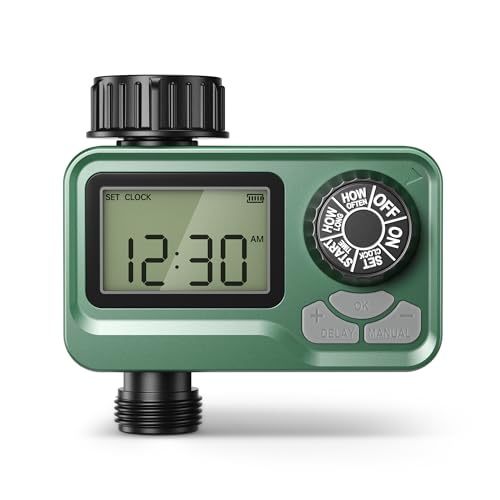
BN-LINK has built a reputation in the smart-plug space, and this outdoor timer carries the same no-nonsense approach. You set a start time, a duration between 1 minute and 3 hours 59 minutes, and a frequency from every hour up to once a week. The screen is plain and readable in direct sun, which sounds trivial until you’ve squinted at a tiny LCD while holding a wet hose.
Rain delay can pause the schedule for 24, 48, or 72 hours, and a manual mode overrides the timer for one-off watering without erasing the program. For someone stepping into automatic irrigation for the first time, this is a friendly on-ramp. Where the RAINPOINT unit leans on brass hardware, BN-LINK keeps the focus on scheduling clarity.
The Upside
- Scheduling covers both hourly short cycles and weekly deep-watering sessions.
- Rain delay avoids wasted water without you having to unplug the unit.
- Manual mode is useful for washing the car or rinsing muddy tools.
Worth Noting
- Plastic inlet and outlet threads may wear faster on frequently removed hoses.
- Single outlet limits expansion unless you buy a second timer.
- Battery compartment seal should be checked seasonally to keep moisture out.
Right Fit For
First-timers who want the simplest path to a working schedule on a single hose line.
Consider Something Else When
The TiFFCOFiO 2-Outlet Sprinkler Timer is a better match if you want to run two drip lines from one faucet without buying a second unit.
The DEWENWILS moves up from the single-zone category into true multi-zone territory. A 3.4-inch LCD takes up most of the face, with five physical buttons to set programs for four independent zones. Each zone can run on its own duration and frequency, so a shaded north lawn and a sunny south vegetable patch no longer have to share a single schedule.
Auto, manual, and rain-delay modes cover the everyday decisions a homeowner faces across a season. Compared with the RAINPOINT Brass Inlet & Outlet Hose Timer, the trade-off is fewer brass components in exchange for dramatically more scheduling reach. For yards that have outgrown a one-zone mindset, that’s usually a fair swap.
Notable Gains
- Four independent zones let you match watering to sun, shade, and plant type.
- Large LCD keeps programming legible at a glance.
- Auto, manual, and rain-delay modes cover the full range of day-to-day needs.
A Few Limitations
- More buttons mean a steeper learning curve for first-time multi-zone users.
- Bulkier than single-outlet timers, so plan clearance on a tight hose-bib wall.
- Best paired with a manifold of quality solenoid valves downstream.
Feature Snapshot
Best Suited To
Homeowners running a multi-zone yard with mixed plant water needs.
Where Another Pick Suits Better
The RAINPOINT 3-Zone Brass Water Timer is a better fit if three zones are enough and you want brass threads on every connection.
This TiFFCOFiO shares the dial-based programming of the single-outlet model but splits the output into two hose lines. Each outlet can be set with its own duration and frequency, which is genuinely useful when front and back yards share a single spigot wall. You don’t need to commit to one combined schedule for two very different watering jobs.
The weatherproof shell keeps the electronics sealed through summer storms, and the rain delay option covers 24, 48, or 72 hours. Compared with the DEWENWILS 4-Zone Sprinkler Timer, this is the simpler two-zone option that doesn’t ask you to commit to four zones. For most medium-sized residential lots, two is plenty.
Key Advantages
- Two outlets from one faucet, without a separate splitter accessory.
- Same dial programming as the single-outlet TiFFCOFiO for muscle-memory consistency.
- Weatherproof and dustproof housing suits exposed installations.
- Manual mode available for those one-off watering tasks.
Small Caveats
- Only two zones, so a property with more than two distinct watering areas will outgrow it.
- Plastic threads are fine for typical use but less durable than the RAINPOINT brass approach.
Whose Shelf It Belongs On
Anyone with a side yard and a back garden sharing a single faucet who wants one timer instead of two.
Look Elsewhere When
The MetryGrow 2 Brass Inlet Irrigation Timer is worth a look if you want both of your two zones fed by brass fittings.
Orbit is a familiar name in residential irrigation, and the 62067 is its straightforward single-outlet hose-end timer. The interesting angle here is the 2-pack: you get two fully programmable timers in one box. For a household with a front-yard spigot and a backyard spigot, that means a matched pair without mixing brands.
Each unit runs the same Orbit programming interface, which is simple enough for a one-zone situation. Compared with the BN-LINK Outdoor Programmable Sprinkler Timer, you’re trading a single brand-name unit for two of a known irrigation player. Where you might find a difference is in the durability of the plastic housing after multiple seasons of UV exposure.
A Few Strong Suits
- Two matched timers cover two spigots without mixing brand ecosystems.
- Orbit’s interface is a familiar sight for anyone who’s used an Orbit controller before.
- Single-outlet focus keeps programming simple per unit.
Honest Caveats
- Plastic components won’t match the longevity of brass-threaded competitors like the RAINPOINT Brass Inlet & Outlet Hose Timer.
- Two-pack pricing only makes sense if you actually need two units.
Perfect Match For
Two-spigot households who want a matched set of timers on a single faucet program.
Not Your Match When
The Insoma Brass Inlet & Outlet Sprinkler Timer is the better buy if you only need one timer and want metal threads.
The Insoma timer is built around the same brass-first philosophy as the RAINPOINT unit, with metal inlet and outlet threads that hold up under repeated connection cycles. A built-in metal filter stops sediment from sneaking into drip emitters, which is one of the most common silent failures on plastic timers that lack a filter.
Programming follows a rotate-the-dial and press-the-buttons approach, which feels familiar if you’ve used any other modern hose timer. Auto, manual, and rain-delay modes cover the same everyday scenarios. Versus the BN-LINK Outdoor Programmable Sprinkler Timer, the trade is again metal hardware in exchange for similar scheduling features.
The Value In It
- Brass fittings hold up better under repeated hose swaps.
- Integrated metal filter helps protect downstream drip lines from clogging.
- Auto, manual, and rain-delay modes cover daily watering needs.
- Single-outlet simplicity keeps programming easy.
Trade Offs
- Single outlet means you’ll need a second timer for a second zone.
- Brass body adds noticeable weight compared with all-plastic models.
Feature Snapshot
Built With In Mind
Homeowners with high-pressure water lines or mineral-heavy water who want one robust single-zone timer.
Skip It When
The RAINPOINT 100% Metal Pipe Sprinkler Timer is a better match if you want the entire internal water path to be metal, not just the threads.
MetryGrow’s two-outlet timer is a thoughtful middle ground. Both inlets are brass, which is unusual in this price band where most dual-outlet units use plastic. You can run two zones with independent watering durations from 1 to 360 minutes and frequencies from every hour to every 15 days, so a small greenhouse and a lawn can finally have their own programs.
Rain delay keeps a downpour from triggering another cycle. Compared with the TiFFCOFiO 2-Outlet Sprinkler Timer, the upgrade here is the brass threading on a dual-outlet body, which is genuinely rare. If your two zones have very different water needs, this is a strong fit.
Useful Touches
- Two brass inlets bring metal-thread durability to a dual-outlet design.
- Independent durations up to 360 minutes handle deep soakings and quick misting.
- Frequency range to 15 days suits drought-tolerant plantings.
Possible Compromises
- Larger footprint needs clearance on a busy hose-bib wall.
- Two-outlet plumbing adds more potential leak points over time, so check fittings seasonally.
Who Will Love This
Gardeners juggling a lawn, a bed, or a small greenhouse who want two zones without a four-zone controller.
A Better Fit Elsewhere
The DEWENWILS 4-Zone Sprinkler Timer is worth choosing if you need three or four independent programs instead of two.
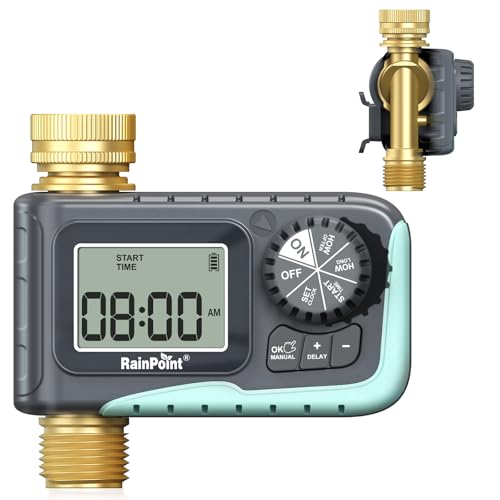
This RAINPOINT goes a step further than its brass-thread siblings: the entire water path inside the body is metal, not just the inlet and outlet threads. The benefit is a wider full-bore opening and a metal ball valve that lets more water through with less pressure loss, which matters when you’re feeding a long run of 1/4-inch drip tubing.
Manual watering and rain delay round out the usual feature set. The pressure rating, paired with full-metal internals, makes this a confident choice for yards that have struggled with timers choking down flow. Compared with the Insoma Brass Inlet & Outlet Sprinkler Timer, the value is in the water path, not just the connections.
Where It Helps
- All-metal internal water path minimizes pressure loss across long drip runs.
- Full-bore ball valve keeps flow high for thirsty plants.
- Manual override for non-scheduled watering tasks.
Trade-Offs To Consider
- Heavier unit needs a solid hose-bib mount.
- Single outlet, so multi-zone setups need additional hardware.
Feature Snapshot
Who Should Grab It
Homeowners running long drip lines who need a timer that doesn’t choke their flow.
Where Another Pick Suits Better
The RAINPOINT 3-Zone Brass Water Timer is a better match if you need multiple zones and want brass-threaded reliability on each.
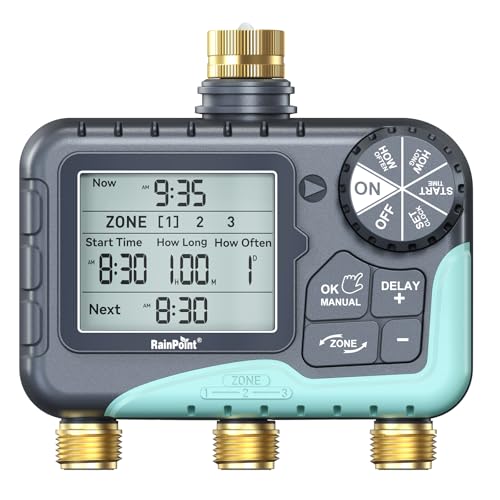
RAINPOINT’s three-zone hub is the most capable controller in this roundup, with three independent watering plans, a large LCD, and an IP65 weather rating. Each zone can run on its own duration from 1 minute to 8 hours and a frequency from every hour to every 7 days. That range covers everything from a quick mist for seedlings to a long soak for a mature tree.
Brass outlets and a coil valve (a solenoid-driven internal valve that opens and closes on signal) aim to keep leakage down across years of cycling. The IP65 rating (a standard meaning protection against low-pressure water jets and dust ingress) means the unit handles rain and sprinkler splash without complaint. Compared with the DEWENWILS 4-Zone Sprinkler Timer, the trade is fewer zones for brass connections and a more weather-sealed body. For complex yards, that’s usually the right swap.
Real Benefits
- Three independent watering plans with broad duration and frequency ranges.
- IP65 weatherproofing for full outdoor exposure.
- Brass outlets paired with a coil valve for long-term leak resistance.
- Large LCD readable at arm’s length in direct sun.
A Few Limitations
- Higher complexity than a single-outlet timer; budget time for initial setup.
- Only three zones, so properties with four or more distinct areas still need a different controller.
Feature Snapshot
The Right Fit
Homeowners with a complex yard, including lawns, beds, and a hedge, who want a hub-style controller with weather-sealed hardware.
Where A Sibling Pick Shines
The DEWENWILS 4-Zone Sprinkler Timer is the better pick if four zones are non-negotiable and IP65 weatherproofing is less of a concern.
Choosing A Garden Water Timer That Fits Your Yard
The first decision is zone count, since a single-outlet timer covers one hose line, a two-outlet model covers two, and three- or four-zone controllers handle more complex layouts. Yard size matters too, because drip irrigation running off a long 1/4-inch line loses pressure quickly through narrow tubing. For longer runs, look for a unit with a full-bore ball valve that keeps flow up.
Thread material is the next major fork. Plastic threads work fine in mild climates with soft water, but brass threads handle hard water, mineral buildup, and frequent hose changes much better. If you live in a region with high mineral content, you may find that brass pays for itself in fewer leaks.
Programmability should match the plants you actually have. A simple start-time and duration combo covers most lawns. Vegetables and bedding plants often need frequency fine-tuning down to the hour, so wider frequency ranges earn their keep. Rain delay, available on every model here, prevents overwatering without you having to manually pause the timer.
Finally, the display and buttons matter more than people expect. A large LCD readable in sun and physical buttons you can press with wet hands make the difference between a timer you actually program and one you ignore. For most households, the right pick is the simplest unit that still covers the number of zones you need.
Key Considerations Across These Picks
Common Shopping Slip Ups
The most frequent mistake is buying a single-outlet timer for a yard that clearly needs two or three zones, then buying splitters that add leak points and pressure loss. A two- or three-zone hub is usually the better first purchase if there’s any chance you’ll add a bed or a greenhouse later. Another common miss is overlooking thread material, then replacing the same plastic timer in two seasons when the threads strip or crack.
What The Higher Tier Buys
Stepping up from a basic plastic timer to a brass-threaded or all-metal unit buys longer service life under hard water and heavy use. Moving to a multi-zone controller buys scheduling flexibility, since you stop forcing one schedule to fit a lawn, a hedge, and a vegetable bed. The upgrade pays off most when your yard has more than one plant type and your water bill is high enough that overwatering would sting.
Frequently Asked Questions
How long do garden water timers typically last?
Most quality garden water timers last several seasons, and units with brass fittings and weatherproof seals tend to outlast all-plastic models in regions with harsh sun or hard water. Battery life for the controller electronics is usually a full season or longer on standard AA batteries.
Can one timer run both a sprinkler and a drip line?
Yes, if the timer is downstream of a Y-splitter or you choose a two- or three-zone controller. Match the timer’s flow capacity to the higher-demand device, since a long drip run needs a timer that won’t choke the flow.
Do I need a rain delay feature?
For most yards, rain delay is one of the most useful features, because it prevents the timer from running during or right after a storm. Every model on this list includes some form of rain delay, with 24, 48, and 72 hours being the most common pause options.
Are brass fittings really worth it?
Brass inlet and outlet fittings resist cross-threading, corrosion, and mineral buildup much better than plastic. For households on hard water or with frequent hose changes, brass fittings tend to outlast plastic ones by several seasons.
What’s the difference between a hose timer and an in-ground sprinkler timer?
A hose timer attaches to a standard outdoor faucet and controls a hose, drip line, or small sprinkler. An in-ground sprinkler timer is wired to solenoid valves buried in the yard, which is a more involved installation. The picks here are all hose-end timers.
Wrap Up
The right garden water timer depends less on specs on paper and more on how your yard is actually laid out. A small bed and a single hose do fine with a basic single-outlet unit, while a yard with lawns, beds, and a greenhouse benefits from a two- or three-zone hub. Brass fittings, weatherproofing, and a readable display are the quiet upgrades that pay off across many seasons. Pick the unit that matches your real-world watering routine, and the rest of the season tends to take care of itself.
