

A kitchen windowsill, a corner of a rental, or a dim apartment where the soil never quite cooperates: hydroponic tower gardens solve all three. You skip the dirt, you skip the guesswork on light, and you pull herbs, lettuces, and small fruits year-round without a yard. The eight systems below cover everything from a 12-pod countertop starter to a full 60-pod vertical tower, so you can match capacity, footprint, and control panel to your actual space.
The Picks In Brief

Ahopegarden 12 Pods Hydroponics Kit with LCD
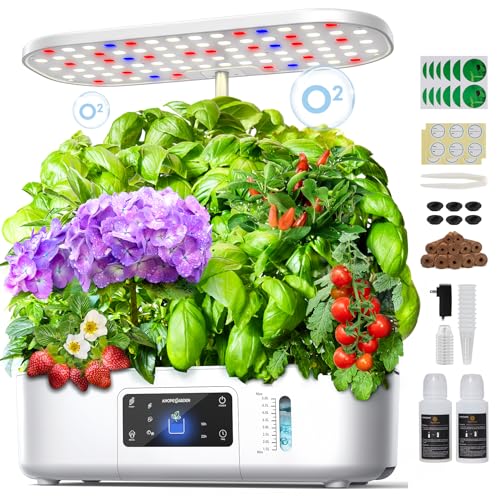
Ahopegarden 12 Pods Hydroponics Touch Panel

URUQ 8 Pods Hydroponics with LED (Black)

URUQ 8 Pods Hydroponics with LED (White)

Ahopegarden 12 Pods with Temp & Humidity

Ahopegarden 12 Pods Smart Env. Detection

KUCKGO Plants Propagation Station

Ahopegarden 60 Pods Hydroponic Tower
The Strengths Of Each Pick
The Ahopegarden 12-Pod LCD kit makes a strong first impression if you appreciate clean industrial design. Its 17-inch ABS body (a tough, moldable plastic used in everything from luggage to appliance housings) keeps the footprint small enough for a kitchen island, while the LCD touchscreen handles timer, light mode, and pump cycles at a tap. Twelve pods cover the basics: basil, parsley, romaine, and a few experiments without crowding the canopy.
Compared with the simpler Ahopegarden touch-panel sibling later in this list, this kit hands you finer control over light schedules, which helps if you’re cycling crops like lettuce that prefer shorter photoperiods (the number of hours of light a plant receives per day). For most renters and condo dwellers, the size and noise floor both stay manageable.
What Pays Off
- Compact 17-inch vertical profile suits narrow counters and tight corners.
- LCD touchscreen simplifies timer and light mode changes without an app.
- Full-spectrum LED panel supports leafy greens and herbs through dark months.
- ABS construction handles everyday kitchen splashes and the occasional wipe-down.
- Twelve pods offer enough variety for a small household without a learning curve.
Things To Consider
- Reservoir capacity is modest, so topping off water and nutrients becomes a frequent habit.
- ABS plastic can show scuffs over time if brushed against heavy cookware.
Key Specs
Made For
Tech-curious apartment dwellers who want app-free, touchscreen control in a clean, compact package.
Swap It Out When
The Ahopegarden Smart Env. Detection kit is a smarter fit if your room swings between dry winter air and humid summers and you want the system to react automatically.
Where the LCD kit leans into visual flair, this Ahopegarden 12-pod sibling strips the interface down to a touch panel with straightforward presets. It’s the kind of unit you can plug in, fill, drop in pre-seeded pods, and largely forget for a couple of weeks. The same ABS shell and 17-inch profile carry over, so the kitchen footprint matches its LCD twin.
For a first hydroponic setup, fewer buttons usually means fewer mistakes. If you’ve never mixed nutrient solution or calibrated a pump cycle, the touch panel keeps the learning curve honest without dumbing things down.
Where It Helps
- Simplified presets cut the guesswork out of light timing.
- Compact 17-inch build matches the LCD kit’s footprint.
- Twelve pods let you start herbs and a couple of leafy greens together.
Worth Noting
- Less granular control than the LCD model if you want to customize photoperiods.
- No built-in humidity or temperature feedback, so you monitor conditions yourself.
- ABS shell will need gentle cleaning to avoid surface clouding under bright grow lights.
Who It Suits Best
First-time indoor growers who want preset cycles and a low-maintenance starter system.
Look Elsewhere When
The Ahopegarden Temp & Humidity Monitor kit serves you better if you like live environmental readouts and don’t mind paying a little more for the extra sensor data.
The black-finish URUQ 8-pod system is built around a 24-watt full-spectrum LED panel (a light that covers the wavelengths plants use most for photosynthesis, roughly mimicking sunlight) on an adjustable arm. The post rotates up to 180 degrees and telescopes to a maximum 21 inches, so the light tracks growth from seedling to harvest without burning the canopy.
Compared with the 12-pod Ahopegarden units above, this URUQ trades capacity for adjustability. If you’ve got a windowsill or a small kitchen corner that catches morning light, the slim profile disappears into the room. The black housing looks modern but does show dust and water spots, so a weekly wipe keeps it tidy.
Where It Delivers
- 24W adjustable LED panel raises and rotates to follow plant height.
- Eight pods suit small households focused on culinary herbs.
- Slim footprint fits a windowsill or narrow countertop run.
- Full-spectrum output supports germination through leafy growth stages.
Trade Offs
- Smaller pod count than 12-pod rivals if you want crop variety.
- Reservoir runs lower, so expect more frequent water top-ups in warm rooms.
Right Fit For
Windowsill growers and small kitchens where a slim, modern herb garden beats a bulky countertop setup.
Consider Something Else When
The KUCKGO Propagation Station is a stronger pick if you want a true 30-pod vertical tower rather than a flat 8-pod counter unit.
The white URUQ 8-pod system mirrors its black sibling in function: same 24-watt LED, same adjustable arm, same 180-degree rotation and 21-inch max height. The difference is purely cosmetic, and that matters more than it sounds in a Scandinavian-style kitchen or a rental where the fridge, counters, and trim all lean light.
White finishes also tend to hide mineral deposits (the whitish chalky residue that builds up when water evaporates and leaves dissolved minerals behind) better than black, though you’ll still see algae creep along the reservoir edges if light hits the water. In our experience, that’s manageable with a quick monthly scrub.
Points In Its Favor
- Neutral white housing blends into light-colored kitchens.
- 24W full-spectrum LED handles herbs from germination through harvest.
- Compact 8-pod layout suits a single user or a couple.
- Adjustable arm tracks plant height up to 21 inches.
Honest Caveats
- Reservoir runs small, so plan for more frequent nutrient refills.
- White surfaces can yellow slightly under constant LED exposure over the years.
Best Suited To
Renters and minimalists who want the grow light to disappear visually into a light-toned kitchen.
Reach For A Different Pick When
The URUQ black unit is a closer match if your kitchen already runs dark countertops and you want the system to feel intentional rather than invisible.
The Ahopegarden 12-pod Temp & Humidity kit adds a sensor module that reports the actual room conditions your plants live in. For growers who’ve lost a basil crop to a dry winter or watched lettuce bolt (prematurely flower and turn bitter) when indoor heat spiked, that data changes the conversation. The full-spectrum LED panel runs a 16-hour-on, 8-hour-off cycle by default, a solid mid-range photoperiod for herbs and greens.
Versus the simpler 12-pod touch-panel Ahopegarden earlier in this list, the trade is more data versus fewer buttons. You may find the extra readouts more useful than app integration if you tend to check on plants the old-fashioned way.
Reasons It Performs
- Built-in temperature and humidity sensor takes the guesswork out of room conditions.
- Full-spectrum LED runs a sensible 16/8 light cycle by default.
- Twelve pods support a varied herb-and-greens rotation.
Points To Note
- Sensor adds cost versus the simpler touch-panel Ahopegarden sibling.
- Sensor accuracy depends on placement: keep it out of direct LED glare for honest readings.
- Reservoir still demands routine top-offs in dry indoor air.
Feature Snapshot
Whose Shelf It Belongs On
Data-driven plant owners who’d rather watch a humidity readout than guess why leaves are curling.
A Better Fit Elsewhere
The Ahopegarden Smart Env. Detection kit is a closer fit if you want the system to auto-adjust light or watering based on those readings rather than just display them.
The Smart Env. Detection kit steps beyond passive monitoring. Its sensor pair feeds a control board that can shift the 16-hour photoperiod in response to room conditions, useful in apartments where heating kicks on at sunrise or AC cycles through the afternoon. The same ABS shell and 12-pod layout from the rest of the Ahopegarden family keep the parts familiar.
Compared with the Temp & Humidity Monitor kit above, this is the one that actually reacts. You give up a little simplicity for a system that responds to a dry January afternoon or a humid August evening without you having to toggle anything manually.
The Practical Payoff
- Smart detection adjusts light or watering cycles to current room conditions.
- Twelve pods support a working culinary herb rotation.
- Compatible with the wider Ahopegarden pod ecosystem for easy seed swaps.
Practical Considerations
- Auto-adjust behavior means less manual control if you prefer fixed schedules.
- Sensor placement still affects accuracy, so avoid shoving it against a wall.
Feature Card
Perfect Match For
Growers in rooms with strong seasonal swings who want the system to react instead of relying on manual tweaks.
Where Another Pick Suits Better
The Ahopegarden LCD kit suits you better if you prefer dialing in fixed schedules yourself rather than letting the system decide.
The KUCKGO Propagation Station is the first true tower in this list. Its 6-layer vertical frame holds 30 pods in a footprint small enough to slide into a corner, and the design is intentional about that: strawberries, tomatoes, lettuce, and a working herb rotation all coexist without dominating the floor. Smart water management cycles the reservoir through each layer so root zones stay evenly wet.
Compared with the 8- and 12-pod countertop systems above, this is the jump into serious capacity. In our view, it’s the right pick the moment your ambitions outgrow a single kitchen tray, though it asks for floor space rather than counter space.
What Works In Its Favor
- 30-pod, 6-layer tower supports strawberries, greens, and herbs at once.
- Corner-friendly vertical frame saves floor space.
- Smart water management circulates evenly across layers.
Potential Drawbacks
- Floor-standing footprint requires a dedicated corner, not just a counter.
- Higher pod count means more frequent nutrient solution mixing.
- Setup takes longer than a flat countertop kit.
Who Should Grab It
Growers who want real vertical capacity and have a corner to spare in a kitchen, sunroom, or greenhouse.
Skip It When
The Ahopegarden 60-pod tower is a stronger fit if you want even more capacity plus a dual-tank reservoir for less frequent refills.
The Ahopegarden 60-pod tower is the heavyweight on this list. A 32-liter reservoir split across two tanks (8L + 24L) feeds 60 pods stacked vertically, which is enough capacity to run a real household herb-and-greens operation out of a single corner. The 30W full-spectrum LED panel runs two preset modes, “Vegetables” and “Fruits/Flowers”, each dialing in a 16h or 22h photoperiod so you don’t have to memorize what a strawberry plant wants.
Compared with the 30-pod KUCKGO above, this doubles the capacity and adds a true dual-mode light cycle. The honest read is that the footprint grows with the pod count, so measure your ceiling height and floor patch before committing.
Where It Excels
- 60 pods support a year-round herb, lettuce, and small-fruit rotation.
- Two-mode LED (Vegetables / Fruits-Flowers) removes photoperiod guesswork.
- 32L dual-tank reservoir cuts down on refill frequency.
Factors To Consider
- Tower height demands decent ceiling clearance and a stable floor spot.
- Larger reservoir still demands monthly deep cleaning to prevent biofilm (a slimy layer of bacteria that forms on wet surfaces over time) buildup.
- Higher energy draw on the 30W LED versus smaller countertop kits.
Feature Rundown
Who Will Love This
Households that cook from scratch daily and want a real year-round supply of greens without hitting the store.
Not Your Match When
The KUCKGO Propagation Station is a better fit if 30 pods is enough capacity and you’d rather start with a smaller, lighter tower.
Picking The Right Hydroponic Tower For Your Space
Capacity and footprint are the two filters that matter most when shopping for hydroponic tower gardens, and they tend to drive everything else. A countertop unit with 8 or 12 pods keeps things simple: one reservoir, one light panel, a small weekly routine of topping off water and adding nutrients. These suit renters, small kitchens, and anyone new to soilless growing. The trade is variety: eight pods means eight crops, so you pick your herbs and stick to them.
Vertical towers with 30 or 60 pods change the equation. You get crop diversity (strawberries on the top tiers, lettuce in the middle, herbs along the bottom), but you give up the convenience of a counter-top setup. Floor space, ceiling clearance, and reservoir weight all become real factors. If your ceiling sits under seven feet or your floor isn’t level, a 60-pod tower can feel oversized fast.
Light control matters too. Basic panels run fixed 16-hour cycles, which work for most leafy greens. Smart Env. Detection kits sense humidity and temperature and shift accordingly, useful in homes with strong seasonal swings. LCD touchscreens give you manual scheduling without an app, which is a quiet advantage for anyone who avoids yet another phone login.
Lastly, think about maintenance reality. Any hydroponic system benefits from a monthly reservoir scrub and a quarterly pump check. Towers with larger tanks stretch the interval between refills, but every system still wants attention. The honest read: match capacity to how often you’ll actually tend it, not how ambitious you feel in week one.
Key Considerations Across These Picks
Where Shoppers Go Wrong
The most common slip is buying a tower sized for the garden you imagine in your head, not the one you’ll actually maintain. An 8-pod kit feels small by week three; a 60-pod tower feels heroic by month two when you’re hauling nutrient mix upstairs. Measure your space, count how many fresh herbs you realistically use in a week, and size up only from there.
Another frequent miss is ignoring light placement. Towers cast shadows, and countertop units behind a south-facing window can wash out the LED’s effect or, worse, cook roots in a sunny corner. Position matters as much as panel wattage.
When Paying More Pays Off
The step from a basic 8-pod flat kit to a sensor-equipped 12-pod tower usually buys three real things: finer photoperiod control, larger reservoirs that stretch refill intervals, and sturdier frames that survive a move. If your room has dry winters, humid summers, or AC cycling, those upgrades pay off within a season. For a stable, climate-controlled kitchen, a simpler kit gets you nearly the same harvest at lower cost.
Frequently Asked Questions
How often do hydroponic tower gardens need refilling? Smaller 8- to 12-pod systems usually need a top-off every 1 to 2 weeks, while larger 30- to 60-pod towers with bigger reservoirs can run 3 to 4 weeks between refills, depending on room temperature and plant load.
Do these systems work without natural sunlight? Yes. Every kit on this list includes a full-spectrum LED panel that replaces sunlight, so placement matters less than proximity to a power outlet.
What can you actually grow in a 12-pod starter? Basil, parsley, mint, lettuce, and arugula all do well. Fruiting crops like cherry tomatoes stretch the limit of smaller kits, but leafy greens and herbs are reliable.
How loud are hydroponic pumps indoors? Most countertop pumps run quietly enough to live near a bedside or home office. You may hear a soft hum during the watering cycle, which usually lasts only a few minutes.
Is setup genuinely beginner-friendly? The flat countertop kits are: fill the reservoir, drop in pre-seeded pods, plug in. Vertical towers take longer because of the stacking, but no special tools are typically required.
The Takeaway
Pick the kit that matches how often you cook with fresh herbs and the space you’ll actually give it. A small countertop system rewards consistency, a vertical tower rewards capacity. Either way, the upside is the same: fresh greens in January without a yard.
