

Aphids chewing through your tomato leaves, hornworms decimating fruit overnight, and whiteflies gathering under the canopy of a healthy plant: anyone who has grown tomatoes for more than one season knows the slow dread of walking out to the garden and spotting the first wave of pests. The right spray turns that moment from a panic into a plan. Whether you garden organically, need something gentle around kids and pets, or want broad-spectrum coverage for a heavy infestation, this roundup covers the categories worth knowing before you spray.
The Picks In Brief

Earth’s Ally 3-in-1 Plant Spray 32 Oz
Bonide All Seasons Horticultural Spray Oil 32 oz

EcoVenger Garden Insect Control 16 oz

BioAdvanced 3-in-1 Insect, Disease, and Plant Mite Control 24 fl oz

Bonide Captain Jack’s Rose Rx 4-in-1 32 oz

BioAdvanced Tomato & Vegetable Insect Killer 24 fl oz

Garden Safe Multi-Purpose Garden Insect Killer 32 oz

BioAdvanced 3-in-1 Fruit, Citrus, and Nut Tree Spray 32 oz
Taking A Closer Look At The Options
Earth’s Ally takes a botanical approach to three common tomato problems at once. The ready-to-use bottle mixes essential oils into a soft-bodies-insect-targeting formula that also helps with fungal pressure, which is helpful when you’re juggling both pests and disease in the same bed.
For gardeners who want a spray they can use around kids, pets, and pollinator-friendly plants without much second-guessing, this fits the bill. The 32 oz size covers a decent mid-size backyard without forcing an immediate refill. Compared to BioAdvanced’s heavier-hitting formulas later in this list, Earth’s Ally trades raw knockout power for a gentler, more frequent-application rhythm.
What It Does Well
- Ready-to-use format means no measuring or mixing before heading outside.
- Plant-based essential oil blend reads as a softer choice for organic-minded households.
- Targets soft-bodied insects like aphids while also supporting disease control on tomato foliage.
- 32 oz bottle handles a small raised bed or a few containers in one treatment pass.
Things To Consider
- Botanical oils tend to need more frequent reapplication than synthetic options during heavy pressure.
- The essential-oil blend has a noticeable scent that lingers briefly after spraying.
- Coverage is sized for home gardens rather than large market-style plots.
Right Fit For
Organic-leaning home growers with a small raised bed who want one bottle to handle both pests and mildew without harsh ingredients.
Look Elsewhere When
You face a serious hornworm or beetle outbreak, where BioAdvanced Tomato and Vegetable Insect Killer’s contact-kill formula will move faster.
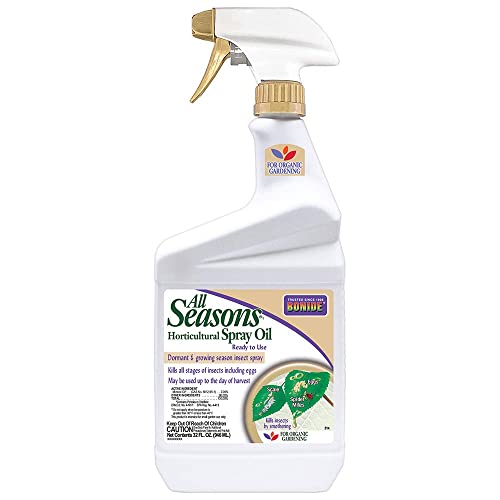
Bonide’s horticultural oil is the kind of bottle veteran tomato growers keep on the shelf year after year. It’s a refined paraffinic oil that can go on dormant canes, swollen buds, and active foliage alike, so one container handles three very different points in the calendar.
Spray oils work by smothering insects and their eggs, which makes them a smart fit against overwintering aphids, scale, mites, and whitefly. Where Earth’s Ally leans gentle, this oil goes after harder-shelled pests in their most vulnerable life stages. For gardeners who plan their season in advance rather than reacting to the first sighting, the multi-season label is the main draw.
A Favorable Mix
- One bottle covers dormant, delayed dormant, and growing-season applications.
- Targets overwintering eggs that would otherwise hatch into next season’s aphid and scale colonies.
- Paraffinic oil formulation is widely used in organic and conventional programs alike.
- Suitable for fruit trees, ornamentals, and tomatoes on the same rotation.
Trade Offs
- Requires careful timing; spraying in midday heat can stress leaves.
- Needs proper dilution and tank mixing rather than grabbing and going.
- Not a rescue spray for an active, heavy infestation already in progress.
At A Glance
Whose Shelf It Belongs On
Tomato growers who also tend fruit trees and want a single product that earns its spot across the calendar.
Reach For A Different Pick When
You need a one-step ready-to-use rescue during a sudden mid-summer outbreak, where Captain Jack’s Rose Rx or BioAdvanced’s Tomato and Vegetable Insect Killer acts faster.
EcoVenger sits at the intersection of plant-based ingredients and broad pest coverage. The 16 oz bottle is smaller than most of the list, which actually plays to its strength: it’s the spray you keep on the counter for spot treatments rather than full-bed coverage.
The formula targets aphids, mealybugs, spider mites, and fungus gnats, which covers the most common indoor-outdoor nuisance pests without dragging in heavy synthetic chemistry. Households with curious cats or toddlers benefit from the plant-based label. For tomato growers, this often lives next to the bigger BioAdvanced or Garden Safe bottle as a precision tool rather than the main workhorse.
What Helps Most
- Plant-derived active ingredients read well on labels for cautious shoppers.
- Listed for indoor and outdoor use, so the same bottle handles houseplants and patio tomatoes.
- Targets pests at multiple life stages, including eggs, not just visible adults.
Honest Caveats
- Smaller 16 oz bottle means more frequent repurchasing for larger gardens.
- Delicate new growth may need dilution, which adds a step to the routine.
Who Should Grab It
Balcony or patio tomato growers who also fight gnats and mites on houseplants and want one shared bottle.
Swap It Out When
You’re managing a full in-ground tomato bed with active caterpillars, where BioAdvanced’s Tomato and Vegetable Insect Killer covers a wider pest list at full label strength.
BioAdvanced’s 3-in-1 is the heavy lifter on this list. One bottle handles listed insects, listed diseases, and listed plant mites, so a single trip through the garden can cover three fronts at once, which is genuinely useful when conditions are warm and humid and problems are stacking up.
Where Bonide’s horticultural oil takes a slow smothering approach, this one delivers a more direct knock-down. For a tomato bed under real pressure from Japanese beetles or aphids plus a creeping black spot or rust problem, the combined coverage is the main reason to reach for it. Like other synthetic options, it carries a pre-harvest interval you should read on the label before spraying close to picking day.
Positive Points
- Three-in-one coverage limits the number of bottles on the garden shelf.
- Lists pests like Japanese beetles, aphids, and whiteflies that hit tomato plants hard.
- Also tackles diseases like black spot, powdery mildew, and rust.
Worth Noting
- Not formulated with organic gardening in mind, which matters for some households.
- Pre-harvest interval must be observed closely on food crops.
- Stronger chemistry means extra caution around kids, pets, and beneficial insects.
Feature Snapshot
Made For
Growers managing a tomato and ornamental bed at the same time who want one bottle that handles both worlds.
A Better Fit Elsewhere
Strict organic gardeners will be happier with Captain Jack’s Rose Rx 4-in-1, which uses cold-pressed neem instead.
Captain Jack’s Rose Rx leans on cold-pressed neem oil to do four jobs at once: fungicide, insecticide, miticide, and nematicide. Despite the “Rose” in the name, the formula reads as a generalist that works equally well on tomato foliage under pressure from multiple directions.
For organic-leaning gardeners, neem oil is the closest thing to a daily-driver ingredient. The ready-to-use bottle removes the guesswork of dilution. Compared to BioAdvanced’s 3-in-1 earlier on the list, this trades raw chemical strength for an OMRI-friendly active ingredient that plays well with integrated pest management routines.
The Helpful Details
- Cold-pressed neem handles insects, mites, fungi, and nematodes in one bottle.
- Ready-to-use format saves measuring time during a busy weekend.
- Listed for organic gardening programs.
- 32 oz bottle covers a full tomato bed through several treatment cycles.
Some Limits To Know
- Neem works best applied in cooler parts of the day to avoid leaf burn.
- Strong neem scent can stick around the garden for a few hours.
- Slower-acting than a synthetic contact killer on heavy infestations.
Best Suited To
Organic gardeners who want a single neem-based product that handles most of the tomato pest and disease checklist.
Not Your Match When
You face a sudden hornworm or cutworm emergency and need fast knock-down, where BioAdvanced’s Tomato and Vegetable Insect Killer acts more aggressively on contact.
This is the bottle built specifically for the pest list tomato growers actually deal with. Aphids, Japanese beetles, cutworms, and tomato hornworms are all named on the label, which makes it the most purpose-built entry in the roundup for vegetable beds under active attack.
The fast-acting contact formula works well when you walk out and find a hornworm in the act. For growers rotating tomatoes, peppers, carrots, and cucurbits in the same plot, one bottle handles the full rotation. Where Earth’s Ally and EcoVenger lean gentle, this is the no-nonsense option that you reach for when the problem is already visible.
Practical Pluses
- Labeled pests match the actual tomato pest list rather than a general garden list.
- Fast-acting contact formula gives visible results on active infestations.
- Works on leafy, fruiting, and root vegetables, plus cucurbits.
- 24 fl oz size is manageable for one or two beds without going oversized.
Possible Compromises
- Synthetic chemistry, so pre-harvest interval matters on food crops.
- Not intended for disease control, so pairing with a fungicide may be needed during wet seasons.
Quick Facts
Who It Suits Best
Home vegetable gardeners who want a no-frills, contact-style insect killer that targets the pests actually showing up on their tomatoes.
Where Another Pick Suits Better
Growers who also need disease control in the same bottle should consider BioAdvanced 3-in-1 Insect, Disease, and Plant Mite Control instead.
Garden Safe’s Multi-Purpose Insect Killer handles a long list of over 100 listed insects, which is the main reason it tends to live in the shed year-round rather than waiting in reserve for emergencies. Tomatoes, peppers, fruit trees, and ornamentals can all share the same bottle.
The formula is approved for organic gardening, which puts it in the same general lane as Earth’s Ally and Captain Jack’s but with broader insect coverage. For larger plots, the 32 oz bottle keeps refills from interrupting the routine. Where Bonide’s horticultural oil is about planning ahead, this is about reacting to whatever walked into the garden this week.
Real-World Strengths
- Broad insect list covers most of what shows up on tomatoes and beyond.
- Approved for organic gardening programs.
- Can be used up to the day of harvest on listed crops, simplifying timing.
- Suitable for indoor and outdoor use across vegetables, fruits, and ornamentals.
Factors To Consider
- Contact kill only, so thorough coverage of leaf undersides matters.
- Reapplication is needed after rain or overhead watering.
Feature Rundown
Perfect Match For
Backyard growers with mixed vegetable and fruit plantings who want one organic-friendly bottle to handle a wide range of pests.
Consider Something Else When
You also need disease control at the same time, in which case Captain Jack’s Rose Rx 4-in-1 covers both pests and fungal issues in one bottle.
The Fruit, Citrus, and Nut Tree Spray rounds out the list as a tri-purpose formula for growers who don’t keep tomatoes in a vacuum. Fruit trees, nut trees, vegetables, and vine crops are all on the label, so one bottle covers the mixed edible landscape that often surrounds a tomato bed.
It targets caterpillars, aphids, and mites while also addressing diseases like black spot, powdery mildew, and rust. For gardeners who want fewer bottles on the shelf and a single product to rotate through, this earns its place. Compared to BioAdvanced’s Tomato and Vegetable Insect Killer, you trade tomato-specific focus for cross-crop versatility.
What Makes Sense
- Triple-action formula handles insects, mites, and diseases in one application.
- Label covers fruit trees, nut trees, vegetables, and vine crops.
- Usable on edibles up to the day before harvest when applied as directed.
- 32 oz bottle fits a mixed edible yard without running out mid-season.
Practical Considerations
- Not organic, so harvest interval and protective gear during application matter.
- Broader use sites mean more careful label reading before each application.
Built With In Mind
Growers running a mixed edible property who want a single bottle to rotate between tomatoes, fruit trees, and vines.
Skip It When
Tomatoes are your primary crop and you want a label built specifically around them, in which case BioAdvanced’s Tomato and Vegetable Insect Killer is a tighter match.
What To Weigh Before Choosing An Insect Spray For Tomatoes
Match The Formula To Your Gardening Style
Organic-friendly options like Earth’s Ally, EcoVenger, Captain Jack’s Rose Rx, and Garden Safe’s Multi-Purpose Insect Killer use botanical or soap-based active ingredients that fit integrated pest management routines. Synthetic formulas from BioAdvanced offer faster knock-down but require closer attention to pre-harvest intervals and protective gear during application. Matching the bottle to how you actually garden matters more than chasing a single “best” answer.
Think About Timing, Not Just Active Pests
Some products work best as preventive measures during dormancy or bud swell, while others target insects already feeding on the plant. Bonide’s horticultural oil is at its strongest before the season gets going, while contact killers like BioAdvanced’s Tomato and Vegetable Insect Killer shine once pests have already arrived. Reading the label’s use timing helps you avoid buying a rescue product when what you actually needed was a spring preventive.
Size The Bottle To Your Plot
Small container gardens and balcony setups rarely need more than 16 to 24 oz, and a smaller bottle stays fresh through the season. Larger plots with multiple beds benefit from 32 oz containers that reduce refill trips. Buying the smallest bottle that comfortably covers the area keeps the active ingredients from degrading between treatments.
Read The Pre-Harvest Interval On Edibles
Any spray used on tomatoes or other food crops carries a label-defined wait time between application and harvest. Synthetic products often require longer intervals, while several organic-approved options can be used closer to picking day. Skipping this step is the easiest way to undermine an otherwise careful spray program.
Key Considerations Across These Picks
Pitfalls Shoppers Hit
The most common mistake is grabbing a general-purpose insecticide when the real problem is fungal. Tomatoes are just as vulnerable to early blight, septoria, and powdery mildew as they are to chewing insects, and a contact killer won’t address either. A second slip is ignoring coverage of leaf undersides, where aphids and whiteflies actually live. Spraying only the top of the plant leaves the colony largely intact.
What The Higher Tier Buys
Stepping up to a 3-in-1 or 4-in-1 formula means you’re buying consolidated coverage: insect control, disease control, and sometimes miticide action in a single bottle. For a mixed edible yard, that consolidation saves shelf space and the cognitive load of tracking multiple spray schedules. The trade-off is that higher-tier formulas often lean synthetic, so the upgrade is really a question of whether convenience or organic certification matters more for your situation.
Frequently Asked Questions
Can insect sprays for tomatoes be used up to harvest day?
That depends on the active ingredient and the specific product label. Several organic-friendly options allow application close to harvest, while synthetic formulas usually require a defined pre-harvest interval. Always read the label before spraying, especially on fruit that will be picked within days.
How often should insect sprays for tomatoes be reapplied?
Most contact sprays need reapplication every 7 to 14 days, and definitely after rain or overhead watering. Preventive oils may go on once per season at a specific growth stage. The label’s instructions are the most reliable source for any given product.
Do insect sprays for tomatoes also handle fungal disease?
Only multi-purpose formulas like BioAdvanced’s 3-in-1 or Captain Jack’s Rose Rx 4-in-1 are designed to address both insects and disease in the same bottle. Pure insecticides like BioAdvanced’s Tomato and Vegetable Insect Killer or Garden Safe’s Multi-Purpose Insect Killer focus on pests only, so a separate fungicide may be needed during wet stretches.
Are these sprays safe around pollinators?
Botanical and oil-based formulas tend to carry fewer restrictions, but any spray applied to open blooms can still affect bees and other pollinators. Spraying in the early morning or evening when pollinators are less active, and avoiding direct application to flowers, is a sensible precaution regardless of which bottle you choose.
Will insect sprays for tomatoes work on other vegetables too?
Most of the products in this roundup are labeled for use on multiple vegetables, including peppers, cucurbits, and leafy greens. Always check the label for the full list of approved crops and any crop-specific intervals before expanding use beyond tomatoes.
Closing Remarks
Tomato pest pressure changes week to week, and the right bottle depends less on finding a single answer and more on matching the formula to your garden’s style, timing, and tolerance for synthetic inputs. Use the categories above to narrow the field, then let the actual pest list and harvest timing make the final call.
