

Grubs turn a healthy lawn into a brown patchwork fast, and by the time you spot the damage, the larvae have usually settled in for the season. Picking the right product ahead of their feeding cycle is the difference between a quick fix and a frustrating repeat application. This lineup covers granular options, ready-to-spray bottles, organic spore treatments, and professional-grade systemic picks to match the size of your yard, your tolerance for chemicals, and the pests you’re actually fighting.
A Snapshot Of The Selections

Hi-Yield Grub Free Zone, 15 lbs

Hi-Yield Grub Free Zone III, 10 lbs

Hi-Yield Systemic Insect Spray RTS, 32 oz
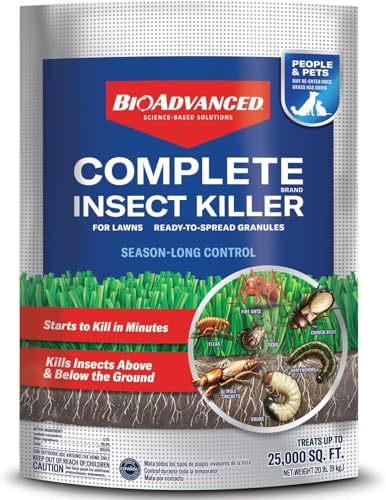
BioAdvanced Insect Killer Granules, 20 lb

Talstar PL Granules Insecticide

St. Gabriel Organics Milky Spore, 15lb

Bayer Merit 0.5 Granular, 30 lb

Quali-Pro Imidacloprid T&O 2F
The Details Behind The Selections
You pour, you water, you move on. That’s the rhythm of Hi-Yield’s 15-pound Grub Free Zone, a granular treatment aimed at homeowners who want straightforward control without a complicated mixing station in the garage. The bag covers up to 5,000 square feet, which fits a typical suburban lawn nicely without leaving a half-empty sack cluttering the shed.
Beyond white grubs, the formulation targets mole crickets, aphids, and adelgids (tiny sap-sucking insects that attack conifers and ornamental shrubs). For anyone dealing with a multi-pest problem rather than grubs alone, that wider reach makes a single spring application go further. Timing still matters: lay it down before eggs hatch, and you’ll interrupt the feeding cycle before the real damage starts.
Key Advantages
- Broad pest coverage that handles grubs, mole crickets, and sap-sucking insects in one pass
- 5,000-square-foot coverage suits most suburban lots without leftover product going stale
- Granular format spreads evenly with a standard broadcast spreader
- Spring-to-summer application window gives flexibility around weather delays
- Works across lawns, flower beds, and shrub borders without separate products
Things To Consider
- Application rates differ by pest, so reading the label carefully matters for results
- Granules need light watering in to activate, which adds a step on dry weeks
Right Fit For
Homeowners managing a mid-size lawn who want one product that handles both grubs and a few surface pests in the same treatment pass.
Look Elsewhere When
You want an organic approach with no synthetic active ingredient. St. Gabriel Organics Milky Spore suits that priority better.
The “III” in the name signals a stronger formulation, and the coverage jumps to roughly 7,000 square feet from a smaller 10-pound bag. For larger yards or properties with extended flower bed borders, that efficiency per pound is the real story. You spend less time refilling the spreader and more time getting the application done before the heat of the day sets in.
Use sites stretch beyond turf to include ground covers and the base of ornamental trees, which matters in mixed landscapes where grubs migrate from lawn edges into planting beds. Compared to the standard Grub Free Zone above, this version trades a little bag weight for noticeably more coverage per scoop.
A Few Highlights
- Higher-concentration formula covers more square footage with less product to haul
- Approved for ground covers and around ornamental trees, not just open lawn
- Targets grubs plus a wider range of damaging insects in one pass
- Spreader-friendly granules for clean, even distribution
Worth Noting
- Stronger concentration means reading the application rate carefully to avoid over-applying
- Pre-hatch timing matters: late applications catch fewer larvae and reduce visible results
Built With In Mind
Owners of larger suburban lots or multi-zone landscapes who want efficient coverage without committing to a 20- or 30-pound bag.
Swap It Out When
You’re treating a smaller yard where the standard Grub Free Zone’s lower coverage makes more sense.
Granular products need a spreader. This one skips the gear entirely: it’s a ready-to-spray bottle (RTS) that hooks onto a garden hose and meters itself out as you walk. For smaller lawns, flower beds, or quick spot treatments where dragging out equipment feels like overkill, the convenience is hard to beat.
The 32-ounce container covers up to 5,333 square feet and provides two to four weeks of control, so timing the application matters. Grubs, mole crickets, aphids, leafminers, and scale all fall within its labeled range, and you can use it on ornamentals, fruit and nut trees, shrubs, and lawn without switching containers.
What Earns Its Place
- No mixing or dilution required, just attach a hose and spray
- Broad label coverage for lawns, ornamentals, fruit trees, and shrubs
- Liquid delivery reaches foliage and soil contact evenly
- Ideal for spot treatments along lawn edges and planting beds
Honest Caveats
- Shorter residual window than granular options, so plan repeat visits for heavy infestations
- Hose-end sprayers can drift, so a calm day makes the application cleaner
Whose Shelf It Belongs On
Anyone treating a small lawn, raised beds, or scattered problem zones who values speed over long residual coverage.
Reach For A Different Pick When
You need season-long protection across a large lawn. Bayer Merit 0.5 Granular handles that workload more efficiently.
BioAdvanced’s Complete Brand Insect Killer takes the granular-grub concept and widens the net considerably. The formula claims to kill surface insects on contact while pushing protection down into the soil for grubs and other listed pests, so you don’t have to choose between above-ground and below-ground problems. It’s ready-to-spread from the bag, no mixing, no waiting.
The 20-pound bag suits medium-to-large properties and works directly on lawns plus visible ant mounds around the home, which adds flexibility for people who notice mound activity near walkways or the foundation. Compared to the Hi-Yield options above, this leans more toward the broad-spectrum side of the category, with ants, fleas, ticks, chinch bugs, and mole crickets in addition to grubs.
A Strong Showing
- Dual-action reach across surface and soil-dwelling pests
- Handles ants, ticks, and fleas alongside grubs
- Targets visible ant mounds around the home, not just open turf
- Granular format means simple broadcast application
Points To Keep In Mind
- Stronger formulation means following label precautions carefully around pets and kids during application
- Surface and contact claims don’t eliminate the need for proper watering-in on dry lawns
Best Suited To
Homeowners with multi-pest pressure on larger properties who want one product to handle grubs, ants, and surface insects at once.
A Better Fit Elsewhere
If avoiding synthetic active ingredients is the priority, St. Gabriel Organics Milky Spore is the organic-friendly choice instead.
Talstar PL takes a different angle: instead of working fast and fading quickly, it leans into longevity. The sand-core granular structure provides a two-to-four-month residual, which means one spring application can carry you through most of the active grub season without a second round. The granules penetrate mulch and grass on their own, with no watering required, so it suits properties where irrigation is patchy or non-existent.
The professional background shows in the formulation. Talstar is widely used in pest-control work for outdoor perimeter treatments, and the granular form brings that performance into a homeowner-friendly package. Ants and fleas on the surface fall within its reach, so it doubles as a perimeter treatment around patios and foundations.
Everyday Wins
- Two-to-four-month residual reduces repeat applications during peak season
- No watering needed, which helps on sloped or hard-to-irrigate sections
- Penetrates mulch and thatch to reach insects where they hide
- Professional-grade background with homeowner-friendly application
- Doubles as outdoor ant and flea control
Trade Offs
- Professional-grade product requires careful label review before use
- Granular format can be harder to find in small bag sizes for very small lawns
Who Should Grab It
Owners who prefer fewer applications per season and want a single product that bridges grub control and perimeter pest defense.
Consider Something Else When
You need a fast knockdown of an active infestation. Hi-Yield’s ready-to-spray bottle acts more quickly in the short term.
Milky Spore works on a completely different timeline than synthetic options. Instead of killing grubs on contact, you spread a naturally occurring bacterial spore that colonizes the soil and persists for years, gradually reducing the grub population each season as larvae ingest the spores and pass them on. It’s the slow-and-steady approach, and it’s been in use for decades.
Because the active ingredient is biological rather than chemical, the product fits yards where minimizing synthetic exposure matters, including homes with vegetable gardens, kids, or pets that use the lawn daily. The 15-pound bag treats a substantial area, and once established, the spore population tends to maintain itself without repeated annual treatments.
A Favorable Mix
- Biological active ingredient for yards where synthetic chemicals are a concern
- Long-term population reduction rather than a one-shot knockdown
- Suitable for use around food crops and residential play areas
- One application can provide multi-year benefits in established soil
- Weather-resilient once the spores are in place
Some Limits To Know
- Slower to show visible results compared to synthetic options, patience is required
- Targets Japanese beetle grubs specifically, so coverage of other grub species varies by region
Perfect Match For
Households prioritizing organic lawn care, families with pets or children, and gardeners who think in multi-year cycles rather than single seasons.
Not Your Match When
You have an active infestation that needs immediate knockdown. BioAdvanced Insect Killer Granules addresses urgent pressure faster.
Bayer’s Merit 0.5 Granular is the kind of product you find on golf courses and professional turf operations, repackaged for serious homeowners. The 30-pound bag covers meaningful acreage, and the imidacloprid 0.5% formulation is systemic, meaning the active ingredient moves through the plant’s root system and protects from within. Grubs feeding on treated roots stop feeding and die.
Label use sites include turfgrass, trees, shrubs, evergreens, flowers, foliage plants, and ground covers, which makes it one of the more versatile products in this lineup. The annual application ceiling is capped at 80 pounds per acre, so calibrating your spreader correctly matters for both performance and staying within label limits.
Well-Handled Touches
- Systemic protection through the plant, not just surface contact
- Wide use-site label covering turf, ornamentals, and ground covers
- Large 30-pound bag suits properties with significant acreage
- Trusted professional-grade active ingredient
- Season-long prevention when applied preventively
Potential Drawbacks
- Annual application cap requires careful rate calculation on larger properties
Made For
Property owners managing large turf areas or mixed landscapes who want professional-grade prevention rather than reactive treatment.
Where Another Pick Suits Better
Homeowners with smaller lawns who want easier handling. Hi-Yield Grub Free Zone in a 15-pound bag fits smaller properties more comfortably.
Quali-Pro’s Imidacloprid T&O 2F is often referenced as a generic equivalent of Merit, sharing the same active ingredient class but coming in liquid concentrate form. The “2F” in the name refers to the flowable formulation, and “T&O” stands for turf and ornamental, the two primary use sites. For someone comfortable mixing concentrates, the low use rates translate to a lot of finished spray per bottle.
It’s labeled for systemic control of soil-dwelling pests across turfgrass and landscape plantings, and it targets the grub species that matter most: southern masked chafer, northern masked chafer, Japanese beetle, and European chafer. Application flexibility is the big draw here: you can use it on golf courses, residential turf, and landscape beds, depending on your rate and equipment.
Useful Touches
- Low use rates make one bottle cover significant ground
- Same active ingredient class as Merit at a typical cost advantage
- Application flexibility across turf and ornamental sites
- Liquid format mixes cleanly with standard spray equipment
- Targets the grub species that cause the most turf damage
Less Ideal Details
- Concentrate format requires measuring, mixing, and calibration before use
- Less beginner-friendly than granular or ready-to-spray alternatives
- Requires appropriate spray equipment for accurate application
Who Will Love This
Experienced DIYers and homeowners with spray equipment who want professional-grade results at a cost advantage over branded equivalents.
Where A Sibling Pick Shines
First-time users benefit from BioAdvanced Insect Killer Granules, which skips the measuring and mixing step entirely.
What Matters Before Choosing Insecticides For Grubs
Match The Formula To Your Pest Problem
Start by identifying what you’re actually fighting. White grubs, Japanese beetle larvae, and European chafer all respond to imidacloprid-based systemic products like Bayer Merit or Quali-Pro’s version, while broader surface-and-soil mixes like BioAdvanced handle ants and ticks alongside grubs. For organic approaches, milky spore targets Japanese beetle grubs specifically, so check your local grub species before committing.
Granular Versus Liquid Delivery
Granular products spread evenly with a broadcast spreader and suit large lawns, with most requiring light watering to activate. Liquid concentrates like Quali-Pro Imidacloprid offer more flexibility and lower per-acre cost but demand calibration and proper equipment. Ready-to-spray bottles bridge the gap for small lawns and spot treatments.
Time The Application To The Grub Life Cycle
Preventive applications go down before eggs hatch, typically late spring through early summer depending on region. Curative treatments target active larvae in late summer and fall, but results take longer and require stronger active ingredients. The label on every product in this list specifies timing windows for best results.
Consider Yard Use And Household Priorities
Homes with kids, pets, or vegetable gardens may prioritize organic or low-exposure options like St. Gabriel Milky Spore. Properties with ant mounds near the foundation or tick pressure around play areas benefit from broad-spectrum products that handle surface and soil pests at once.
Key Considerations Across These Picks
Pitfalls Shoppers Hit
Treating after damage appears is the most common mistake. By the time brown patches show up, grubs have already fed through the root zone and the lawn needs recovery time, not just pest control. Reading the label for application rate by pest species is the second slip-up. Grub rates differ from mole cricket rates, and using the wrong one wastes product and delivers weaker results.
When Paying More Pays Off
The jump from a basic granular to a professional-grade systemic product like Bayer Merit or Quali-Pro buys season-long prevention through the plant itself, rather than a one-time knockdown. For properties with chronic grub pressure or large acreage, that systemic protection typically means fewer applications over several years. Higher-tier options also tend to carry broader labels, covering more use sites without buying a second product.
Frequently Asked Questions
When Is The Best Time To Apply Grub Insecticides?
Late spring through early summer is the preventive window, before eggs hatch and larvae begin feeding. Curative treatments work in late summer and fall once grubs are actively feeding near the surface.
Are Organic Grub Treatments As Effective As Synthetic Options?
Organic options like milky spore work on a longer timeline, building up in the soil over multiple seasons rather than knocking down an active infestation. For immediate pressure, synthetic products act faster and more visibly.
How Much Product Do I Need For My Lawn?
Measure your lawn’s square footage first, then divide by the coverage listed on each bag. Most products in this list cover between 5,000 and 7,000 square feet per bag, so a 10,000-square-foot yard typically needs two bags for full coverage.
Can I Use Grub Insecticides Around Pets And Children?
Granular products generally require keeping pets and kids off treated areas until watering-in is complete and the lawn dries. Ready-to-spray and organic options vary by label, so check specific re-entry guidance before application.
Do Grub Insecticides Also Kill Other Lawn Pests?
Several products in this list, including BioAdvanced Insect Killer Granules and Talstar PL, target ants, fleas, ticks, and mole crickets alongside grubs. Check the label’s pest list for the full spectrum of activity before choosing.
Closing Remarks
The right insecticide depends on your lawn size, your tolerance for synthetic ingredients, and how soon you need results. Granular options handle most suburban lawns with a single spring pass, organic spore treatments reward patience with multi-year suppression, and systemic professional-grade products suit larger properties with chronic pressure. Match the formula to the pest and the timing to the season, and your lawn stays ahead of the curve.
