

Grubs chewing through turf roots, fire ants colonizing the dog run, mosquitoes turning the patio into a no-go zone, all of it traces back to a yard full of unprotected grass. Choosing the right insecticide comes down to matching the formula and delivery style to your pest, your lawn size, and your tolerance for mixing concentrates.
This lineup covers granular options that spread with a broadcast spreader, hose-end ready-to-spray bottles for quick coverage, and professional-grade concentrates for large properties. Each pick is matched to a real-world situation so the choice feels less like guesswork.
The Lineup, Simplified
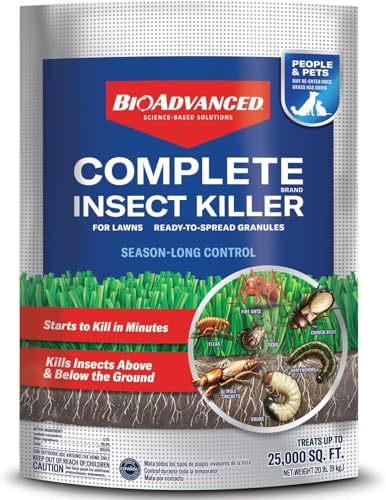
BioAdvanced Complete Brand Insect Killer for Lawns Granules 20 lb

Bayer Merit 0.5 Granular Systemic Insect Control 30 lb

Agrisel Bifenthrin Pro 7.9 Insecticide 1 Gallon

Martin’s Cyonara Lawn & Garden Concentrate 32 oz

Talstar One Insecticide 1 Gallon Bifenthrin Concentrate

Atticus Mineiro 2F Flex Imidacloprid Insecticide 1 Gallon

Amdro Quick Kill Insect Killer Ready-to-Spray 32 oz

BioAdvanced Complete Brand Insect Killer Ready-to-Spray 32 oz
The Strengths Of Each Pick
Granular insecticides are a strong match for homeowners who already own a broadcast spreader and prefer a slow, even application over dragging a hose around the perimeter. The BioAdvanced Complete Brand Insect Killer Granules come in a 20 lb bag designed to flow through standard drop and rotary spreaders, which makes mid-size yards straightforward to treat in a single pass.
Coverage leans toward surface-feeding pests such as ants, fleas, ticks, and chinch bugs, while also addressing listed below-ground grubs and mole crickets. The ready-to-spread format eliminates measuring or mixing, so the chance of over-application drops noticeably compared to liquid concentrates. For most homeowners who want one product to cover the common cast of lawn pests, this bag has wide appeal.
Real-World Strengths
- Ready-to-spread granules skip the measuring and mixing step concentrates demand
- Targets both surface insects on contact and listed below-ground pests in one application
- 20 lb bag covers enough ground for typical quarter-acre lots without frequent refills
- Works through standard broadcast spreaders already in many garage toolkits
Honest Caveats
- Requires a separate spreader purchase for anyone without one on hand
- Granular delivery means slower visible knockdown than hose-end sprays
- Storage in a sealed, dry bin keeps the product from clumping between seasons
Key Product Details
Who It Suits Best
Homeowners with a quarter-acre yard who already own a spreader and want season-long surface pest control without handling liquid concentrate.
Where Another Pick Suits Better
The Bayer Merit 0.5 Granular Systemic Insect Control is a stronger match for properties that need a true systemic approach to grubs rather than contact control alone.
Systemic insecticides work differently from contact killers: the active ingredient is absorbed by grass roots and moves through the plant, which means insects that feed on treated turf are exposed even when they never touch the granules. The Bayer Merit 0.5 Granular Insect Control uses imidacloprid at a 0.5% concentration to deliver that systemic uptake, and the 30 lb bag covers large properties or multiple lawn zones in one go.
This format works best in a preventive program, applied before grub damage becomes visible, since curative rescue treatments on heavily damaged turf have limited recovery odds. The label extends beyond turf to trees, shrubs, evergreens, and flowers, so the same bag can serve a varied landscape. Professional-looking turf without the curative scramble is the headline benefit for most owners.
Benefits That Matter
- Systemic uptake targets pests feeding on treated turf from the inside out
- 30 lb bag suits large lawns or multi-zone landscape programs
- Label covers turf, ornamentals, trees, and shrubs in a single product
- Granular format suits homeowners comfortable with rotary spreaders
Trade Offs To Consider
- Per-acre limits cap how much product can legally be applied in a year
- Preventive timing window matters more than fast visible knockdown
- Bag requires cool, dry storage to keep granules free-flowing
Made For
Owners of large lawns or multi-zone landscapes who plan a spring preventive grub program and want one granular product that doubles as an ornamental treatment.
Consider Something Else When
The BioAdvanced Complete Brand Insect Killer Granules are a better fit for homeowners whose primary concern is fast surface knockdown of ants and fleas rather than preventive grub defense.
Bifenthrin is one of the workhorse pyrethroid (synthetic pyrethroid, meaning a class of contact insecticides modeled on natural chrysanthemum chemistry) active ingredients in professional lawn care, and the Agrisel Bifenthrin Pro 7.9 packs it into a one-gallon concentrate that dilutes into a large spray volume. That math matters on bigger properties where small ready-to-spray bottles run out before the second pass.
This liquid concentrate covers spiders, ants, fleas, mosquitoes, stink bugs, and mole crickets, which makes it useful across both lawn and ornamental applications. The formula is noted as pet-safe after drying, so timing around kids and pets matters but the post-dry window is workable. Experienced homeowners who already own a pump sprayer will find the most value here, while first-timers may find the dilution step a hurdle.
Practical Advantages
- One-gallon concentrate dilutes into enough spray for large properties
- Covers spiders, ants, mosquitoes, fleas, and mole crickets in one product
- Suitable for lawn, ornamental, and broader agricultural-adjacent settings
- Pet-safe once dry supports normal household routines after application
Where It May Fall Short
- Requires a pump sprayer and careful dilution that beginners may find intimidating
- Liquid concentrates need cool, shaded storage to keep potency stable
Feature Snapshot
Best Suited To
Homeowners with a half-acre or larger property who already own a pump sprayer and want one concentrate to handle perimeter, lawn, and ornamental pest control.
Skip It When
The Amdro Quick Kill Insect Killer Ready-to-Spray is a smoother pick for first-time homeowners who would rather skip dilution and connect a hose instead.
Lambda-cyhalothrin is another pyrethroid active ingredient, and Martin’s Cyonara Lawn & Garden Concentrate delivers a 0.5% formulation in a quart-size bottle with a notably low odor profile. For households sensitive to chemical smells, that low-odor profile is often the deciding factor between a pyrethroid concentrate they tolerate and one they avoid.
The label lists coverage across 130-plus pests including spider mites, fleas, aphids, fire ants, and chinch bugs, and protection spans lawns, vegetables, roses, flowers, trees, and shrubs. That versatility is unusual for a single quart bottle, and it makes the product useful for gardeners who manage both turf and edible beds. For most backyards, a single bottle dilutes into enough finished spray for multiple treatments.
Real Benefits
- Low-odor formula suits households bothered by stronger chemical smells
- 130-plus pest label covers lawn and edible garden in one bottle
- Quart size fits standard pump sprayers without leftover storage issues
- Versatility extends from turf to ornamentals and food crops
Points To Keep In Mind
- Concentrate still requires accurate dilution to avoid over-application
- Food-crop label means stricter pre-harvest intervals than turf-only products
- Bottle should be stored upright in a shaded cabinet between uses
Whose Shelf It Belongs On
Gardeners managing mixed turf and edible beds who want broad pest coverage without a strong chemical smell hanging in the air after treatment.
Look Elsewhere When
The Talstar One Insecticide is a smarter match for homeowners whose primary goal is perimeter barrier protection rather than food-crop coverage.
Perimeter spraying is a different discipline than broadcast lawn treatment: the goal is a continuous barrier around foundations, doors, and windows that intercepts pests before they come inside. The Talstar One Insecticide concentrate is built for that job, with bifenthrin as the active ingredient and a label covering over 75 pests including spiders, ants, mosquitoes, and fleas.
The one-gallon size matches the dilution math of professional perimeter programs, so a single jug covers multi-side barrier treatment plus spot applications. Indoor-adjacent outdoor use gives the bottle a dual role when window wells, garage thresholds, and patio doors need attention alongside foundation spraying. In our view, the trade-off is that perimeter-only buyers in small homes may find a full gallon more than they need in a single season.
Where It Delivers
- Perimeter barrier design suits foundation spray programs around the home
- Bifenthrin formulation targets over 75 listed pests on contact
- One-gallon jug covers multi-side perimeter plus spot applications
- Indoor and outdoor labeling extends use to window wells and thresholds
Some Limits To Know
- Full gallon is overkill for small homes with simple foundation layouts
- Concentrate format requires a pump sprayer and careful mixing
The Right Fit
Homeowners with persistent spider and ant entry issues who want a continuous perimeter barrier around foundations, doors, and windows.
Reach For A Different Pick When
The Agrisel Bifenthrin Pro 7.9 Insecticide is a comparable concentrate at a friendlier volume for properties that mix perimeter and broad lawn treatments in roughly equal measure.
The Atticus Mineiro 2F Flex delivers imidacloprid at 21.4% in a liquid suspension concentrate, which is a meaningfully higher concentration than granular 0.5% products and changes how the product gets used. A single gallon dilutes into a substantial spray volume suited to large turf areas, and the formulation matches the industry-standard preventive approach that’s dominated grub programs for two decades.
Pre-season application is the operating model, which means timing matters more than mixing accuracy: homeowners who understand grub life cycles and apply before egg hatch get dramatically different results than those treating after visible damage. For warm-zone turf where grub pressure peaks predictably each summer, this bottle fits into a calendar-based program nicely. The honest read is that curative rescue is not where this product shines.
Notable Gains
- 21.4% imidacloprid matches the industry-standard preventive rate
- Liquid suspension dilutes to cover large turf areas per gallon
- Calendar-based timing suits warm-zone grub programs reliably
- Same active ingredient as leading branded imidacloprid products
Potential Drawbacks
- Preventive timing window matters far more than fast visible results
- Requires pump sprayer and accurate calibration across larger areas
- Suspension concentrate needs gentle shaking before each tank mix
Spec Overview
Perfect Match For
Homeowners in warm-zone regions who run a calendar-based preventive grub program and have a pump sprayer ready for liquid application.
Not Your Match When
The BioAdvanced Complete Brand Insect Killer Ready-to-Spray is a better fit for households that want a hose-end treatment with no mixing or calibration steps.
Hose-end ready-to-spray bottles are the lowest-friction option in the insecticide aisle, and the Amdro Quick Kill Insect Killer sits firmly in that category. Connect the bottle to a garden hose, squeeze the trigger, and water pressure dilutes the concentrate as it sprays. For first-time homeowners who want results without buying a pump sprayer or learning calibration, that workflow matters more than chasing the most potent concentrate.
The label lists coverage across over 500 insects including mosquitoes, ants, spiders, fleas, Japanese beetles, and chinch bugs, with up to three months of listed pest control per application. Lawn and landscape use covers both turf and ornamental beds, so a single bottle serves the typical residential mix. Depending on water pressure and walking speed, one bottle may finish the yard or fall a bit short.
What Works In Its Favor
- Hose-end application removes dilution and calibration from the workflow
- 500-plus insect label covers most residential pest encounters
- Up to three months of listed pest control per application
- Works across lawn and landscape beds in the same treatment pass
Where It Is Less Suited
- 32 oz bottle may finish before larger yards are fully covered
- Hose pressure changes how much product actually reaches the lawn
Quick Technical Notes
Who Should Grab It
First-time homeowners and renters who want a hose-end treatment with no calibration, mixing, or extra equipment purchases.
Swap It Out When
The Agrisel Bifenthrin Pro 7.9 Insecticide is a smarter pick for larger properties where a single 32 oz bottle runs out before coverage is complete.
Where many hose-end products focus on surface pests alone, the BioAdvanced Complete Brand Insect Killer Ready-to-Spray extends coverage to listed soil and turf insects, including grubs. That dual-target framing closes a common gap: homeowners fighting chinch bugs above ground in July often face grub damage below in fall, and a single bottle that addresses both layers simplifies the program.
The fast-acting formula kills listed pests by contact and includes mosquitoes in the label coverage. The 32 oz bottle uses the same hose-end workflow as other ready-to-spray products, so the convenience curve stays flat compared to a concentrate. You may find that the bottle finishes a mid-size yard in one pass but leaves larger properties needing a refill mid-treatment.
A Few Highlights
- Covers both surface insects and listed soil and turf pests including grubs
- Contact kill plus mosquito coverage broadens seasonal use
- Ready-to-spray hose-end format removes mixing from the workflow
- 32 oz bottle suits mid-size yards in one continuous pass
Details To Watch
- Surface pests dominate the contact kill profile; deeper curative work needs a dedicated product
- Larger properties may require a second bottle for complete coverage
- Spray nozzle clogs can occur if the bottle sits unused between seasons
Feature Card
Built With In Mind
Homeowners with mixed pest pressure who want one ready-to-spray bottle that handles both surface insects and listed soil-dwelling pests through the season.
Another Choice May Suit
The Bayer Merit 0.5 Granular Insect Control is a stronger fit for properties committed to a dedicated preventive grub program with systemic uptake rather than contact-only control.
What Matters Most Before Choosing Insecticides For Lawns
Match The Formula To The Pest
The single biggest decision is whether the problem is above-ground (mosquitoes, ants, fleas, ticks, chinch bugs) or below-ground (grubs, mole crickets). Contact insecticides, including most pyrethroid sprays and granules, address surface pests quickly but have limited reach into soil layers where grubs feed. Systemic products like imidacloprid move through the plant, so grubs ingest the active ingredient when they feed on roots.
Pick A Delivery Method That Fits Your Equipment
Granular insecticides flow through broadcast spreaders, which many homeowners already own for fertilizer. Liquid concentrates require a pump sprayer and accurate dilution, which adds steps but reduces cost per acre on big properties. Hose-end ready-to-spray bottles skip both equipment purchases and dilution math, which matters most for small yards and first-time users.
Read The Label For Use Sites And Timing
Labels specify turf types (cool-season vs warm-season grasses), ornamental plants, and sometimes food crops. Pre-harvest intervals apply when edible gardens are treated. Application timing windows also vary: preventive grub products work best when applied before egg hatch, while contact sprays perform whenever pests are active.
Size The Container To Your Property
A 20 to 30 lb granular bag suits a quarter-acre to half-acre yard. A one-gallon concentrate covers large properties or multiple treatment rounds. A 32 oz ready-to-spray bottle finishes mid-size yards in one pass but may run short on larger lots.
Key Considerations Across These Picks
Mistakes Worth Dodging
Treating on the wrong day wastes product and effort. Most insecticides need dry weather with no rain forecast for 24 hours, so calm mornings without wind or imminent storms work best. Mowing right before application also matters less than watering timing: many granules activate with irrigation, while sprays need foliage to dry undisturbed.
Where The Extra Money Goes
Higher-tier concentrates earn their cost through coverage per acre, longer residual windows, and broader pest labels. The trade-off shows up clearly between a 32 oz ready-to-spray bottle and a one-gallon concentrate: the concentrate dilutes into enough finished spray to treat several times the area, but only homeowners with the right sprayer and patience for calibration will realize that savings. Premium systemic products like imidacloprid formulations are preventive tools, so the value depends on running the program on a calendar rather than chasing visible pests after they appear.
Frequently Asked Questions
How long does a typical lawn insecticide application last?
Surface contact sprays typically offer several weeks of listed pest control, while granular and systemic products can extend coverage across months. Residual duration depends on weather, irrigation, and pest pressure, so reapplication intervals vary.
Can I apply insecticide to a newly seeded lawn?
Most labels caution against treatment on newly seeded or stressed turf, since young grass may show sensitivity to active ingredients. Waiting until seedlings establish, often after the third or fourth mowing, gives safer results.
Do I need to water my lawn after applying granular insecticide?
Many granular products activate with irrigation or rainfall within a specified window after application. Light watering shortly after spreading moves the active ingredient into the soil layer where listed pests encounter it.
Are these products safe around pets and children?
Most modern lawn insecticides are designed to be safe once dry, but keeping pets and kids off treated surfaces during application and the drying window is standard practice. Label guidance for any specific product provides the exact re-entry interval.
How do I know if grubs are the problem in my lawn?
Spongy turf that lifts easily, increased animal digging, and irregular brown patches that don’t respond to watering often point to grub activity. Confirming with a small square-foot soil sample before treatment helps match the right product to the actual pest.
Bottom Line
A lawn insecticide earns its place by matching the active ingredient and delivery format to your specific pest pressure, equipment, and property size. Granular options suit homeowners with broadcast spreaders, concentrates reward patience and sprayer access, and ready-to-spray bottles trade some efficiency for the simplest workflow. Pick the format that fits how you actually maintain your yard, and the rest of the decision gets easier.
