

A patchy, uneven yard turns mowing into a chore, scalps the grass, and collects water where roots don’t want it. After a few seasons of bumps, pet damage, or settling soil, most homeowners start hunting for the same fix: a leveling rake that actually flattens things out without renting heavy equipment. The right rake spreads topdressing, fills low spots, and gives you the kind of smooth surface that makes a lawn look like it finally belongs in the neighborhood.
Your Options, Compared

Dremmt Professional-Grade Lawn Leveling Rake 30×10 inch

HIDALIFE Stainless Steel Lawn Leveler 30×10 Ground Plate

cogardenshower Heavy Duty Leveling Rake 30×10 Stainless Steel

cogardenshower Leveling Rake 17×10 Stainless Steel Plate

BlumeTrec 30×10 Sand Leveling Rake 7FT Handle
BlumeTrec 45×10 Sand Leveling Rake 7FT Handle

COCONUT 17×10 Heavy Duty Lawn Leveler 60 Inch

EUIJOIP Foldable Leveling Rake 30×10 72-Inch Handle
Meet The Standout Selections
The Dremmt lands first because it offers something most leveling rakes skip: a configurable head width that grows with your yard. You can run the 30-inch plate through narrow garden strips or step up to the 45-inch version when leveling a larger patch of lawn. The stainless steel handle shrugs off the rust that ruins cheaper tools after a single wet season.
For homeowners just starting with topdressing (a thin layer of soil or compost spread over turf to smooth and feed it), this flexibility matters more than raw weight. You can experiment on a small area before committing to a wider pass. Compared to the fixed-plate options coming up, this one adapts to uneven terrain without forcing you to swap tools.
Standout Benefits
- Swappable plate widths suit anything from a backyard strip to a half-acre lot
- Stainless steel handle resists corrosion through repeated wet-soil use
- 6.5-foot reach reduces lower-back strain during long sessions
- Wide plate spreads sand and compost evenly, cutting repeat passes
Honest Caveats
- Larger plate sizes add weight, which can tire out smaller users on bigger jobs
- Owners commonly report the assembly instructions could use more detail
Key Specs
Right Fit For
Homeowners who want one leveling rake that adapts as their yard work scales up from a small patch to a full lawn.
Look Elsewhere When
Shoppers working primarily in tight garden beds should consider the COCONUT 17×10 model, which handles narrow spaces with less bulk.
The HIDALIFE positions itself as the tall gardener’s friend, offering a 78-inch handle that keeps you from stooping over every pass. That extra reach matters when you’re working a half-acre or pushing topdressing across a sports-field-sized lawn. The 30-inch plate hits a sweet spot between coverage and maneuverability.
Where the Dremmt offers plate flexibility, this rake doubles down on raw handle length. You trade the option of swapping widths for a tool that simply covers more ground per sweep. For most backyards, the 78-inch reach feels almost excessive, but for taller users it removes the hunch that ruins half-hour sessions.
The Value In It
- 78-inch handle saves your back during extended leveling
- 30-inch plate balances coverage with the ability to navigate around trees and beds
- Stainless steel construction holds up season after season
- Green color stays visible if you set it down in tall grass
Trade Offs
- Long handle is harder to store in a standard garage corner
- Fixed plate width means less flexibility for narrow garden strips
At A Glance
Built With In Mind
Anyone over six feet tall, or homeowners leveling larger yards where shorter handles become uncomfortable fast.
Skip It When
Those working in a small shed should look at the EUIJOIP foldable rake, which collapses to a slimmer profile for tight storage.
When the soil fights back, lighter rakes get shoved around. The cogardenshower Heavy Duty answers that problem with double spot welds and reinforced seams at the handle connection, where most leveling rakes eventually crack. At 12 pounds, it has real presence, and the anti-flipping smooth edge keeps the plate from digging in or skipping across uneven ground.
The adjustable 28-to-60-inch handle range makes it usable for short helpers and tall operators alike. If you’ve been fighting clay-heavy soil or trying to level compost over compacted spots, the weight here works with you instead of against you. Compare that to the lighter 8.5-pound sibling coming up, and the trade-off becomes clear: this one trades effort for results.
Positive Points
- Double spot welds and reinforced seams extend the tool’s working life
- Anti-flipping edge prevents the plate from rocking or gouging uneven ground
- Wide 28-60 inch adjustment fits a range of user heights
- Drives through compacted soil that stalls lighter rakes
Worth Bearing In Mind
- 12-pound build can wear down arms during long sessions
- Heavier construction adds to shipping and storage bulk
- Less ideal for delicate topdressing on already-loose soil
Feature Snapshot
Best Suited To
Homeowners with heavy clay or compacted soil who need a tool with enough weight to level without bouncing.
Consider Something Else When
Anyone prioritizing lighter handling over brute force should look at the cogardenshower 17×10 model, which trims weight while keeping the same welded construction.
This is the lighter sibling to the 30-inch cogardenshower above, and the 8.5-pound weight changes how the tool feels in motion. You give up some coverage per pass, but you gain a rake you can carry one-handed and steer between raised beds without dragging soil where you don’t want it. The 17-inch plate is sized for tight garden work, not open lawn.
For anyone leveling a small backyard or working around stepping stones and edging, the narrower plate is a genuine advantage. The same reinforced welds and stainless construction carry over from its bigger brother, so you don’t sacrifice durability for the smaller footprint.
Everyday Advantages
- 8.5-pound build makes it manageable for most users without fatigue
- 17-inch plate fits between garden beds and narrow paths
- Spot-welded stainless steel holds up over multiple seasons
- 28-60 inch handle adjustment suits different user heights
Points To Note
- Narrower plate means more passes to cover a full lawn
- Less weight can cause skipping on harder, compacted ground
Perfect Match For
Gardeners with limited space or anyone working around intricate landscaping where a wide plate would cause more cleanup than it saves.
Reach For A Different Pick When
Homeowners leveling an open half-acre should consider the BlumeTrec 45×10 rake, which covers wide stretches in far fewer passes.
The BlumeTrec 30×10 builds for users who think in terms of fairways and greens. The 7-foot handle is the longest fixed reach in this lineup, and the steel construction handles sand, compost, and gravel with equal ease. If you’ve ever watched a grounds crew at a golf course, this is the same basic design adapted for home use.
That reach is the headline feature, but it also means you’ll want decent ceiling clearance in your shed. The steel head resists denting when you hit a hidden rock, which matters if your lawn has buried debris from past landscaping. For most backyards, the 30-inch plate covers ground efficiently without overwhelming the operator.
Useful Strengths
- 7-foot handle keeps you upright across long leveling sessions
- Steel head stands up to sand, gravel, and rocky patches
- 30-inch plate covers a wide strip per pass
- Works across soil, compost, and stone without changing tools
Softer Spots
- Long fixed handle is awkward for shorter users
- Steel (rather than stainless) may need a wipe-down to prevent surface oxidation over time
Who It Suits Best
Homeowners with large lawns, golf-style properties, or anyone who wants fairway-smooth results across a wide area.
Swap It Out When
Shoppers needing adjustable height should consider the cogardenshower 30×10, which telescopes from 28 to 60 inches for shared use.
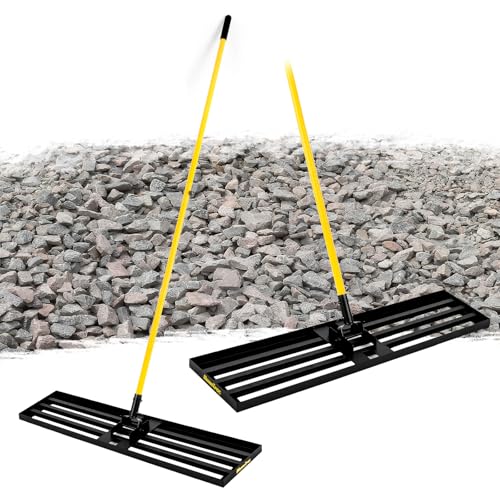
This is the open-field version of the previous BlumeTrec, swapping a wider 45-inch plate onto the same 7-foot steel-handled frame. Every sweep pushes more material further, which translates directly to fewer trips down the same stretch of yard. For acre-scale properties or pasture work, that coverage difference is the whole story.
The trade-off is steering. A 45-inch plate doesn’t bend easily around curves or obstacles, so this rake shines on straight runs and rectangular lawn sections. You may find it unwieldy on a typical suburban yard full of trees and curved beds, where the 30-inch sibling feels more natural.
Where It Helps
- 45-inch plate covers nearly 50% more ground per pass than 30-inch models
- Steel construction handles abrasive materials without wearing down
- 7-foot reach keeps posture upright on long jobs
- Suited for compost, sand, gravel, and topsoil alike
Less Ideal Details
- Wide plate is harder to steer around trees, beds, and curved edging
- Long fixed handle may be too tall for shorter users
Who Should Grab It
Property owners with wide, open lawn areas, pastures, or sports-field-scale spaces where straight, efficient passes matter most.
Another Choice May Suit
Homeowners with curved beds and obstacle-filled yards should look at the Dremmt 30×10, which handles tight layouts more gracefully.
The COCONUT 17×10 is built around rounded plate edges instead of sharp 90-degree angles, and that detail changes how the tool behaves on real lawns. Hard corners push dirt ahead of them, leaving wake behind, but rounded edges glide and catch loose material at the same time. For first-time users, this means fewer frustrating passes to undo.
Assembly reportedly takes under a minute: connect the extender poles with a twist, then tighten a single screw to lock the plate to the handle. The 60-inch handle adjusts to fit, and the metal construction avoids the snapping that plagues cheaper wood-handled rakes. It’s a low-fuss pick for someone renting or testing the leveling concept before committing to a heavier tool.
Strengths Worth Knowing
- Rounded edges glide over dirt while filling small holes
- Twist-and-screw assembly requires no extra tools
- Metal handle resists the snapping common in budget wood-handled rakes
- Works on common grass types including Bermuda, Bluegrass, and Fescue
Practical Considerations
- 17-inch plate requires more passes on bigger lawns
- Best results come with grass cut to 1.5 inches or less, so timing matters
Made For
First-time users, renters, or anyone leveling a small yard without committing to a heavier, more expensive tool.
Where Another Pick Suits Better
Homeowners ready to invest in long-term heavy use should consider the cogardenshower 30×10, which handles bigger jobs with fewer passes.
Most leveling rakes are awkward to store: long handle, wide plate, nowhere to put them. The EUIJOIP solves that with a folding head that collapses the 30-inch plate down to a 10-inch-wide profile, slim enough for a narrow garage corner or a carport shelf. Available in 72-inch and 80-inch handle options, it covers the same ground as other 30×10 rakes once unfolded.
Stainless steel construction and an ergonomic handle design round out a rake built for storage-constrained shoppers. The tradeoff shows up at the hinge: folding mechanisms add one more thing that could wear or loosen over years of use, so long-term durability depends on keeping that joint clean.
What Pays Off
- Folding head reduces storage footprint by roughly two-thirds
- 72 or 80-inch handle options fit different user heights
- Stainless steel resists rust in damp garage conditions
- 30-inch plate covers wide strips when unfolded
Minor Gripes
- Folding hinge adds a potential wear point over years of use
- Slightly higher cost than non-folding 30×10 alternatives
Quick Facts
Whose Shelf It Belongs On
Anyone with limited storage, whether that means a small garage, a crowded shed, or an apartment balcony tool closet.
A Better Fit Elsewhere
Homeowners who don’t worry about space can save money with the BlumeTrec 30×10, which delivers similar coverage in a simpler fixed-head design.
What To Look For In A Leveling Rake
A good leveling rake earns its place by solving three problems at once: spreading topdressing evenly, settling low spots, and leaving a finish flat enough to mow without scalping. The head width drives how fast you work. A 17-inch plate is right for tight garden beds or small lawns where obstacles force constant steering. A 30-inch plate is the everyday standard for suburban yards, balancing coverage with maneuverability. A 45-inch plate is open-ground territory, useful on flat pastures or wide lawn sections but a hassle around trees and curved edging.
Handle length and material shape the comfort of the job. Stainless steel handles outlast wood and resist the rust that ruins cheap tools after one wet season, while steel heads take more abuse from gravel and rocky soil. Adjustable handles let a single rake serve multiple users, which matters for shared family tools or community garden settings.
Weight is the underrated factor. Lighter rakes (around 8 to 9 pounds) stay nimble on loose topdressing but skip across hard-packed soil. Heavier rakes (10 to 12 pounds) push through compacted ground without bouncing, but tire out smaller users on long sessions. Matching the tool’s weight to your soil type and your strength matters more than chasing the heaviest model.
Construction details like spot welds, smooth (non-flipping) edges, and reinforced handle connections extend service life. Folding head designs trade a small durability question at the hinge for much easier storage, which can matter in tight garages or shared sheds.
Key Considerations Across These Picks
Pitfalls Shoppers Hit
Choosing the widest plate because more coverage sounds better often backfires on real lawns full of trees, beds, and curves. A 45-inch head becomes an obstacle course. Plate width should match the largest open stretch you’ll level, not the total yard size.
Another common miss is ignoring handle length. A handle that’s too short bends your back over hours of work, while one that’s too tall makes steering harder for shorter users. Adjustable handles solve this for shared households, but fixed-length rakes need to match the primary user.
When Paying More Pays Off
The jump from budget rakes to mid-tier options usually buys stainless steel construction and reinforced welds at the handle-to-head joint. That’s where most leveling rakes fail first. Higher-tier models also tend to offer better edge geometry, the smooth or rounded transitions that keep the plate from digging in or skipping.
Premium features like folding heads, anti-flipping edges, and adjustable handles add cost, but they solve real problems: cramped storage, uneven ground, and shared use. The upgrade is worth it when those problems match your situation, and easy to skip when they don’t.
Frequently Asked Questions
What size leveling rake do most homeowners need?
A 30-inch plate handles the majority of suburban yards well. It’s wide enough to cover ground efficiently but narrow enough to steer around trees, garden beds, and curved edging without constant course corrections.
Can a leveling rake fix deep holes or just shallow ones?
These tools work best on shallow depressions and gradual unevenness, the kind of settling that creates mower scalping spots. Deep holes need fill soil added first, then the rake spreads and levels that added material.
Do I need to cut the grass before leveling?
Shorter grass makes the job cleaner and lets the rake reach the soil surface. Most sources recommend cutting to about 1.5 inches or less before topdressing so material reaches the ground rather than sitting on top of the blades.
How often should I level my lawn?
Once a year is typical for most homeowners, usually in early growing season. High-traffic lawns or properties with settling soil may benefit from a second pass in early fall.
Are stainless steel rakes worth the extra cost?
Stainless steel resists the rust that ruins carbon steel tools after repeated contact with damp soil. Over several seasons, that durability usually justifies the higher upfront cost for anyone using the rake more than once or twice.
The Takeaway
The right leveling rake comes down to your yard size, soil type, and storage space. For most suburban lawns, a 30-inch stainless steel plate with an adjustable handle covers the most ground without becoming unwieldy. Bigger properties benefit from wider plates and longer handles, while tight gardens and obstacle-filled yards call for compact 17-inch models. Match the tool to the conditions you actually face, and the rest of the work becomes a straightforward Saturday project.
