

A patchy lawn, wilted tomato plants, or a dry corner that never quite recovers usually points to one culprit: inconsistent watering. The right irrigation controller removes the daily guesswork, runs on a schedule that matches your climate, and frees you from dragging a hose around at dusk. This lineup spans simple hose-end timers for small beds, dual-zone workhorses for mid-size yards, and full app-driven controllers for eight or more zones, so you can match a system to your space without overspending on features you won’t use.
The Picks In Brief

TiFFCOFiO Digital Programmable Sprinkler Timer
BN-LINK 2 Zone Outdoor Sprinkler Timer

Rain Bird ARC8 8-Zone Smart WiFi Controller
XinFuture Hose Timer with Brass Outlet

HiOazo 4-Zone WiFi Smart Sprinkler Controller

Lumary WiFi Hose Timer with Brass Inlet

Hunter Hydrawise X2 8-Zone Sprinkler Controller

SONOFF Zigbee Sprinkler Timer

HiOazo Indoor 8-Zone Smart Sprinkler Controller

Winbomgo 162ft Drip Irrigation Kit with Timer
Greenhouse And Planters
Why These Options Stand Out
The TiFFCOFiO digital timer is the kind of hose-end controller that earns its place on a starter setup. You twist it onto a standard outdoor spigot, run a hose or a small drip line from the outlet, and the onboard dial takes over from there.
For a single raised bed, a row of containers, or a modest lawn strip, the programming is straightforward enough that you don’t need a manual thicker than a paperback. The rain delay and manual override handle the two real-world cases that catch people off guard: a sudden downpour and the moment you need to hand-water something extra.
Where It Helps
- Digital dial keeps the schedule visible at a glance, so adjusting the start time takes seconds
- Rain delay saves water without needing you to walk outside and fiddle with the dial
- Manual mode lets you run the hose on demand for spot-watering, useful when the program doesn’t fit
- Single-hose design suits small yards where multi-zone logic would be overkill
- Hose-thread connection drops onto a standard outdoor faucet with no extra adapters
Things To Consider
- Only one outlet means the front yard and the back patio can’t run on different schedules
- Battery life can shorten in cold winters, so off-season storage indoors is a smart move
Key Specs
Who It Suits Best
First-timers running a single hose off one spigot, especially renters and small-yard gardeners, will find this the least intimidating controller on the list.
Look Elsewhere When
The BN-LINK Outdoor Water Timer serves you better if you want two independently programmed zones on the same faucet.
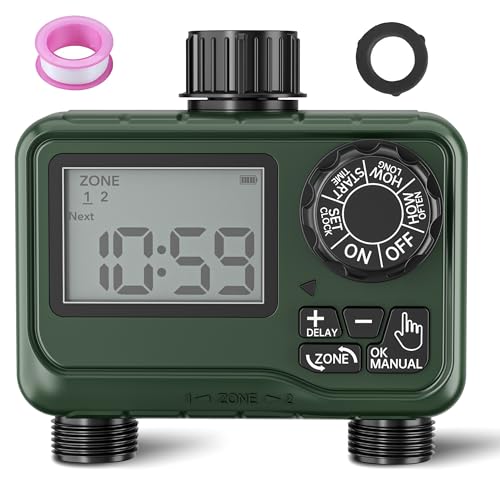
Where the TiFFCOFiO handles one outlet, the BN-LINK controller opens up two independently programmed zones from the same faucet. That’s the meaningful jump for most mid-size yards, since grass and flower beds almost never want the same runtime.
The unit supports 12- and 24-hour clock formats, a small detail that keeps programming intuitive regardless of which side of the Atlantic you learned schedules on. You set each outlet for its own start time, frequency, and duration, then leave both to run their own routines.
Well-Handled Touches
- Independent zone programming means lawn and beds run on different schedules from one spigot
- Dual clock formats (12/24-hour) suit any household’s preference
- Two outlets reduce the need to swap hoses mid-week, which is the kind of chore people quietly stop doing
- Automatic mode handles repeat watering, freeing you from remembering the schedule yourself
Points To Keep In Mind
- Two zones still falls short for larger properties with separate drip, lawn, and garden circuits
- Like most hose-end timers, exposed electronics benefit from a small cover or sheltered install spot
Made For
Homeowners with a front lawn and a separate back bed who want each area on its own schedule without buying a second timer.
Consider Something Else When
The Rain Bird ARC8 fits the bill if your property needs eight zones, app control, and remote scheduling from anywhere.
The Rain Bird ARC8 is a step-change in scope, moving from hose-end convenience to a hardwired controller for an entire irrigation system. The eight zones cover a full suburban property, with separate programs for lawn, beds, drip lines, and any odd corner that needs a dedicated run.
The companion mobile app handles scheduling, manual runs, and delay adjustments, and you can share access with a partner or a landscaper. It carries EPA WaterSense certification, which is a useful shorthand for meeting municipal efficiency benchmarks in drought-prone areas.
Everyday Advantages
- Eight zones bring separate circuits under one roof, replacing a tangle of standalone timers
- App-based control means you can pause watering from the office when storms roll in
- EPA WaterSense certification helps you align with regional water restrictions without research
- Shared access for family or maintenance pros is built into the app, a quiet time-saver
Honest Caveats
- Hardwired installation takes more effort than screwing on a hose timer, and an electrician may be on speed-dial
- Eight zones is overkill for a townhouse patio, so the investment only pays off at a certain scale
- WiFi-dependent scheduling means a router hiccup briefly reverts to a stored fallback
Feature Snapshot
Right Fit For
Owners of mid-to-large properties with a full sprinkler manifold who want centralized app-based control and the flexibility to grow zones later.
Swap It Out When
The HiOazo Indoor Smart Sprinklers Controller is a strong alternative if you prefer indoor mounting and want more flexible plan storage at a tighter budget.
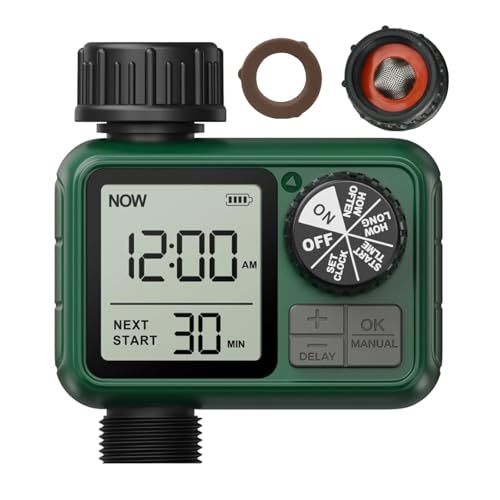
Where many hose timers go plastic from end to end, the XinFuture leans on a brass outlet for the connection that takes the most abuse. Brass resists corrosion from hard water and the daily yank of a hose, which is the part that usually fails first on cheaper units.
The unit supports auto, manual, and rain delay modes, so you can program a baseline schedule and then step in when the weather turns. For drip irrigation lines, the brass threading sits well with standard 3/4-inch drip fittings.
Noteworthy Benefits
- Brass outlet holds up to mineral-heavy water and repeated hose reattachment
- Three modes (auto, manual, rain delay) cover routine and interruption cases
- Pairs naturally with gravity-fed drip systems, useful in off-grid setups
- Single-outlet focus keeps the controls from getting in the way of basic scheduling
Trade-Offs
- Single brass outlet still leaves multi-zone properties needing a second unit or splitter
- Plastic housing around the brass fitting benefits from shade or a simple rain hood in extreme climates
Best Suited To
Drip-irrigation gardeners and anyone dealing with hard water who want a more durable outlet connection than a fully plastic body delivers.
Reach For A Different Pick When
The Lumary WiFi Water Timer is a closer match if you want the same brass-inlet durability plus app control from your phone.
HiOazo lands in the middle of the list with a four-zone, app-enabled controller aimed at homeowners who want smarter watering without jumping to a full eight-zone installation. The four-zone footprint matches the layout of most small-to-medium suburban lots.
The app opens up scheduling from anywhere on a 2.4GHz WiFi network, with sixteen plan slots for rotating seasonal routines. Weather-skip logic, meaning the controller automatically cancels a run when rain, frost, or wind thresholds are met, keeps watering tied to actual conditions rather than a calendar.
Useful Touches
- Four zones suit most lots without paying for capacity you’ll never use
- Sixteen schedule slots let you rotate zones and seasons without rewriting plans
- Auto-skip on rain, freeze, and wind saves water during the kind of weather you’d otherwise forget to override
- App-based setup shortens the learning curve compared with dial-and-button interfaces
A Few Limitations
- 2.4GHz-only WiFi means homes on a 5GHz-only network need to enable the legacy band
- Hardwired 24VAC power supply requires an existing transformer or a simple electrical hookup
Feature Card
Whose Shelf It Belongs On
Tech-comfortable homeowners with a four-zone manifold who want app control and weather-aware scheduling without the eight-zone price tag.
Not Your Match When
The Rain Bird ARC8 makes more sense if your property already needs eight zones or you want EPA WaterSense certification.
Lumary takes the hose-end format and gives it a WiFi brain, with a brass inlet that mirrors the durability of the XinFuture while adding app-based scheduling. A small included gateway bridges the timer to your home network on the 2.4GHz band.
Regular and cyclical irrigation modes cover both fixed schedules and repeating intervals, useful for seed-starting or vacation watering. Rain delay, remote run, and manual mode handle the everyday exceptions that any controller needs to feel flexible.
Where It Delivers
- Brass inlet provides a corrosion-resistant connection for hard-water regions
- App control over a hub removes the need to walk outside to change settings
- Regular and cyclical modes suit both standard schedules and seed-start routines
- Rain delay and remote run add flexibility for sudden weather changes
Possible Compromises
- Hub-dependent operation means an extra box to mount near your router
- Single zone covers one hose, so multi-area setups still need additional timers
Who Should Grab It
Apartment and townhouse gardeners with a single hose who want the convenience of app control paired with a sturdier brass connection.
A Better Fit Elsewhere
The HiOazo 4-Zone Smart Sprinkler Controller is a better fit when you want app control across multiple zones instead of a single hose.
Hunter has a long track record in commercial-grade irrigation, and the Hydrawise X2 carries that pedigree into a residential-friendly outdoor controller. The eight-zone capacity mirrors the Rain Bird ARC8, but the scheduling depth is what sets the X2 apart for serious landscapes.
Cycle and soak mode breaks long runs into shorter bursts with rest intervals, a useful feature for slopes and clay soils where runoff is a constant problem. Weather-based scheduling draws on local data to adjust runtimes, and the unit is ready to add WiFi later via an optional module rather than forcing the upgrade at purchase.
Points In Its Favor
- Weather-based scheduling tunes runtimes to actual local conditions, not just a fixed calendar
- Cycle and soak mode prevents wasteful runoff on slopes and slow-draining soil
- Optional WiFi module means you can add app control later without replacing the unit
- Outdoor-rated enclosure survives a garage wall or exterior install without a separate cover
What To Weigh
- WiFi module is an add-on, so the out-of-the-box experience lacks app access that competitors include
- Hydrawise account setup adds a small learning step for those new to the Hunter ecosystem
Feature Snapshot
Perfect Match For
Homeowners with complex landscapes, slopes, or heavy clay soil who want deeper scheduling logic and a path to WiFi without buying a new controller later.
Where Another Pick Suits Better
The Rain Bird ARC8 is the closer match if built-in app control and EPA WaterSense certification matter more than the optional WiFi approach.
The SONOFF sprinkler timer is a single-outlet controller built for households already running a Zigbee smart-home hub. Zigbee is a low-power wireless protocol that links smart devices through a shared hub, so the timer slots into the same network that already drives your lights, sensors, and switches.
Schedule by time or by volume, run a single cycle or repeat cycles, and pull the history log to see how much water each session actually used. Voice control through compatible smart assistants makes it easy to fire off a quick watering without opening an app.
Practical Advantages
- Zigbee 3.0 protocol delivers stable communication with low power draw
- Time- and volume-based scheduling adds precision that simple timers can’t match
- History records track daily, monthly, and six-month usage for spotty anomalies
- Voice control through common smart assistants removes the need to reach for a phone
Some Limits To Know
- Requires a Zigbee hub, so households without one face an extra purchase before the timer works
- Single zone means multi-area properties need additional units or a manifold-level upgrade
Who Will Love This
Smart-home enthusiasts running an existing Zigbee mesh who want their irrigation to live alongside lights, locks, and sensors in one app.
Skip It When
The Lumary WiFi Hose Timer is a better fit if you don’t already own a Zigbee hub and just want straightforward app control over a single hose.
The sibling to the four-zone HiOazo, this indoor version stretches to eight zones while shifting the enclosure to a wall-mount design meant for a garage, basement, or utility room. Indoors keeps the electronics away from direct weather, which is a comfort for anyone whose outdoor enclosure has yellowed in the sun.
Sixteen plan slots, hyperlocal weather-skip on rain, frost, and wind, and a cycle-and-soak mode cover the same depth of scheduling found on the Hunter X2, but at a friendlier entry tier for households that don’t need commercial certification.
A Strong Showing
- Eight zones support a full residential manifold from a single indoor enclosure
- Hyperlocal weather-skip logic tailors runs to neighborhood conditions, not just regional data
- Cycle and soak mode prevents runoff on slopes and dense soil
- Indoor mounting keeps the unit away from UV and direct rain exposure
Where It May Fall Short
- Indoor placement requires routing sprinkler wires back to a garage or utility room
- 24VAC hardwired power means existing transformer compatibility should be confirmed before purchase
Built With In Mind
Homeowners with a finished garage or utility space who prefer indoor mounting and want eight-zone capacity without paying for outdoor-rated certification.
Another Choice May Suit
The Hunter Hydrawise X2 is a better match for those who need outdoor-rated housing and the option to add WiFi later.
The Winbomgo bundle closes the list with something different: a complete drip kit rather than a standalone controller. You get 162 feet of combined 5/16-inch main line and 1/4-inch distribution tubing, a spread of adjustable spray nozzles, root-watering drippers, and a Y-connector to tie it back to a faucet.
Add a water timer from earlier in the list and the kit becomes a turnkey solution for greenhouses, raised beds, container rows, and any layout that needs slow, targeted watering rather than overhead spray.
What Pays Off
- All-in-one package removes the guesswork of matching tubing, fittings, and emitters separately
- Two tubing diameters cover both main runs and individual plant branches
- Adjustable spray nozzles plus root drippers handle a range of plant types in one kit
- Y-connector splits flow so you can run a hose and the drip system side by side
Things To Consider
- The kit doesn’t include a controller, so budgeting for a separate timer is necessary for full automation
- 162 feet is generous, but sprawling properties may still need extension tubing to cover everything
Who It Suits Best
Greenhouse growers and raised-bed gardeners who want a complete drip system in one box and are happy to add a hose-end timer separately for automation.
Look Elsewhere When
The XinFuture Hose Timer is the better starting point if your priority is a single durable timer with a brass outlet rather than full drip distribution.
What Matters Most Before Choosing Garden Irrigation Controller Water Systems
Zone Count and Yard Layout
The single biggest factor is how many separate areas you actually need to water. Count the distinct circuits: front lawn, back lawn, side strip, vegetable bed, drip line for containers, and so on. A single hose timer covers one area, a two-zone controller handles a simple front-and-back split, and four to eight zones suit a typical suburban lot. Match the count to your layout rather than paying for capacity you won’t use, and leave one or two slots free for future expansion like a new bed or a drip conversion.
Power Source and Connectivity
Hose-end timers run on batteries, which is a plus for renters and easy installs. Hardwired controllers draw 24VAC from a transformer and live near the irrigation manifold, which is more involved but more reliable. WiFi-enabled models add app control and weather-aware scheduling, with the trade-off that a router hiccup briefly disrupts remote access. Zigbee and hub-based options suit households already invested in a smart-home mesh, since they slot into the existing network.
Weather Awareness and Water Efficiency
Automatic rain skip, freeze skip, and wind skip prevent the most common waste case: watering right before a downpour. Cycle and soak mode breaks long runs into rest intervals, useful on slopes or clay-heavy soil. WaterSense certification is a useful shorthand for meeting municipal efficiency benchmarks, especially in drought-prone regions where restrictions can change mid-season.
Durability and Installation Realities
Brass outlets and threaded connections hold up to repeated hose reattachment and hard water better than all-plastic bodies. Outdoor-rated enclosures survive a garage wall or exterior mount, while indoor units require routing sprinkler wires back to a utility space. Off-season storage of batteries, simple rain hoods, and sheltered placement all extend service life in extreme climates.
Key Considerations Across These Picks
Pitfalls Shoppers Hit
The most common error is buying more zones than the yard actually needs and then wrestling with programming a controller that does too much. The opposite mistake is choosing a single-outlet timer and discovering a year later that a second bed would benefit from independent scheduling. Another trap is overlooking transformer compatibility, since 24VAC controllers require an existing power supply that older homes may not have at the manifold. Finally, ignoring WiFi band requirements leaves some app-based timers stranded on 5GHz-only networks that need a router reconfiguration.
When Paying More Pays Off
Spending up delivers value when your property genuinely needs more zones, when you want weather-aware scheduling that adjusts to local conditions, and when outdoor-rated housing avoids a separate weatherproof cabinet. Higher-tier controllers also buy warranty depth, longer component life, and access to companion apps that store usage history for spotting leaks. The upgrade pays off most clearly for owners of complex landscapes with slopes, mixed soil types, and multiple irrigation circuits, where a smarter controller saves more water over a season than its price premium.
