

Gardening in a cold climate tests your patience as much as your seed-starting schedule. A short growing season, surprise frosts in May, and snow piling up by October all conspire against tomatoes, peppers, and anything that isn’t a tough perennial. The right greenhouse changes the math, giving tender starts a sheltered head start in spring and keeping cool-season crops productive deep into shoulder seasons.
This roundup covers walk-in tunnels, compact portable houses, raised bed combos, and one surprisingly practical build guide. Each pick was chosen for a specific kind of gardener, from apartment patio growers with a single shelf to homesteaders who want a full 20-foot tunnel to overwinter half their backyard. The list leans heavily on galvanized steel frames and PE covers, the combination that handles snow load and wind without the cost of glass. Cold-climate growing is less about heat and more about wind protection, sun capture, and keeping soil from freezing solid, and every option below delivers on at least two of those fronts.
A Fast Comparison Of The Options

Ohuhu 4x2x1 FT Raised Garden Bed Outdoor with Cover

Ohuhu Portable Mini Greenhouse 71x36x36 Inches

Black and Decker Complete Guide to DIY Greenhouses 3rd Edition

Grezone Walk-in Greenhouse 10x7x7 FT
10x7x7 FT Greenhouses for Outdoors Heavy Duty

Ohuhu Portable Tunnel Greenhouse 5.9×5.9×6.6 FT

KING BIRD Premium Greenhouse 56x56x78 in

Outsunny 20x10x7 FT Walk-in Tunnel Greenhouse

10x7x7 FT Walk-in Greenhouse for Winter Plant Protection

Greengro Greenhouse 28x57x76 in Walk-in
Why These Options Stand Out
The Ohuhu 3-in-1 raised bed and cover combo is the smallest footprint in this roundup, and that is exactly its charm. A galvanized steel planter sits at ground level while a removable greenhouse cover slips over the top, letting you grow herbs, salad greens, and starts on a patio, balcony, or small backyard without committing to a full tunnel structure.
For cold-climate growers, the cover traps daytime warmth and shields seedlings from late-spring frost, which is often the difference between a viable tomato crop and a washed-out one. The sloped roofline helps shed light snow rather than letting it pile on the cover, and zippered windows let you vent on sunny days when interior temps can spike fast.
What Stands Out
- Modular design works as a planter alone, cover alone, or both together
- Compact 4x2x1 FT footprint fits apartment patios and narrow side yards
- Sloped roof design sheds rain and snow before they weigh the cover down
- Zippered windows allow manual ventilation during sunny winter spells
- Galvanized steel bed resists rust through repeated spring moisture cycles
Things To Consider
- The compact bed volume limits how many large root vegetables you can grow at once
- PE cover may need seasonal retightening as temperature swings cause fabric slack
Best Suited To
Patio and balcony growers who want frost protection for a single raised bed of greens and herbs without dedicating a full yard to a structure.
Look Elsewhere When
You need walk-in headroom for taller crops, in which case the Ohuhu Portable Mini Greenhouse gives you actual standing space.
Where the Ohuhu raised bed is a planter with a cover, this is a proper walk-in greenhouse scaled down for tight lots. The 71-inch tall peak means average-height gardeners can stand inside, work on a potting bench, or step in to water without hunching. At 71x36x36 inches, it is a tunnel you can fit against a fence or along a driveway.
The clear PE cover is treated for UV protection, which matters more in cold climates than you might think, because low winter sun angles amplify material breakdown. Dual zippered doors at each end let you create a cross-breeze on warm spring afternoons and seal the house tight once evening temperatures drop.
Everyday Advantages
- Tool-free assembly means you can have it standing in under an hour on a calm day
- UV-protected cover stands up better to low-angle winter sun than untreated plastic
- Anchor stakes included for wind resistance in exposed yards
- Two zippered doors make summer ventilation straightforward
- Compact footprint suits renters and gardeners with HOA restrictions
Points To Note
- Frame tubing is lighter than walk-in tunnels in the 10×7 class, so heavy snow loads should be brushed off promptly
- At 36 inches wide, fitting a full potting bench inside requires careful measurement
Quick Facts
Who Will Love This
First-time greenhouse owners and renters who want a movable structure that survives a couple of seasons without a major investment.
Consider Something Else When
You live somewhere with heavy wet snow, where the Grezone Walk-in Greenhouse’s reinforced diagonal bracing is a better bet.
Not every greenhouse comes in a box. The Black and Decker Complete Guide to DIY Greenhouses is a Kindle-format reference that walks through building hoophouses, cold frames, and full greenhouses from scratch. For gardeners in cold zones with a tight budget and a weekend habit, the savings over a prefab kit can be substantial.
The book covers accessory projects, from automated vents to shelving layouts, that a manufactured greenhouse usually leaves out. The trade-off is time: a DIY build on a 4×6 hoophouse can eat a full weekend, and a more ambitious 10×12 structure becomes a multi-week project.
The Case For It
- Detailed plans for hoophouses and cold frames, both proven in cold-climate use
- Includes accessory builds, from roll-up sides to internal benches
- Material lists help you source lumber and poly locally at better prices
- Read on phone, tablet, or e-reader in the shop while you work
Honest Caveats
- Requires basic carpentry skills and access to tools most prefab owners skip
- DIY frames rarely include the engineered connectors of branded kits, so longevity depends heavily on build quality
Right Fit For
Hands-on gardeners who would rather build than buy and want a custom-sized structure tuned to their specific yard and climate.
A Better Fit Elsewhere When
You need something standing by next weekend, in which case the gaildon 10x7x7 FT walk-in ships as a kit and goes up in an afternoon.
The Grezone is what you reach for when snow load is the deciding factor. The galvanized steel frame pairs with four reinforced diagonal bars and cross bars across the roof, a layout designed to keep the structure square under wind gusts and wet snow that would buckle lighter kits. At 10x7x7 feet, the footprint gives you real bench space without dominating a small lot.
The dual-door setup is the part cold-climate gardeners will appreciate most. One door is a mesh screen for insect control and summer airflow, and the other is a PE cover door for warmth retention in shoulder seasons. Independent zippers mean you can run one open and one shut depending on conditions.
The Helpful Details
- Galvanized steel frame handles rust through multiple wet seasons
- Six mesh screen windows for summer cross-ventilation
- Cross bars and four diagonal braces add stability in wind
- Dual zippers let you mix and match mesh and PE doors
- Butterfly screw assembly keeps the build tool-light
Trade-Offs
- At 10 feet long, you need a level site and ideally a helper during assembly
- PE cover longevity depends on UV exposure; expect to replace it every few seasons in high-altitude sun
Feature Snapshot
Made For
Growers in snowy regions who want a real walk-in footprint and need a frame that won’t fold under the first March storm.
Skip It When
Your space is more patio than yard, where the Greengro Greenhouse’s slimmer 28×57-inch base fits where this one cannot.
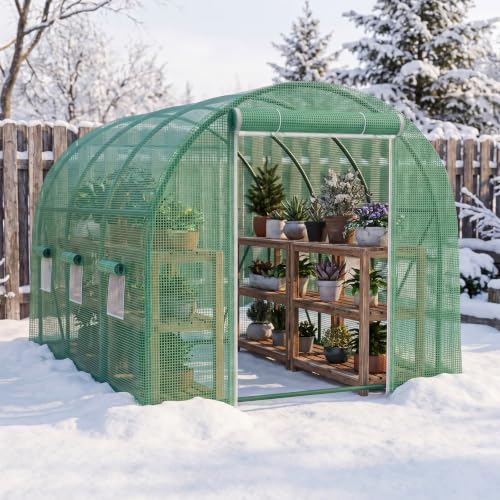
The gaildon 10x7x7 hits the middle of the roundup by design, balancing walk-in space, cover durability, and ventilation in one package. The 140g/m² PE grid cover is heavier than the industry standard, which translates to better tear resistance and slightly improved heat retention on cold nights.
Six mesh windows run along the sides, and a single roll-up zipper door handles access. For most backyards, this is the kit that does the most jobs without specializing in any one of them, useful for overwintering containers in November and starting tomatoes in March.
Good Reasons To Consider
- 140g/m² PE cover is thicker than typical walk-in kits
- Reinforced cross bars and diagonal supports add frame rigidity
- Six mesh windows allow good passive airflow in mild weather
- Single roll-up door design simplifies daily entry and exit
Smaller Limitations
- Single door can feel limiting when you are hauling a wheelbarrow in for soil work
- Galvanized finish is functional but not the thickest in this roundup
Who Should Grab It
All-season backyard growers who want one greenhouse that handles spring starts and fall overwintering without swapping covers.
Swap It Out When
You need dual-door access for ventilation control, in which case the Grezone Walk-in Greenhouse gives you mesh and PE doors working independently.
The Ohuhu tunnel stands out for one architectural choice: a pointed Gothic arch roofline rather than a rounded tunnel. In practical terms, that means snow slides off more reliably than on curved profiles, which matters anywhere you get more than a dusting. The 5.9×5.9 base footprint keeps the whole structure under 36 square feet, friendly to small backyards.
You can connect two of these side by side if your plans grow, which is a nice escape hatch that most rigid kits do not offer. Mesh windows along the sides pair with a PE cover for the same dual-approach that the larger Grezone uses, just in a smaller package.
Useful Touches
- Gothic arch roof sheds snow and rain better than rounded tunnels
- Connectable design lets you expand to 12×5.9 feet later
- Mesh windows for passive airflow during shoulder seasons
- 5.9-foot peak height suits most gardeners for working inside
Some Limits To Know
- Smaller interior volume means less thermal mass, so temperatures swing more overnight
- Frame connectors are plastic on some models, which can crack in deep cold
Perfect Match For
Suburban gardeners with limited square footage who still want walk-in headroom and a roofline that handles snow without intervention.
Another Choice May Suit When
You have a wider lot and want more interior bench space, where the gaildon 10x7x7 FT stretches out for serious production.
The KING BIRD is the one built around shelving rather than ground beds. Four tiers of side and back shelves turn the interior into a vertical seed-starting and overwintering station, so you can keep dozens of starts off the ground and organized by date. Shelf weight ratings well above typical kits mean you can load soil bags, pots, and water trays without flexing.
The reinforced PE cover is a real upgrade from the thin plastic on entry-level walk-ins, and powder-coated steel poles resist corrosion in damp spring conditions. If you start everything from seed rather than buying transplants, this layout saves you hours of bending and rearranging flat after flat.
Useful Strengths
- 4-tier shelving with high load capacity per shelf
- Reinforced cover material handles repeated freeze-thaw cycles
- Powder-coated frame resists corrosion in wet spring conditions
- Walk-in height of 78 inches suits tall gardeners working upright
Practical Considerations
- Shelves reduce the available floor footprint for taller crops like indeterminate tomatoes
- More parts in the box means a longer first-time assembly than simpler tunnels
Key Attributes
Whose Shelf It Belongs On
Seed-starting growers who want organized vertical space for dozens of trays rather than a single ground bed.
Reach For A Different Pick When
You grow full-height indeterminate tomatoes that need ground space, where the Outsunny 20x10x7 FT tunnel is the better fit.
The Outsunny 20-footer is the largest kit in this roundup by a wide margin. At 20×10 feet, you can run two long raised beds down the center, line the walls with containers, and still have a working aisle. For homesteaders trying to overwinter half their backyard or start a thousand onions in February, that interior volume changes the math entirely.
Heavy-duty galvanized steel and slant bracing tubes are the structural selling points here, since a 20-foot tunnel flexes more in wind than a 10-foot one. The zippered door runs across one end and gives full-width access for a wheelbarrow, which matters more than it sounds when you are hauling compost in.
Reasons It Performs
- Generous 20×10 FT interior fits multiple beds and a working aisle
- Galvanized heavy-duty steel frame with slant bracing resists racking
- Full-width zippered door accepts a wheelbarrow for soil work
- Extends growing season for both cool and warm season crops
Factors To Consider
- Requires a level, well-drained site and a second pair of hands for assembly
- PE cover replacement becomes a bigger chore at this scale than on smaller kits
Built With In Mind
Homesteaders and serious backyard growers who want to push production into shoulder seasons without giving up half their yard.
Where A Sibling Pick Shines
First-time greenhouse owners should start smaller, where the Ohuhu Portable Mini Greenhouse costs less and teaches you how you actually use the space.
Kecreque’s winter-oriented 10x7x7 doubles down on airflow. Six ventilated screen windows line the sides, and double-stitched seams at those windows help prevent the most common failure point on cheaper kits: torn window corners after a season of wind flap. Two roll-up doors on the long sides give you cross-ventilation when conditions allow.
The reinforced galvanized steel frame follows the same playbook as the Grezone and gaildon kits in this roundup, with cross bars and diagonal supports holding the structure square. The real differentiator is the attention to seam durability, which extends cover life in climates that swing from subzero to thaw every few weeks.
Practical Advantages
- Double-stitched window seams resist tearing in heavy wind
- Six screen windows for thorough summer cross-ventilation
- Two roll-up zipper doors for flexible airflow control
- Galvanized frame with reinforced cross bars
Worth Bearing In Mind
- At 10x7x7, it shares footprint limits with several other kits, so the differentiator is really cover and seam quality
- Window screens mean extra openings to check for insect intrusion during summer
Spec Overview
Made For
Growers whose main concern is keeping frost-tender plants alive through winter wind and temperature swings without cook them in late-winter sun.
Not Your Match When
You need a single large bed setup rather than container-friendly shelving, in which case the Outsunny 20x10x7 FT handles serious in-ground production better.
The Greengro finishes the roundup as the most compact walk-in option, narrow enough to slide onto a balcony or tuck against a wall. At 28 inches deep and 57 inches wide, it is a slim profile, but the 76-inch peak still lets you step inside and work upright if your ceiling clearance allows.
The setup leans on a zippered door and screened windows for airflow, the same dual approach you see in larger kits. The polyethylene cover and steel frame combination keeps weight manageable for upper-floor balconies, where some heavier kits exceed load tolerances.
What Works In Its Favor
- Narrow 28-inch depth fits balconies and tight side yards
- 76-inch peak height for upright working in most spaces
- Zippered door and screened windows for airflow control
Some Limits To Know
- Limited interior volume restricts how many large containers you can overwinter at once
- Smaller footprint means temperature swings more than larger tunnels overnight
Best Suited To
Apartment and condo gardeners who need walk-in height on a balcony without giving up usable outdoor space to a wide tunnel.
Look Elsewhere When
You have a full backyard and want ground beds inside, in which case the gaildon 10x7x7 FT has the room to grow in soil rather than containers.
What To Weigh Before Picking A Cold-Climate Greenhouse
A greenhouse for a cold climate is fundamentally a wind and sun management problem, not a heat problem. Three attributes matter more than any others: frame strength, cover weight, and ventilation control.
Frame strength comes down to tube gauge and reinforcement. Galvanized steel is the baseline, and the difference between a kit that lasts four seasons and one that folds in the first March storm usually comes down to diagonal bracing. Cross bars across the roof and angled supports at the corners prevent racking, which is what happens when wind catches a square profile. Walk-in tunnels in the 10×7 class with reinforced diagonals handle meaningful snow load, while lighter frames need brush-off after every storm.
Cover weight is measured in grams per square meter, where 140g/m² is the practical floor for serious cold-climate use. Lighter covers tear faster, lose tension as temperatures swing, and transmit less solar gain on sunny winter days. PE (polyethylene) is the standard, with reinforced versions adding scrim layers for tear resistance. Glass and polycarbonate are superior in thermal retention but cost several times more and require more substantial framing.
Ventilation control matters because solar gain in a sealed greenhouse can spike interior temperatures well above outdoor readings, even in January. Mesh windows, roll-up doors, and screened vents let you tune airflow without losing all your heat. Dual-door systems, where one door is mesh and the other is solid PE, are particularly useful because they let you ventilate while keeping some thermal mass.
Sizing is the final decision that cuts across all three attributes. A walk-in 10×7 tunnel is the practical sweet spot for most home growers, with enough room for benches and a couple of beds, while still being manageable for one person to assemble. Anything smaller than 6×4 becomes a season extender rather than a true growing space.
Common Shopping Slip Ups, Plus When To Spend Up
Pitfalls Shoppers Hit
The most common mistake is underestimating snow load. Manufacturers rate their covers and frames under ideal conditions, so a kit rated for light snow often struggles under wet, heavy snowfall. Plan to brush off the cover after storms regardless of the rating, and anchor the frame to ground stakes or a base.
Another trap is buying a kit that is too big to ventilate. A 20-foot tunnel without adequate windows becomes a solar oven by April, cooking whatever you planted. Match ventilation features to your climate: hot summers need six or more windows and roll-up sides, while shoulder-season growers in mild-summer zones can manage with two.
Finally, many shoppers forget about door width. A single 3-foot zippered door works for daily watering but blocks wheelbarrow access for soil work. If you plan to bring compost in or rotate large containers out, look for full-width doors or plan to remove a side panel seasonally.
Where The Extra Money Goes
Higher-tier kits cost more for a reason, and most of it goes into two places: cover weight and connector hardware. A 160g/m² cover outlasts a 140g/m² cover by several seasons in harsh sun, and steel connectors at frame joints outlast plastic ones that crack in deep cold. Shelving kits and reinforced shelves also fall into the upgrade category, and they pay off if you start most of your plants from seed.
The honest read is that mid-tier kits like the gaildon 10x7x7 and Grezone cover 90 percent of home grower needs. The step up to a premium kit like the KING BIRD or the 20-foot Outsunny makes sense once you know exactly how you use the space, which usually takes a season or two of growing.
Frequently Asked Questions
How much snow can a walk-in greenhouse handle?
Most walk-in PE greenhouse kits handle a few inches of dry snow without issue, but wet snow heavier than 4 to 6 inches should be brushed off. The frame is the limiting factor, and the reinforced diagonal braces on kits like the Grezone and Kecreque add meaningful headroom compared to lighter frames.
Can a portable greenhouse survive winter wind?
Portable greenhouses handle moderate wind when anchored with the included ground stakes, but exposed sites with sustained gusts above 40 mph benefit from additional anchoring. Adding a perimeter base of treated lumber or burying the cover edge in a soil trench both reduce wind flap dramatically.
Do greenhouse covers need to be replaced every year?
Cheap PE covers can degrade in one or two seasons under harsh UV, while 140g/m² reinforced covers typically last three to five seasons. Storing the cover in a shed during the off-season extends life, and most manufacturers sell replacement covers that fit the original frame.
Is a small greenhouse enough for tomatoes?
A walk-in greenhouse at least 6×4 feet gives you room for two or three indeterminate tomato plants in containers or a small bed. Smaller structures like the Ohuhu raised bed work for compact determinate varieties, but the yield ceiling is real compared to a full tunnel.
Where should I place a greenhouse in a cold climate?
Full southern exposure with protection from prevailing north winds gives you the most solar gain. A slight east-west orientation is ideal for sun capture, and a windbreak like a fence or hedge on the north side reduces cover stress through winter storms.
The Takeaway
A cold-climate greenhouse pays for itself in the first extended season you use it, whether that means fresh salads in November or tomatoes in June. The kit that fits your space, your soil plan, and your local snow load is the right one, regardless of how it ranks on a list. Start with the size you can actually use, anchor it well, and let the structure teach you what your specific microclimate needs from there.
