

Tired of dragging hoses around the yard or watching your lawn brown out while you’re away? A hose timer takes the chore off your plate, and a WiFi-equipped one lets you control the whole show from your phone, even on vacation. Whether you’re juggling a small flower bed or mapping out multiple lawn zones, the right connected timer turns guesswork into a set-and-forget routine. The eight picks below cover a spread of zone counts, materials, and app ecosystems so you can match one to your yard’s layout and your tolerance for tinkering.
The Shortlist At A Glance
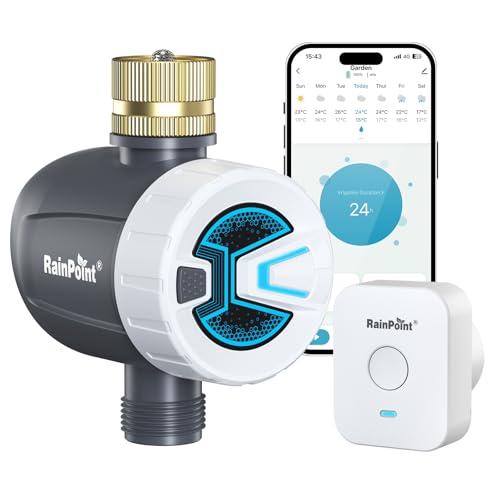
RAINPOINT WiFi Water Timer for Garden Hose with Brass Inlet
Diivoo Brass 3 Zone WiFi Water Timer

Diivoo Brass WiFi Sprinkler Timer 2 Zone

Lumary WiFi Water Timer for Garden Hose with Brass Inlet

Orbit B-hyve Gen 2 Smart Hose Watering Timer 90204

Orbit 90205Z B-hyve Gen 2 Smart Hose Watering Timer
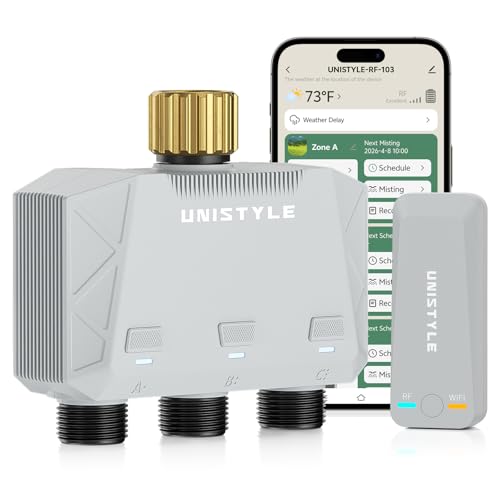
Unistyle 1700FT WiFi Sprinkler Timer 3 Zone
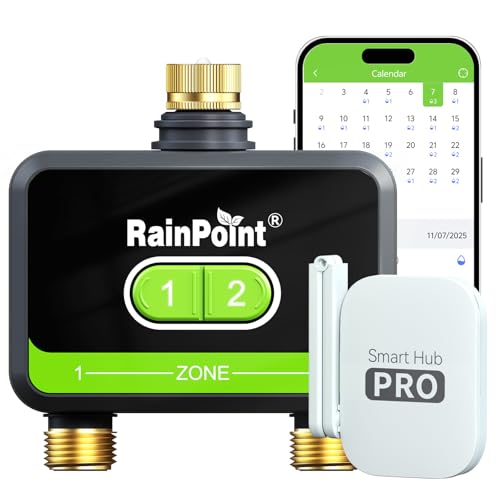
RainPoint WiFi Water Timer for Garden Hose 2-Zone
Meet The Standout Selections
Starting the list is a single-outlet RAINPOINT timer built around an expandable hub architecture, which is a setup where one base station talks to multiple valve units around your yard. Each hub supports up to four timers, so a yard that starts with one hose bib can grow into a multi-zone system without swapping out the brain of the operation later.
The app runs on the TUYA platform (a third-party smart-home framework that many budget-friendly devices share), and it lets you flip the water on from the office or pause a cycle when rain rolls in. The brass inlet threads straight onto a standard outdoor faucet, and the 2.4GHz WiFi plus Bluetooth pairing makes the initial handshake less painful than older timers that only broadcast one protocol.
The Good Stuff
- One hub handles up to four timers, so expansion costs stay manageable as your landscaping grows
- Brass inlet holds up to repeated connection and disconnection cycles better than plastic threads
- 2.4GHz plus Bluetooth dual pairing smooths out setup, especially for first-time smart-home shoppers
- TUYA-based app gives you schedule adjustments, rain delays, and live run-state from anywhere
Trade Offs
- A single hub supporting four timers is convenient, but the hub itself is an extra piece to mount near your router or outlet
- Plastic-bodied valve section may weather faster than all-brass alternatives in full sun
- Battery swaps before each growing season are typical for this category and worth budgeting for
Feature Snapshot
Made For
Yards that plan to grow into multiple zones, or homeowners who already use TUYA-compatible smart-home gear and want one app to rule them all.
Consider Something Else When
You’d rather skip the hub entirely; the Orbit 90205Z B-hyve Gen 2 is a cleaner single-outlet solution for simpler yards.
Compared to the single-outlet RAINPOINT above, this Diivoo doubles down on metal construction and adds a third independent zone. Three separate outlets mean you can run a drip line, a lawn rotor, and a vegetable bed off one faucet without buying three separate timers and three apps.
Brass fittings on both the inlet and outlet ports are the headline here, and they tend to seal tighter and survive more connect-disconnect cycles than plastic. The timer pairs over 2.4GHz WiFi for app and voice control, which gives you the usual mix of scheduling, manual override, and pause-for-rain from your phone. For a yard that has already outgrown a one-zone setup, this lands in a useful middle ground.
Reasons It Performs
- Three independent zones let you run mixed irrigation types without stacking timers
- Brass inlet and outlet ports resist cracking and cross-threading over multiple seasons
- App plus voice control covers both phone-first and hands-free routines
- Weatherproof shell suits outdoor mounting through summer storms and winter freezes
Worth Noting
- Three outlets demand more flow planning; running all zones at once may starve low-pressure homes
- Brass adds noticeable weight at the faucet, so a wobbly hose bib might need a stabilizer bracket
- Battery replacement is a yearly chore in cold climates where the unit sits idle through winter
Whose Yard It Belongs On
Homeowners with a medium-to-large lawn that already has split watering needs, like a turf section, a flower bed, and a veggie row.
Look Elsewhere When
You only need two zones; the Diivoo Brass WiFi Sprinkler Timer 2 Zone handles the same workload with one less outlet to manage.
Drop down to two zones and the same Diivoo build shows up with a slightly more focused pressure tolerance. The manufacturer rates it for water pressure between roughly 7.25 and 116 PSI (pounds per square inch, the standard measure of municipal water force), which is comfortably above what most homes see at the hose bib.
That wide pressure range is the practical story here. Homes on well systems or with a pressure booster tend to push higher PSI, and plastic timers can crack at those levels over time. The included metal filter and sealing kit also help keep grit out of the valve, which extends the mechanical life of the unit in areas with mineral-heavy water. Compared to the three-zone version above, you trade one outlet for a stronger pressure envelope and a simpler app layout.
What Works In Its Favor
- Pressure tolerance up to 116 PSI suits homes with booster pumps or well-fed irrigation lines
- Solid brass inlet and outlet are the parts most likely to fail on cheaper timers, and they’re built tough here
- Metal filter screens sediment before it reaches the valve, a small detail that adds real longevity
- 2.4GHz WiFi pairing plus voice support keeps the app experience on par with bigger ecosystems
Areas To Watch
- Two zones is plenty for many yards, but a turf-plus-drip-plus-vegetable setup will feel constrained
- Installation requires tightening brass threads onto the faucet without over-torquing, which can strip softer outdoor bibs
- Battery access sits behind the same brass housing, so winterizing means a partial disassembly
Quick Facts
Right Fit For
Yards with high water pressure or mineral-rich well water, where plastic-bodied timers have a track record of cracking early.
Swap It Out When
You actually want three independent zones; the Diivoo Brass 3 Zone WiFi Water Timer handles the same brass-build standard with an extra outlet.
The Lumary is the most feature-stuffed option on the list, with regular and cyclical watering modes plus a rain delay built into the firmware. Cyclical mode runs your schedule on a repeating interval (every 12 hours, every other day, and so on), which is handy for new sod, seedbeds, or container plants that prefer steady short drinks over fewer long soakings.
Like the RAINPOINT, the Lumary pairs through an included gateway that bridges your home’s 2.4GHz WiFi to the timer itself. Voice integration is also part of the package, and the app offers manual, automatic, and remote run modes for those days when the weather shifts on you mid-week. Where the brass-body Diivoo picks above lean on hardware toughness, the Lumary leans on software flexibility.
Useful Strengths
- Regular and cyclical modes handle both standard weekly schedules and high-frequency new-plant care
- Rain delay skips watering cycles automatically when local rain is detected or forecast
- Remote, manual, and automatic modes cover last-minute schedule changes from anywhere
- Brass inlet preserves a tighter seal against the faucet than plastic alternatives
Honest Caveats
- Gateway-only pairing adds an extra setup step and a device to keep plugged in near your router
- More scheduling modes also means a steeper learning curve for users who just want on-and-off
- Voice control depends on the smart-home ecosystem you already use, and not every routine shows up in every platform
Best Suited To
Gardeners with mixed plantings, new sod, or seed-starting routines who actually want to fine-tune watering intervals rather than set-and-forget.
A Better Fit Elsewhere
You have a single lawn zone and don’t need cyclical modes; the Orbit B-hyve Gen 2 with Wi-Fi Hub keeps the app experience simpler.
The Orbit B-hyve is the most established name in this lineup, and the Gen 2 refresh ships with a weatherproof AA-battery-powered timer plus its own WiFi hub. Orbit has been building residential watering gear for decades, so the app, firmware updates, and third-party integrations have had more time to mature than the newer brands above.
For first-time smart-watering shoppers, that ecosystem maturity is the real value. The B-hyve app handles schedule setup, weather-based skip logic, and pairing with a wider range of hubs and sensors than most newer competitors. Compared to the Lumary’s feature-heavy approach, Orbit leans toward a cleaner interface and a longer track record.
Everyday Advantages
- Mature Orbit ecosystem means better long-term firmware support and broader smart-home integrations
- AA-battery power is easy to source and replace at any hardware store mid-season
- Weatherproof housing handles rain, sprinklers, and full-sun mounting without complaint
- Hub-based architecture mirrors the RAINPOINT model, so multi-timer expansion is on the table
Points To Keep In Mind
- Hub is required, which adds cost and another box near your router
- The Gen 2 design is functional but plain, and the plastic housing does not match the brass-body Diivoo picks for sheer toughness
- Smart watering features depend on local weather data, so accuracy can drift in microclimates
Perfect Match For
Shoppers who want a brand with a long track record in irrigation and a stable app that won’t feel abandoned after launch.
Reach For A Different Pick When
You don’t want to deal with a hub at all; the Orbit 90205Z B-hyve Gen 2 below drops the hub and is built for single-outlet simplicity.
The 90205Z trims the B-hyve experience down to a single zone with no hub required, which is the model to pick when the timer lives close enough to your router to stay connected on its own. That setup trims one device, one power outlet, and one pairing step out of the install, and for a single-hose yard it’s all the smart-home watering most people actually need.
The app experience is the same Orbit ecosystem you get with the hub-based 90204 above, just without the bridge hardware. You still get app control, scheduling, and weather-based skip logic. For yards with a single turf zone and a hose that already reaches everything, this is the more direct route.
What It Does Well
- Hub-free setup removes a piece of hardware and a permanent outlet from the install
- Same mature Orbit B-hyve app as the hub-based sibling, with weather-aware skip logic
- Compact body fits tight faucet spaces without crowding the spigot
- AA-battery power keeps replacement parts cheap and available year-round
Practical Considerations
- Single zone means no independent control for separate beds or drip lines
- WiFi reception at the hose bib can be flaky in homes where the router sits far from outdoor faucets
- Plastic housing is fine for normal use but lacks the brass-heavy durability of the Diivoo picks
Who Should Grab It
Homeowners with one lawn zone and a router that reaches the backyard, who want Orbit’s app without buying extra hardware.
Not Your Match When
You want app-controlled multi-zone watering from one faucet; the Diivoo Brass 3 Zone WiFi Water Timer fills that role directly.
The Unistyle is the outlier here, marketed at a claimed RF (radio frequency) range of up to 1700 feet between the gateway and the timer. RF is the wireless protocol used for the hub-to-timer link, separate from your home WiFi, and that kind of reach is aimed at properties where the faucet sits well away from the house.
For most urban and suburban yards, 1700 feet is overkill, but small farms, hobby greenhouses, and estate-sized lots actually benefit. The unit runs on the 2.4GHz band, pairs with common voice platforms, and includes brass at the inlet for weather durability. Three zones give you some of the multi-outlet flexibility of the Diivoo three-zone above, with the long-haul wireless story bolted on.
A Strong Showing
- 1700-foot RF range covers large properties where standard WiFi timers lose signal at the far faucet
- Three zones let you split a property into irrigation blocks without stacking multiple units
- Brass inlet holds up to weather cycling through multiple seasons
- Voice and app control land it in the same smart-home category as the rest of this list
Smaller Limits To Know
- Long-range RF performance depends on obstacles, so dense tree cover or metal outbuildings can shorten the effective distance
- Unistyle is a newer brand in this niche, and firmware support history is shorter than Orbit’s
- Three-zone scheduling still requires the gateway plugged in near your network gear
Spec Overview
Built With In Mind
Owners of large lots, small farms, or multi-building properties where the hose bib sits a long way from the router.
Skip It When
Your faucet is close to the house; the Orbit B-hyve Gen 2 with Wi-Fi Hub covers a standard suburban yard without the extra RF hardware.
The closing pick is the second RAINPOINT entry, and it splits the difference between the single-outlet hub system up top and the multi-zone Diivoo hardware in the middle. Two independently programmed zones, brass at both ports, and a gateway-based 2.4GHz hookup give this unit a balanced feel.
Compared to the expandable four-timer hub above, this one is a simpler two-zone package that doesn’t ask you to plan around future expansion. If your yard has a turf strip plus a flowerbed and that’s the whole landscape, the dual-zone setup covers it without buying outlets you’ll never use. Each zone runs its own schedule, which is the practical upside over a single-outlet timer.
Notable Upsides
- Independent zone schedules let turf and beds run on different cycles without manual swaps
- Brass inlet and outlet resist wear from seasonal connect-disconnect cycles better than plastic
- Gateway-based pairing keeps the timer body simpler and easier to swap out if it ever fails
- App-driven manual override means a quick hand-watering session doesn’t break the weekly schedule
Some Limits To Know
- Two zones caps out at smaller yards, so larger properties will feel under-equipped
- Gateway hardware still needs an outlet and a spot near the router
- Battery swaps are an annual chore and worth scheduling before the first hard freeze
Who Will Love This
Homeowners with a turf-plus-bed layout who want independent schedules without expanding into a four-timer hub system.
Where Another Pick Suits Better
You want three or more zones from one faucet; the Diivoo Brass 3 Zone WiFi Water Timer carries that workload with the same brass-build standard.
Picking The Right Smart Timer For Your Yard
A WiFi hose timer is more than a glorified kitchen timer screwed onto a faucet. The brains inside decide how flexible your schedule gets, how often you fight with the app, and how many seasons the hardware survives.
Zone Count Drives Everything Else
Start with how many independent watering areas your yard actually has. One zone is fine for a flat lawn, but the moment you add a flowerbed, a veggie row, or a strip of foundation plantings, a second zone pays for itself. Three zones is the sweet spot for medium yards, and four or more only matters when you’re running drip manifolds, multiple rotors, or a mix of lawn and ornamentals. For most homeowners, two to three zones is the practical range.
Brass Versus Plastic Bodies
Brass fittings at the inlet (and ideally the outlet) are the most common upgrade worth chasing. Plastic threads crack under UV exposure, cross-thread easily when you swap hoses, and tend to be the first part to fail in winter. Brass costs a little more and adds weight, but it also tends to outlast plastic by several seasons. If your faucet sees heavy use, brass is the more durable bet.
Hub-Based Versus Direct WiFi
Some timers connect straight to your 2.4GHz router, while others need a small gateway that bridges the connection. Direct WiFi means fewer boxes but tighter range limits. Hub-based systems reach farther and support more timers, but they add an extra device near your router. For small yards, direct WiFi is simpler. For larger properties or planned expansion, a hub-based system is the more future-proof route.
App And Voice Ecosystem
The app is where you’ll live most of the time. Look for clear schedule screens, easy rain-delay toggles, and quick manual-override buttons. Voice control support is a nice bonus, especially for hands-free routines, but it’s only useful if you already use a compatible smart-home platform.
Practical Pointers Before You Buy
Pitfalls Shoppers Hit
The most common misstep is buying a single-zone timer for a yard that clearly needs two or three. You’ll end up adding splitters and timers later, which costs more than starting with the right zone count. Another trap is assuming any timer works on a high-PSI well system; some plastic-bodied units crack under pressure, so check the PSI range. Finally, ignoring WiFi reception at the actual hose bib leads to frustrating dropouts. Test signal strength at the spigot before mounting anything.
When Paying More Pays Off
Higher-tier timers earn their keep with brass construction, more zone capacity, and more polished apps. If your yard has split irrigation needs or your faucet sees hard water, the upgrade to a brass-body multi-zone unit is worth it. The extra cost shows up as fewer replacements over a five-year window and fewer trips outside to troubleshoot a dropped connection.
Frequently Asked Questions
Do WiFi hose timers need a hub?
Some connect directly to your 2.4GHz WiFi router, while others require a small gateway bridge. Hub-based systems reach farther and support more timers, but direct-WiFi units are simpler to set up. Pick based on the distance between your router and the faucet.
How long do the batteries last?
Most AA-powered timers run a full growing season on a fresh set, sometimes longer in mild climates. Cold winters tend to shorten battery life, so swap batteries before the first hard freeze for the most reliable performance.
Can I use one with a drip irrigation system?
Yes, as long as the timer supports low-flow rates. Most modern timers handle drip lines without issue, but running high-flow rotors and a drip system simultaneously may require a pressure regulator on the drip side.
What happens if WiFi goes out?
Most timers store their schedule locally and keep running through short outages. You may lose app control until WiFi returns, but the programmed watering cycles typically continue on their own.
Are brass fittings worth the extra cost?
For outdoor faucets that see seasonal connect-disconnect cycles or homes with high water pressure, brass holds up noticeably longer than plastic. In milder climates with gentle use, plastic is acceptable but still wears sooner.
Closing Remarks
The right WiFi hose timer turns a daily chore into a set-and-forget routine, and the eight options above cover everything from a single-zone flowerbed to a multi-acre property. Match the zone count to your yard’s layout, lean toward brass if your faucet takes a beating, and choose a hub-based or direct-WiFi setup based on how far your router reaches. Any one of these will pay you back the first time you adjust a watering schedule from the office instead of standing outside with a hose in hand.
